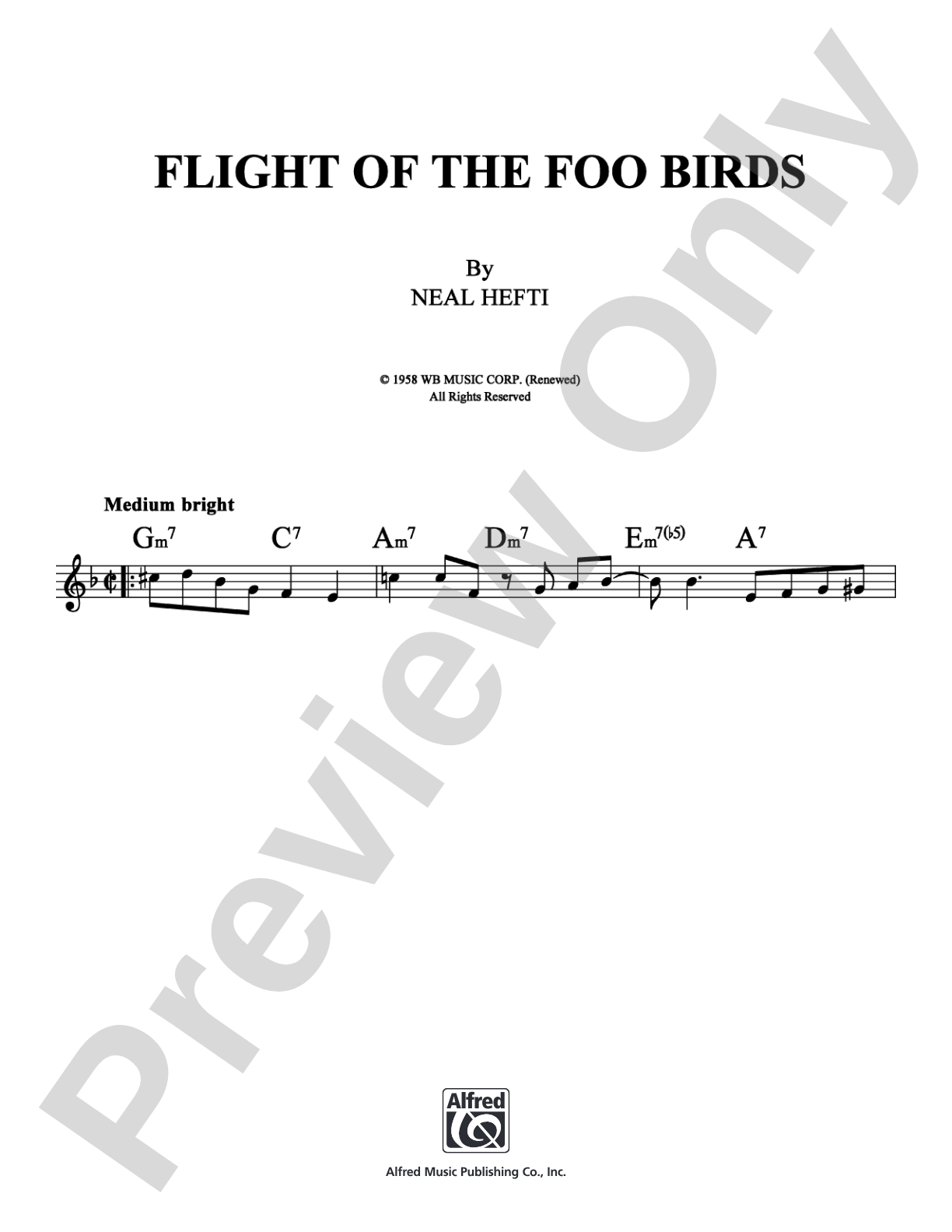
Flight of the Foo Birds: Lead Sheet Digital Sheet Music

Flight of the Foo Birds: Lead Sheet Digital Sheet Music

Neal Hefti, Count Basie

Item: 00-PS-0009237

Digital Download
$1.99
Description

Flight of the Foo Birds: Lead Sheet Digital Sheet Music isn't in MakeMusic Cloud just yet...but it could be. Let us know you'd like to see it, and you'll help shape what comes next. In the meantime, start a free trial and dive into thousands of interactive titles your students can play along with today.

Sample Audio
No sample audio found.
Sample Video
Additional Details
SKU: 00-PS-0009237

More about this title

About the Artist: Count Basie

Count Basie (1904, 1984) built one of jazz's most influential big bands on a foundation of blues feeling and rhythmic precision. His approach to comping, sparse, swinging, perfectly timed, became a model for how to accompany soloists while driving the entire ensemble forward. Basie's influence extends far beyond the bandstand; his concept of economy and pocket has shaped how musicians across all genres think about accompaniment and band arrangement.

Why we love this

This lead sheet captures the spirited playfulness that Basie's arrangements brought to the bandstand. Jazz ensemble directors value it as a window into how swing era heads were structured and how soloists were expected to navigate changes, making it an excellent teaching tool for understanding the architecture beneath classic big band recordings.

What to expect

Infectious and forward-moving, with a sense of humor baked into the melodic contours. The tune sparkles with the confidence of a band that knew how to swing hard while playing with lightness and wit.

Who it's for

Jazz ensemble directors and students learning how to read and interpret lead sheets in a swing context. Pianists, guitarists, and bass players benefit from studying the harmonic and rhythmic clarity of Basie's songwriting. Soloists at the intermediate level and above will find rich material for learning how to construct improvisation within a structured head arrangement.

How to get the most out of it

  • Establish the groove pocket early by locking in on the swing eighth-note feel; let the rhythm section settle into that relaxed, behind-the-beat quality that defines Basie's sound.
  • Use the melody line to orient soloists to the form's landmarks, especially if the head repeats or modulates; mark clear signposts in your arrangement.
  • Accent the riffs that anchor each section; these guide listeners through the changes and give soloists melodic reference points to play around.
  • Work out the comping rhythm for your rhythm section first; Basie's bands succeed when the piano, bass, and drums move as a single pulse beneath the brass.

How to use it

Pair this with other swing era standards in a jazz concert to give students and audiences a taste of how Basie-style arrangements function musically. It works as a learning piece for ensemble directors building a curriculum around classic big band repertoire, or as a bridge between teaching students how to read changes and how to arrange for horns.

Skills your students will build

  • Reading and interpreting lead sheets in swing style
  • Understanding form and sectional phrasing in big band arrangements
  • Recognizing and executing riff-based compositional structures
  • Navigating harmonic changes during improvisation with written melodic anchors
  • Developing ensemble cohesion in rhythm section comping

You May Also Like