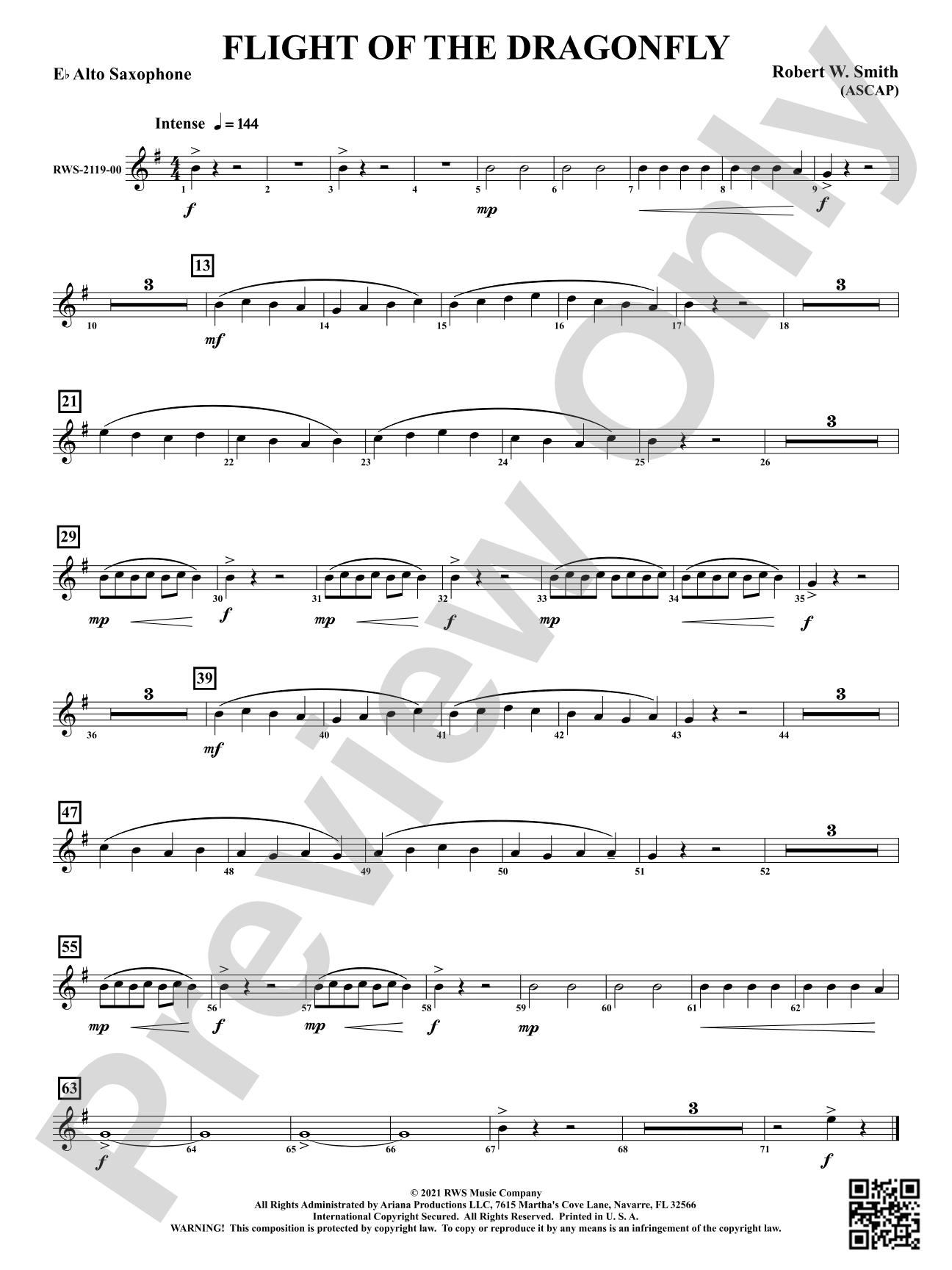
A dragonfly is a fast, agile flier that sometimes migrates great distances and across oceans. In some cultures, dragonflies are symbols of courage, strength and happiness, and in others, they are seen as dark and sinister. "Flight Of The Dragonfly" captures the power and energy of this amazing creature through music. Featuring a soaring melody over driving rhythms, this work for the young band utilizes colorful percussion scoring as well as insect effects using brass mouthpieces. An exciting work that will captivate your developing musician and their audience!
Original Item#: RWS-2119-00
Discover MakeMusic Cloud: thousands of interactive titles your students can play along with today.
Robert W. Smith has established himself as a prolific voice in American band and orchestral composition, with more than 400 published works to his credit. His training at Troy State University (now Troy University) in music education and the University of Miami at the graduate level provided the foundation for a career spanning concert halls, broadcast stages, and major cultural events worldwide. From the opening of the Macy's Thanksgiving Day Parade to performances at the Olympic Games, his compositions have reached audiences far beyond the concert band podium.
As both composer and conductor, Smith has worked extensively across North America, Europe, Australia, Asia, and beyond. His symphonic works, including The Divine Comedy and The Odyssey, have become known to musicians on multiple continents. Pieces like The Tempest established themselves as essential repertoire for developing ensembles, reflecting his deep understanding of what young musicians need to grow musically while remaining engaged and challenged.
Why we love this
Smith captures something genuinely fun here: the playfulness of a novelty concept paired with real compositional craft. The insect effects using brass mouthpieces and colorful percussion scoring give students memorable visual and sonic moments without relying on gimmickry alone. At 1.5 grade level, it hits that sweet spot where a developing band can feel the rush of an exciting work while the technical demands remain manageable.
What to expect
Bright, energetic, and restless, with an almost shimmering quality that captures dragonfly motion without becoming fussy. The driving rhythms underneath a soaring melody create forward momentum that students feel naturally, while the unconventional percussion and brass textures add color and surprise.
Who it's for
Young bands at the developing stage who need a piece that combines accessibility with genuine excitement. This work rewards sections that can execute rhythmic precision and balance dynamics while keeping ensemble morale high through a piece that audiences will enjoy as much as the students perform it.
How to get the most out of it
Shape the driving rhythms with clear articulation in the rhythm section; the energy of the piece depends on locked, decisive attacks rather than sloppy enthusiasm.
Bring out the soaring melody so it reads clearly over the accompaniment; mark dynamic layers in individual parts during sectionals so every player knows whether they're supporting or singing.
Explore the brass mouthpiece effects in rehearsal first without the full ensemble; students often enjoy experimenting with these unconventional sounds, and a quick demonstration prevents confusion during full run-throughs.
Use the percussion scoring to build texture gradually; the colorful parts should feel like they're painting a picture, not competing for attention alongside the melodic line.
How to use it
Program this as an opening piece for a concert to set an upbeat tone, or use it as a palate cleanser between heavier works. It works well on a family concert or a program aimed at younger audiences who respond to the novelty concept and visual element of the performance.
Skills your students will build
Rhythmic precision and rhythmic independence in ensemble contexts
Dynamic shaping and balance with multiple melodic and textural layers
Intonation control in homophonic and contrapuntal sections
Interpretation of non-standard percussion and brass effects
Attention to articulation and its role in creating musical character
You May Also Like
Scan to Complete Your Purchase
Use your phone's camera to scan the code below
You'll log in on your phone and the order will be added to your account