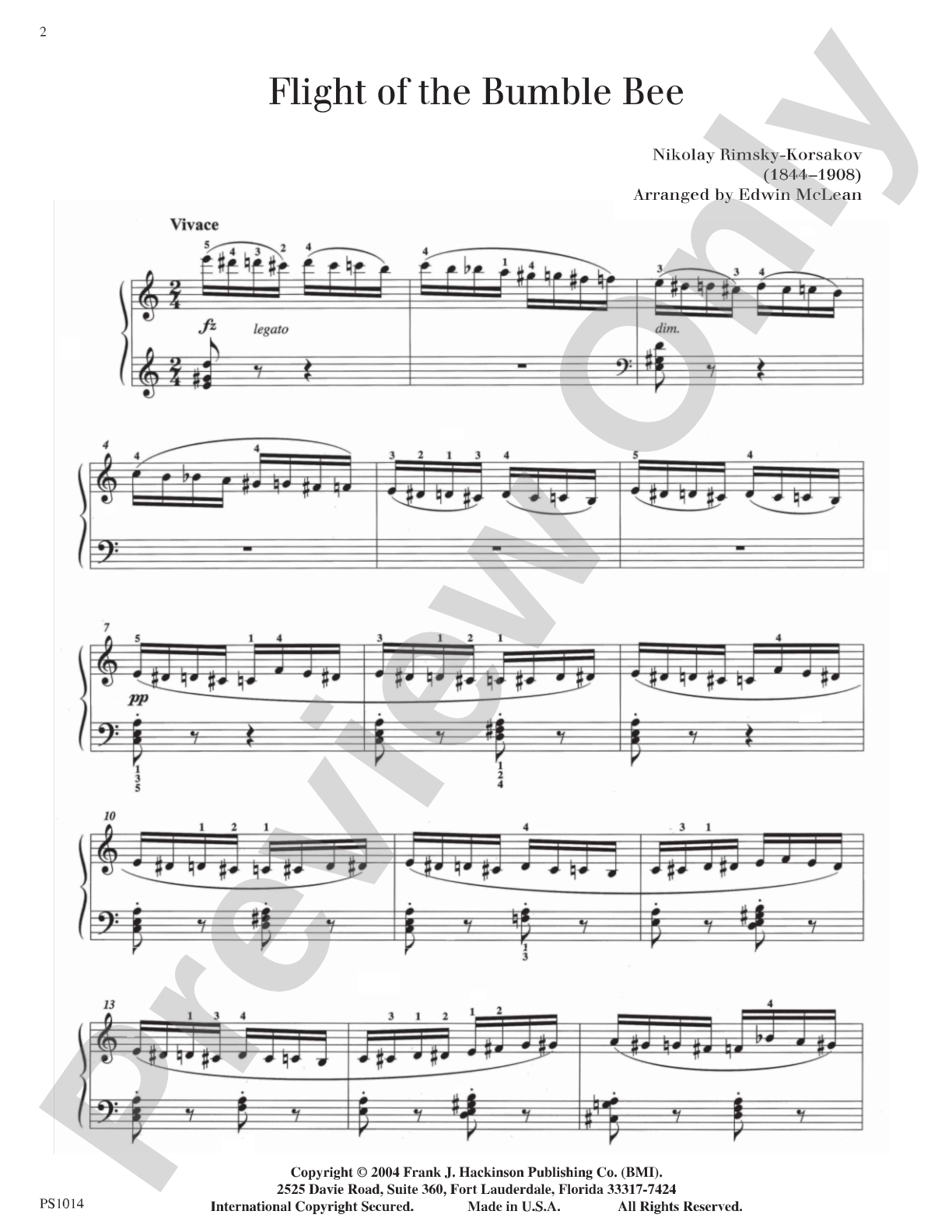
Flight of the Bumble Bee Sheet Music Preview

Flight of the Bumble Bee: Piano

By Nikolay Rimsky-Korsakov / arr. Edwin McLean

Item: 98-DPS1014

Digital Download
$3.50
Description
This famous encore piece, here newly transcribed from the conductor score, has buzzed its way to popular fame. Most recently seen in a breakneck performance at the piano in the movie Shine, Flight of the Bumble Bee is great fun, even at intended, slower speeds, and makes for a wonderful etude in chromatics.

Flight of the Bumble Bee: Piano isn't in MakeMusic Cloud just yet...but it could be. Let us know you'd like to see it, and you'll help shape what comes next. In the meantime, start a free trial and dive into thousands of interactive titles your students can play along with today.

Sample Audio
No sample audio found.
Sample Video
Additional Details
Series: The FJH Piano Solo Series
Publisher: The FJH Music Company, Inc.
SKU: 98-DPS1014

More about this title

About the Composer: Nikolay Rimsky-Korsakov

Nikolay Rimsky-Korsakov (1844-1908) was a Russian composer and orchestrator whose gift for vivid instrumental color shaped the sound of late 19th-century music. As both a composer and professor at the St. Petersburg Conservatory, he elevated orchestration to an art form, and his works remain standard repertoire across ensembles worldwide. Flight of the Bumble Bee, from his opera The Tale of Tsar Saltan, demonstrates his mastery of rapid figuration and harmonic invention.

Rimsky-Korsakov's catalog spans operas, symphonies, and orchestral showpieces, many of which have been successfully adapted for solo instruments. His influence on composers from Stravinsky onward underscores his importance in the musical canon. For pianists, his works offer both technical challenge and the reward of playing music that crackles with energy and personality.

Why we love this

Edwin McLean's transcription draws directly from the conductor score, giving pianists access to exactly what Rimsky-Korsakov orchestrated without interpretive reductions. The piece works beautifully across a range of tempos; students need not tackle it at the frenetic clip made famous by the Shine soundtrack to experience the thrill of rapid chromatic passagework. It's an encore that delivers real musical substance alongside crowd appeal.

What to expect

Restless, propulsive energy held in check by the precision of the chromatic lines. The piece never quite settles; it buzzes, swarms, and darts from one register to another, yet beneath the motion lies elegant harmonic logic that reveals itself to attentive listeners.

Who it's for

Pianists preparing a competitive encore, students developing fluency in chromatic figuration, and anyone seeking a piece that combines technical work with immediate musical payoff. The transcription suits intermediate to advanced pianists who want familiar material with the integrity of a primary source.

How to get the most out of it

  • Approach the chromatic runs as waves of sound rather than isolated notes. Connect the scalar passages smoothly by thinking of them as single melodic strands, not technical hurdles.
  • Experiment with tempo before settling on a final speed. Slower performances (around half the virtuosic pace) allow the harmonic structure and orchestral detail to emerge.
  • Use the natural resonance of the piano to sustain harmonic colors. Pedal judiciously through the chromatic figures so clarity remains intact without muddying the texture.
  • Shape the rare moments of silence and the brief passages that break the relentless motion. These create breathing room and make the return to the buzz feel fresh.

How to use it

Reserve this for a recital closer or a standalone encore where its theatrical flair will land. It pairs naturally with other character pieces and showstoppers but can also anchor a program themed around Russian masterworks or orchestral transcriptions.

Skills your students will build

  • Chromatic scale fluency and evenness across octaves
  • Rapid hand position shifts and scalar passage work
  • Pedal technique for sustaining harmony without muddying texture
  • Dynamic control and shaping of extended figurations
  • Understanding orchestral color translated to keyboard idiom

You May Also Like