
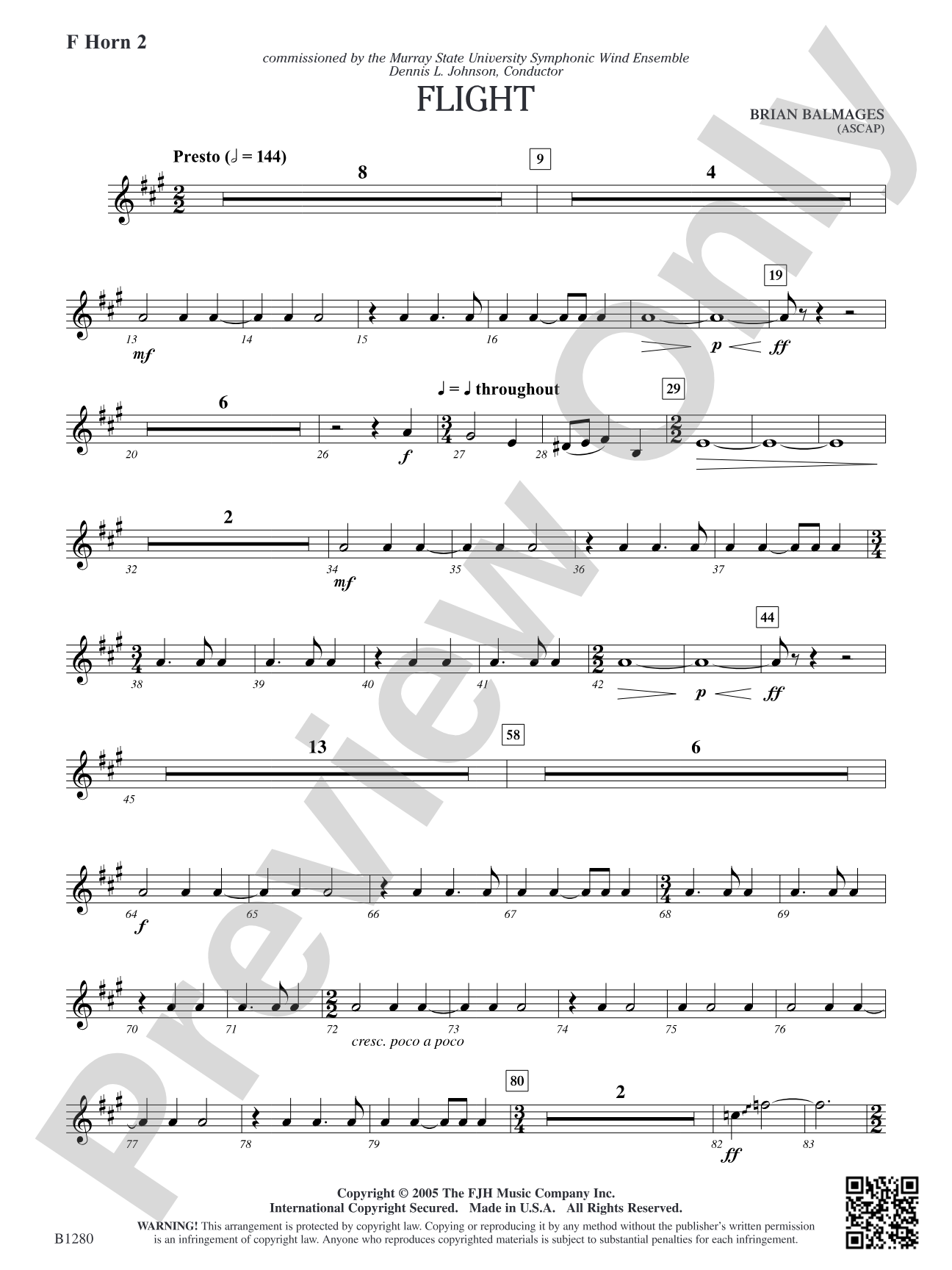

Flight: F Horn 2
By Brian Balmages
Grade: 5
Item: 98-PC-DB1280_H2
$7.00
Pickup currently not available
Description
Premiered at Carnegie Hall, this minimalistic fanfare celebrates SpaceShipOne, the first privately manned spacecraft to exceed an altitude of 62 miles twice within two weeks. The three sections explore the launch to space, reaching the apogee (weightlessness), and return to the atmosphere. Punctuated by incredible brass fanfares and woodwind flourishes, the entire work is a bundle of energy from start to finish, and is the perfect opener for any concert. Monumental!


Don't just read it, hear it, play along with it, and watch your students grow with it. In MakeMusic Cloud, Flight: F Horn 2 comes alive with professional accompaniment, adjustable tempo, and built-in practice tools that turn solo practice into real progress.
Open in the Player
Jump straight in and assign it today.
Start Your Free Trial
Open this title and explore the full library in minutes.
Sample Audio
1
Audio File
--:--
0:00
0:00
Sample Video
No sample videos found.
Additional Details
Series:
FJH Symphonic Band
Publisher:
The FJH Music Company, Inc.
SKU:
98-PC-DB1280_H2
More about this title
About the Composer: Brian Balmages

Brian Balmages has built a reputation as a composer and conductor working across orchestral, band, and chamber idioms with equal fluency. His works have appeared on stages from Carnegie Hall to the Sydney Opera House, performed by ensembles spanning professional orchestras down to elementary school groups. He received the A. Austin Harding Award from the American School Band Directors Association, won the 2020 NBA William D. Revelli Composition Contest for Love and Light, and holds membership in the American Bandmasters Association.
Balmages holds degrees from James Madison University and the University of Miami, institutions that have both recognized his contributions through distinguished alumni honors and major commissions. His music was performed at the 2013 Presidential Inaugural Prayer Service, and he maintains an active guest conducting schedule at all-state ensembles, university groups, and international conferences. He currently directs publications and digital education initiatives for Alfred and MakeMusic.
Why we love this
This is a conductor's dream opener: a high-energy, minimalist fanfare that commands attention without requiring extended rehearsal time to achieve impact. Balmages writes with clarity and purpose, and the programmatic arc through launch, weightlessness, and reentry gives your ensemble a genuine narrative to perform, not just notes on a page. The brass and woodwind writing sparkles, and premiering at Carnegie Hall gives this piece the gravitas that fifth-grade students respond to with real musicianship.
What to expect
Flight is kinetic and purposeful, propelled by crystalline minimalist writing that builds urgency through repetition and layering rather than harmonic complexity. The brass fanfares feel triumphant and bright, while the woodwind flourishes dart and dance around the central themes, creating an overall impression of controlled exhilaration. From ignition to weightlessness to landing, the band experiences the arc of an extraordinary journey compressed into concentrated, energetic music.
Who it's for
Grade 5 concert bands with solid ensemble fundamentals and players who can handle exposed passages in the woodwinds and brass. This repertoire works best for groups that have developed secure rhythmic unity and can sustain minimalist textures without losing focus. Conductors seeking a festival or contest piece will find a work that combines technical interest with genuine crowd appeal.
How to get the most out of it
- Shape the three sections as distinct emotional states: the launch needs forward momentum and building tension, the apogee should float with weightlessness in the melody, and the return demands controlled intensity as the band navigates the atmospheric reentry.
- Balance the brass fanfares so they punctuate without overpowering the ensemble texture; this is minimalist writing, which means every note counts and silence matters as much as sound.
- Lock the woodwind flourishes rhythmically with precision; Balmages' energy comes from tight articulation and clean attacks, not from pushing volume.
- Use the conductor score to trace the programmatic journey so your band understands they are not playing abstract music but telling the story of SpaceShipOne's flight.
How to use it
Program Flight as your opening number at concert or festival; its brevity and impact make it the ideal curtain-raiser that establishes energy and focus without asking the audience to sit through a long exposition. Pair it with contrasting repertoire that explores different compositional approaches, since this piece's minimalist aesthetic will stand out sharply against more traditionally developed concert band literature. The programmatic nature also makes it an excellent choice for a concert theme centered on innovation, exploration, or human achievement.
Skills your students will build
- Articulation control in minimalist textures where silence and precision matter
- Rhythmic entrances and alignment in an ensemble built on layered ostinatos
- Sustained tone production in exposed woodwind and brass passages
- Musical storytelling through programmatic listening and interpretation
- Balance between independent melodic lines and unified ensemble sound