
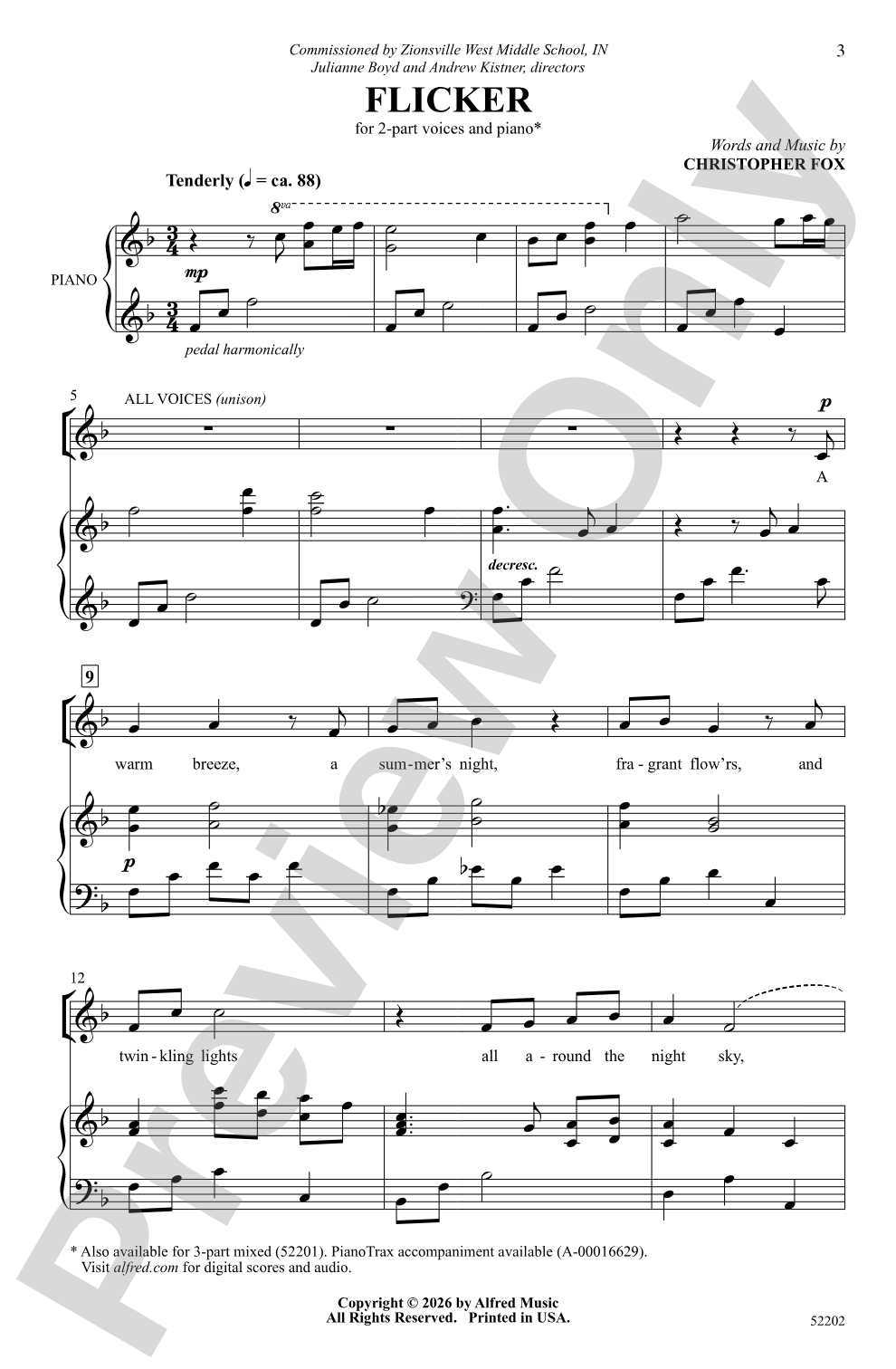
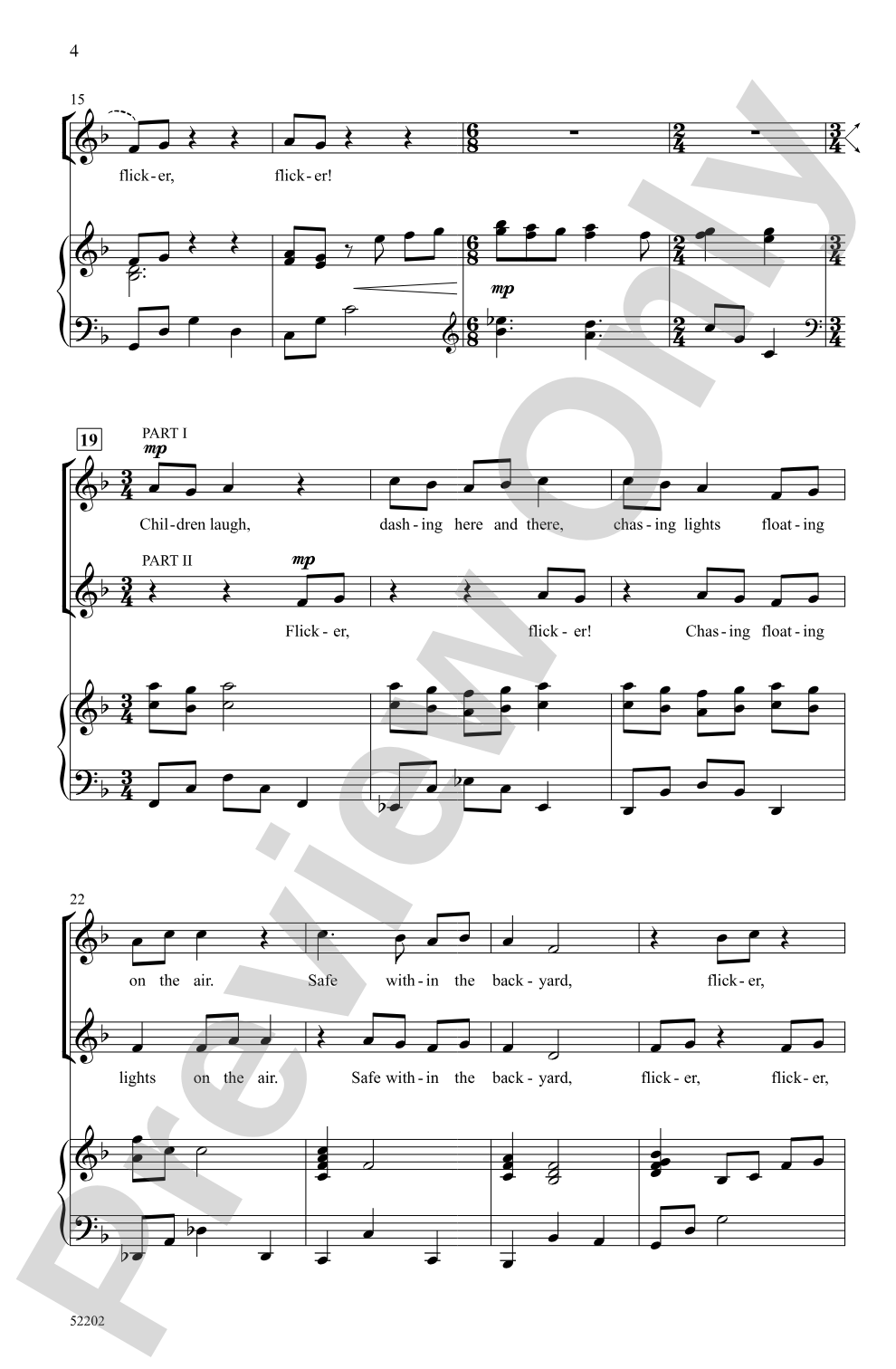

Flicker: 2-Part Choral Octavo
Words and music by Christopher Fox
Item: 00-PO-0007828
$2.50
Minimum order quantity: 20 copies
Pickup currently not available
Description
"A warm breeze, a summer's night" begins this atmospheric work that paints a backyard scene at twilight. As the music unfolds, singers mimic glowing fireflies with soft "flicker" interjections that are both fun to sing and easy to master. In the middle, independent lines stack one at a time, creating a layered soundscape. When the tender main theme returns, the symbolic lyrics have shifted from chasing fireflies to chasing dreams. A refreshing choice on any program.


Flicker: 2-Part Choral Octavo isn't in MakeMusic Cloud just yet...but it could be. Let us know you'd like to see it, and you'll help shape what comes next. In the meantime, start a free trial and dive into thousands of interactive titles your students can play along with today.
Request This Title
Tell us you want it.
Start Your Free Trial
Explore everything that's ready to play right now.
Sample Audio
1
Audio File
--:--
0:00
0:00
Sample Video
Additional Details
Series:
Alfred Choral Designs
Publisher:
Alfred Music
Page Count:
12
SKU:
00-PO-0007828
More about this title
About the Composer: Christopher Fox

Christopher Fox directs choruses at Glenelg High School in Howard County, Maryland, where he has built a reputation as both a skilled conductor and prolific composer. His choral works have been performed nationally and published by Alfred Music, Hal Leonard, and Santa Barbara Music Press, earning multiple Editor's Choice recognitions. Fox has served as an adjunct instructor in theatre at the University of Mary Washington, received commissions from the Virginia Choral Directors Association and Penn State University, and holds certifications in music education and Kodály methodology from Indiana University of Pennsylvania and Loyola University Baltimore.
Beyond the rehearsal room, Fox is an active clinician and has participated in well over one hundred choral projects across the past decade. He has been twice recognized as Teacher of the Year and brings both rigor and creativity to his work with young singers.
Why we love this
Fox captures something genuinely theatrical here without requiring elaborate staging or costuming. The imagery moves from literal (fireflies at dusk) to metaphorical (chasing dreams), and that shift mirrors the musical architecture itself, making the text inseparable from the harmonic and textural choices. Young singers get to play with sound and imitate nature while building real musicianship through independent lines and dynamic control.
What to expect
Flicker evokes a specific summer evening: humid air, dimming light, and the slow emergence of fireflies. The music feels intimate and impressionistic, with soft interjections creating a sense of wonder and movement. When the theme returns with its reframed lyric, there's a quiet shift from external observation to internal dreaming.
Who it's for
This piece works beautifully for middle school and high school choirs seeking repertoire that engages singers emotionally without being condescending. It's equally effective for all-treble or mixed ensembles and offers enough musical substance for festival adjudication while remaining accessible for groups at the beginning stages of part-singing.
How to get the most out of it
- Isolate the stacked, independent lines in the middle section first. Have each part sing alone, then add one layer at a time so singers hear their role in the larger texture.
- Shape the "flicker" interjections as brief, playful punctuation marks, not as fragmented singing. They should feel intentional and synchronized, like a group impulse.
- Balance the main theme carefully when it returns; it should feel like an echo or memory, warmer but not louder than the first statement.
- Use dynamic contrast to deepen the shift from chasing fireflies to chasing dreams. The text transformation deserves a corresponding change in weight and intention.
How to use it
This piece sits naturally in the lighter half of a concert, paired with other accessible repertoire or used as a bridge between more demanding works. Its atmospheric quality and brief length (12 pages) make it ideal for showcasing younger singers or as an encore-style closer on a spring or end-of-year program.
Skills your students will build
- Sustaining tone control and breath management through sustained vowels
- Blending two independent vocal lines without dominating or disappearing
- Text painting and connecting lyrical imagery to musical expression
- Synchronized rhythmic articulation across the ensemble ("flicker" interjections)
- Interpretation of dynamic and textural change as dramatic storytelling