Fledermaus Waltzes: 1st Violin Sheet Music Preview

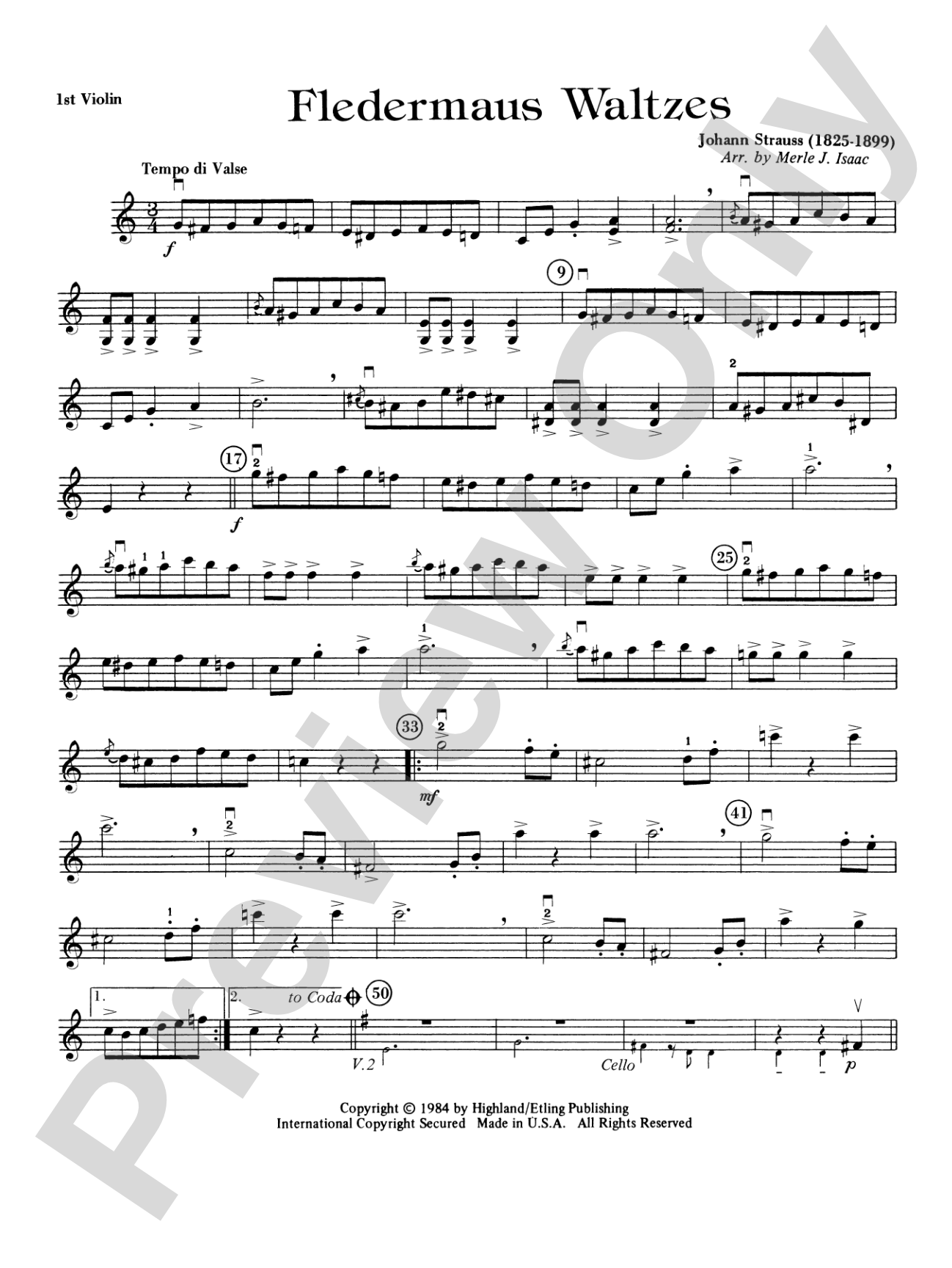
Fledermaus Waltzes: 1st Violin

By Johann Strauss / arr. Merle J. Isaac

Grade: 3

Item: 00-PC-0000101_VN1

Digital Download
$5.99
Description

Don't just read it, hear it, play along with it, and watch your students grow with it. In MakeMusic Cloud, Fledermaus Waltzes: 1st Violin comes alive with professional accompaniment, adjustable tempo, and built-in practice tools that turn solo practice into real progress.

Sample Audio
No sample audio found.
Sample Video
Additional Details
Series: Highland/Etling String Orchestra
Publisher: Alfred Music
Page Count: 82
SKU: 00-PC-0000101_VN1

More about this title

About the Composer: Johann Strauss

Johann Strauss (1825-1899) earned his title as the Waltz King through prolific composition and masterful orchestration. His waltzes and operettas defined the sound of Viennese popular music and remain central to the string orchestra repertoire, offering conductors works that combine melodic richness with genuine orchestral sophistication.

Why we love this

Merle Isaac's arrangement captures the sparkle and energy of Strauss's operetta without overwhelming Grade 3 players. The waltzes sit naturally under the fingers across all string parts, and the familiar melodies engage audiences immediately while teaching genuine style and phrasing.

What to expect

Effervescent and graceful, these waltzes sweep forward with the optimism of a Vienna ballroom. The writing sparkles in the upper strings while the lower parts provide harmonic momentum, creating an experience that feels both light and musically substantial.

Who it's for

String orchestra conductors leading Grade 3 ensembles who want accessible repertoire with real musical substance. Directors preparing for contests, festivals, or concerts will find parts that challenge growing musicians without requiring advanced technique.

How to get the most out of it

  • Shape the characteristic three-beat waltz meter with subtle dynamic lift on beat one; avoid making it mechanical or square.
  • Balance the melody across first and second violins rather than favoring one part, so the familiar themes emerge clearly without sacrificing ensemble texture.
  • Let younger players feel the dance quality in their practice by walking or conducting in three as they learn their parts; this internalizes the rhythm before technical polish matters.
  • Mark breath points in the conductor score to unify the string sections through phrase endings, especially where runs or scalar passages tempt players to rush.

How to use it

Open a concert with this to establish an elegant mood, or pair it with contrasting Romantic works to showcase range. The familiar melodies and festive character work especially well in spring concerts or as a bridge between classical and contemporary programming.

Skills your students will build

  • Waltz meter and three-beat conducting patterns
  • Melodic shaping and phrasing across sustained passages
  • Part independence within homophonic textures
  • Baroque-era bowing and articulation style
  • Listening and balancing in multi-part string writing

You May Also Like