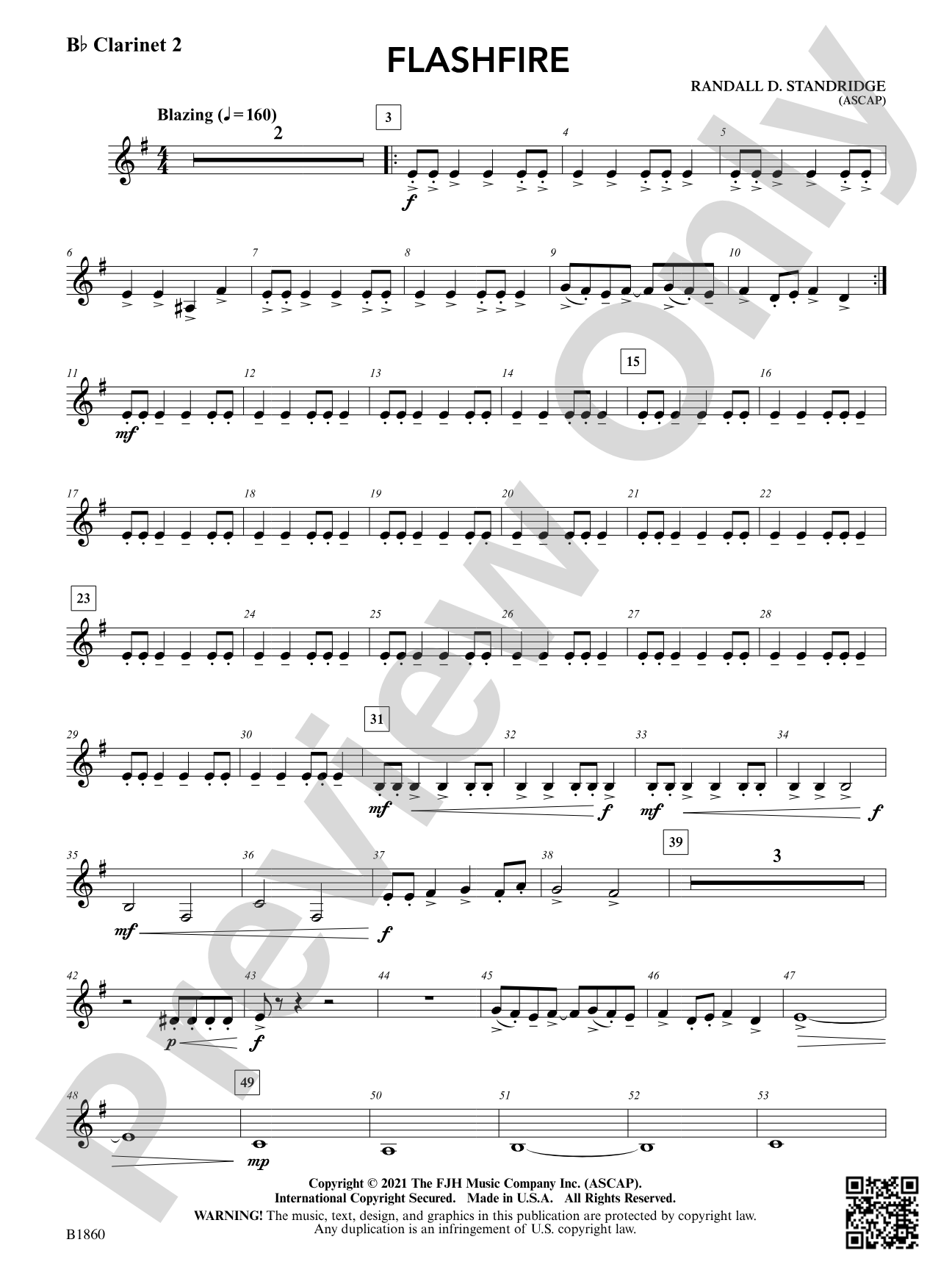
Flashfire: B-flat Clarinet 2 Sheet Music Preview

Flashfire: B-flat Clarinet 2

By Randall D. Standridge

Grade: 2.5

Item: 98-PC-DB1860_C2

Digital Download
$7.00
Description
Ignite your performers’ and audience’s excitement with this fiery concert work. A simple two measure motive serves as the “spark” that is fanned into a flame of rhythmic and harmonic intrigue as all instruments get moments to glow! Featuring fantastic percussion writing and a strong sense of development and orchestration, this work is sure to be a bright spot in your next concert.

Flashfire: B-flat Clarinet 2 isn't in MakeMusic Cloud just yet...but it could be. Let us know you'd like to see it, and you'll help shape what comes next. In the meantime, start a free trial and dive into thousands of interactive titles your students can play along with today.

Sample Audio
0:00
0:00
Sample Video
Additional Details
Series: FJH Young Band
Publisher: The FJH Music Company, Inc.
SKU: 98-PC-DB1860_C2

More about this title

About the Composer: Randall D. Standridge

Randall D. Standridge is a prolific composer and arranger whose catalog spans concert band, jazz ensemble, and choral literature. His works are known for clear orchestration, strong musical development, and accessibility across ability levels, making them staples in school and community band programs nationwide.

Standridge has built his reputation on understanding what young musicians need to grow as players and ensemble members. His concert band writing consistently balances pedagogical clarity with genuine musical substance, giving students meaningful parts to play within a cohesive artistic statement.

Why we love this

Standridge knows how to build excitement from modest materials. A two-measure motive stretched and developed across all sections gives every student ensemble a moment of presence, which keeps motivation high during rehearsal and confidence strong in performance. The percussion writing alone makes this a standout at the 2.5 level, offering color and rhythmic sophistication without demanding virtuosity.

What to expect

Flashfire builds from a spark of curiosity into a glow of collective energy. The early measures hint at what's coming, then rhythmic and harmonic layers accumulate with steadiness and warmth, creating momentum that feels earned rather than imposed.

Who it's for

This work suits developing concert bands (grades 5-8) ready to engage with genuine compositional growth and sectional independence. Players at the 2.5 level will find parts that sit comfortably on their instruments while contributing meaningfully to a larger musical argument.

How to get the most out of it

  • Isolate that initial two-measure motive in the first rehearsal so all sections hear it clearly before variations begin to accumulate. This unified understanding accelerates the ensemble's grasp of the development.
  • Balance the percussion carefully as the work unfolds. These parts drive rhythmic momentum, so ensure attacks are crisp and decay is controlled; overplaying them clouds the ensemble texture.
  • Shape the harmonic colors as the motive transforms. Small dynamic adjustments and slight tempo flexibility in transitions between sections will highlight the orchestrational shifts and keep the architecture transparent.
  • Build the final section with patience. The return to fire and intensity lands harder when you've allowed earlier phrases to breathe and develop at organic pacing rather than driving at top speed throughout.

How to use it

Program this as a opener or closing work to energize your concert and showcase your ensemble's clarity and sectional balance. At 2.5 grade level, it pairs well with early-intermediate standards and gives audiences a clear sense of what young musicians in your program can accomplish.

Skills your students will build

  • Tracking a single melodic idea through harmonic and rhythmic variations
  • Coordinating sectional entries and cutoffs with precision
  • Balancing dynamic layers to support overall form
  • Interpreting rhythmic figurations that drive compositional momentum
  • Responding to conductor gestures that shape harmonic transitions

You May Also Like