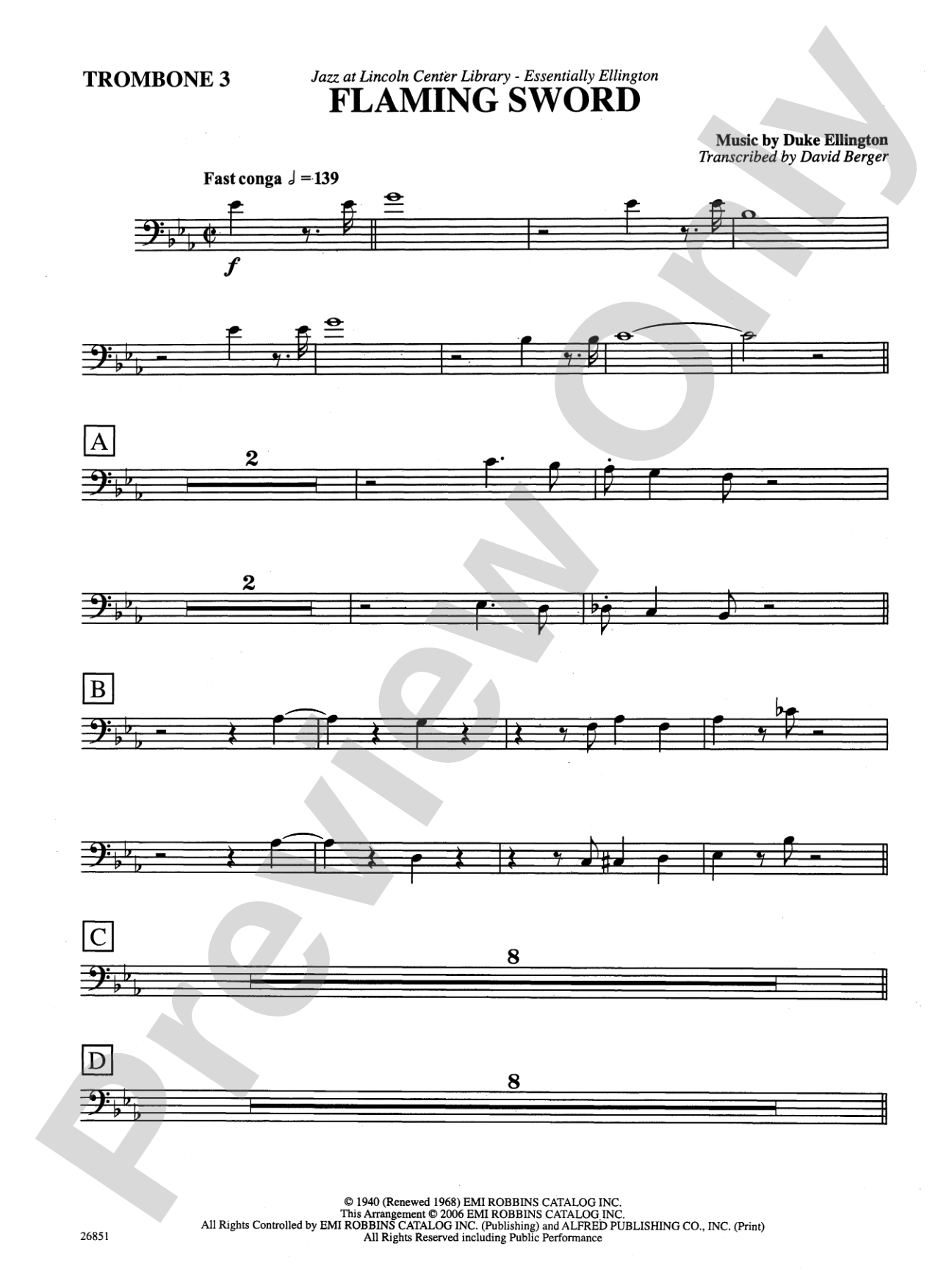
Flaming Sword: 3rd Trombone Sheet Music Preview

Flaming Sword: 3rd Trombone

By Duke Ellington

Item: 00-PC-0017286_TN3

Digital Download
$3.00
Description
This title is available in MakeMusic Cloud.

Don't just read it, hear it, play along with it, and watch your students grow with it. In MakeMusic Cloud, Flaming Sword: 3rd Trombone comes alive with professional accompaniment, adjustable tempo, and built-in practice tools that turn solo practice into real progress.

Sample Audio
No sample audio found.
Sample Video
Additional Details
Series: Essentially Ellington: Jazz at Lincoln Center Library
Publisher: Alfred Music
Page Count: 70
SKU: 00-PC-0017286_TN3

More about this title

About the Composer: Duke Ellington

Duke Ellington (1899-1974) was a pianist, bandleader, and composer whose prolific output fundamentally shaped American jazz and concert music. He moved fluidly between the ballroom, the jazz club, and the concert hall, composing over a thousand works that ranged from three-minute dance numbers to extended suites and film scores. His harmonic sophistication and orchestral thinking influenced generations of jazz composers and arrangers.

Ellington's approach to ensemble writing prioritized the individual voices within the band, writing specifically for his musicians' timbres and personalities. This practice made his scores remarkably detailed and expressive, establishing a standard for big band and jazz ensemble composition that educators continue to study and performers continue to interpret.

Why we love this

Ellington's harmonic language and ensemble textures remain sophisticated enough to challenge advanced players while remaining accessible to conductors with solid jazz fundamentals. The Essentially Ellington library offers repertoire with genuine artistic depth, making rehearsal time feel like musical investment rather than obligation.

What to expect

Flaming Sword unfolds with the sophistication and controlled energy Ellington brought to his extended compositions. The piece balances composed sections with space for ensemble interplay, creating a sound world that feels both orchestral and fundamentally rooted in the jazz tradition.

Who it's for

Jazz ensemble directors leading groups with intermediate to advanced reading skills and jazz fluency. This score works well for ensembles that have played standards or simpler Ellington material and are ready to engage with more complex harmonies and ensemble writing.

How to get the most out of it

  • Balance the reed and brass sections carefully in the ensemble voicings; Ellington wrote specific colors for each register, and clarity matters more than volume.
  • Allow the rhythm section room to breathe and interact. Lock the tempo through feeling rather than rigid metronomic precision; jazz ensemble playing requires flexibility and communication between musicians.
  • Listen closely to recorded versions of Ellington's work to understand his intended sound world, but encourage your ensemble to find their own voice within his compositional framework.
  • Mark articulation and phrasing details with your ensemble from the start. Ellington's written accents and note shapes carry meaning and define the piece's character.

How to use it

Feature this score in a concert focused on jazz standards and classic big band repertoire, or program it alongside other Ellington works to showcase the breadth of his compositional voice. It pairs well with vocal jazz features or with contemporary jazz pieces, anchoring a program in the tradition.

Skills your students will build

  • Reading complex harmonic progressions and chord changes
  • Balancing ensemble voicings across multiple reed and brass sections
  • Responding to expressive phrasing and articulation in a composed jazz context
  • Maintaining ensemble cohesion while accommodating jazz style and flexibility
  • Understanding Ellington's approach to orchestral color and section writing

You May Also Like