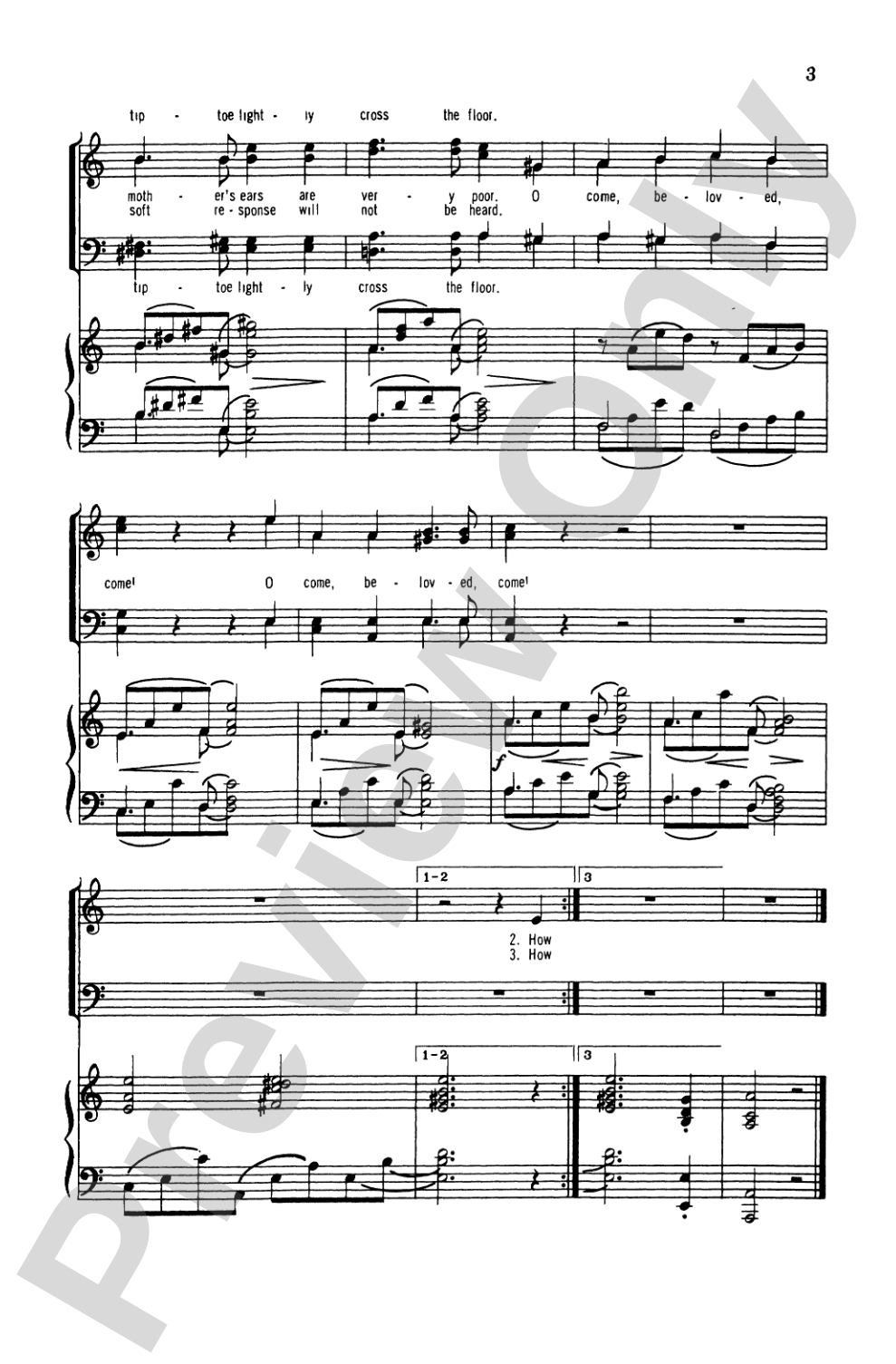
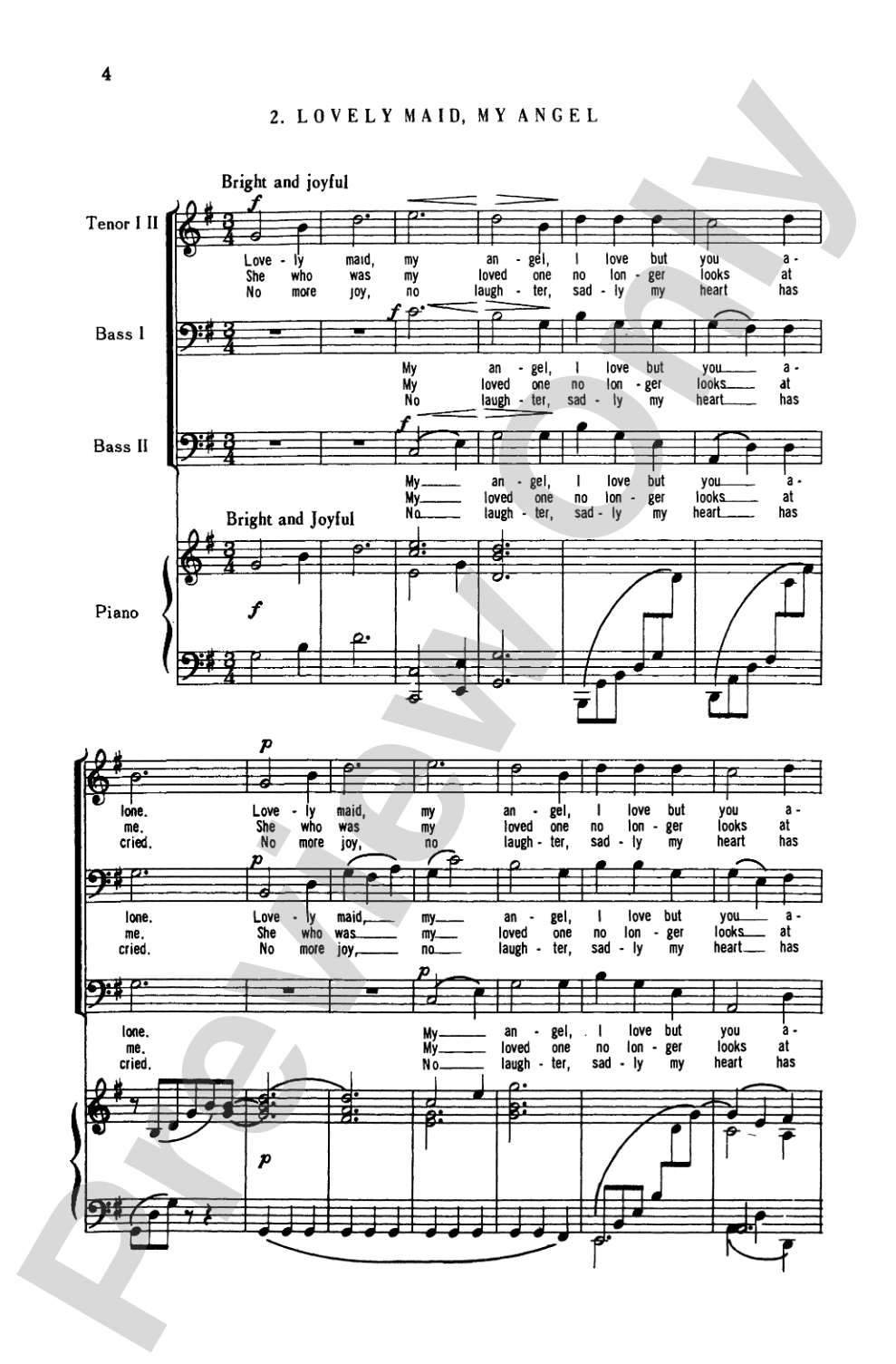
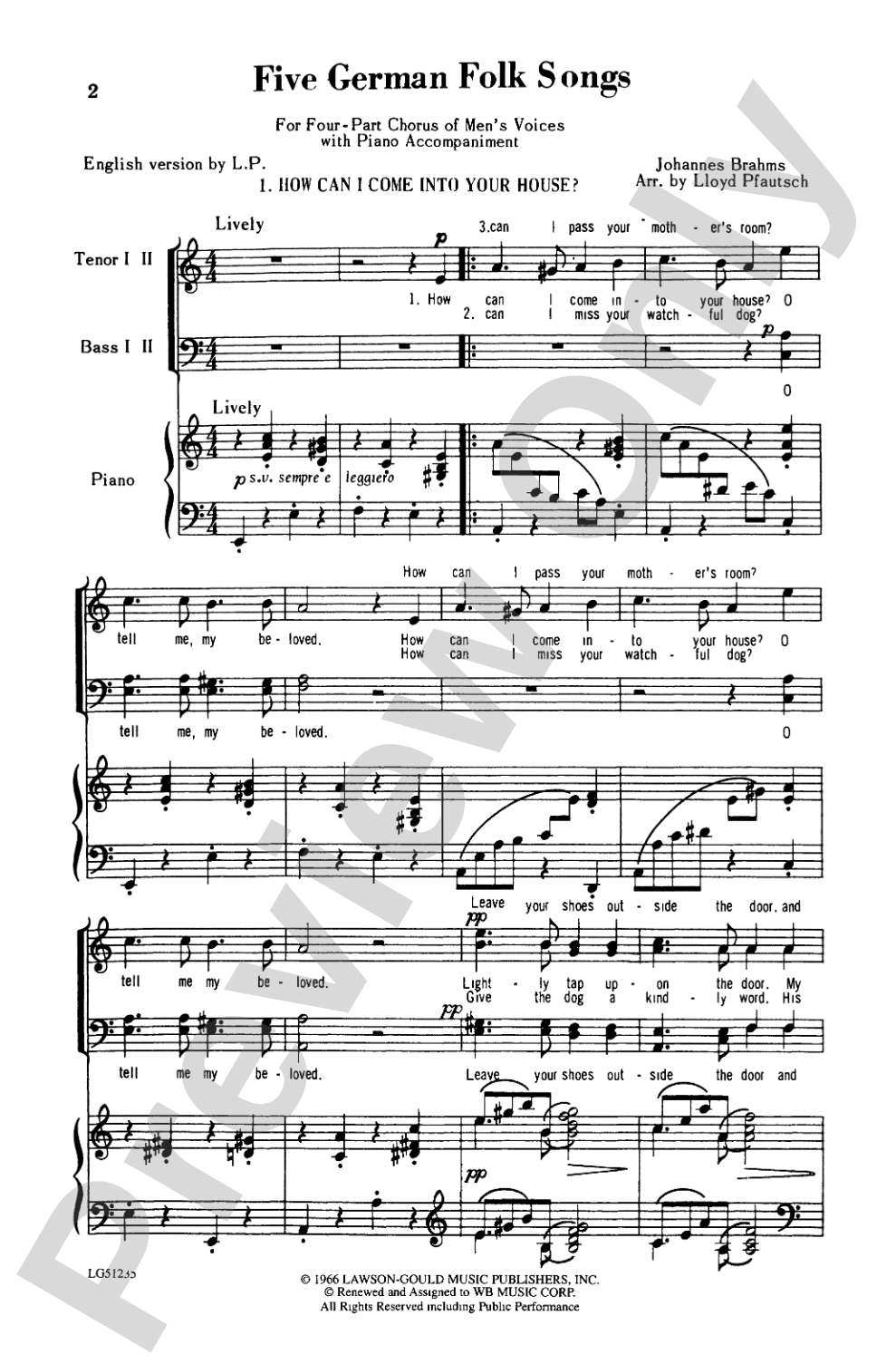
Five German Folk Songs Sheet Music Preview

Five German Folk Songs: TTBB Choral Octavo

By Johannes Brahms / arr. Lloyd Pfautsch

Item: 00-PO-0004982

Digital Download
$2.95

Minimum order quantity: 20 copies

Description

Five German Folk Songs: TTBB Choral Octavo isn't in MakeMusic Cloud just yet...but it could be. Let us know you'd like to see it, and you'll help shape what comes next. In the meantime, start a free trial and dive into thousands of interactive titles your students can play along with today.

Sample Audio
No sample audio found.
Sample Video
Additional Details
Series: Alfred Archive Edition: Lawson-Gould Music Publishers
Publisher: Alfred Music
Page Count: 16
SKU: 00-PO-0004982

More about this title

About the Composer: Johannes Brahms

Johannes Brahms (1833-1897) was a German composer whose output spanned symphonies, concertos, chamber music, and vocal works across nearly five decades. His deep engagement with folk traditions, particularly German and Eastern European material, shaped his compositional voice throughout his career. Brahms collected and studied folk melodies with genuine scholarly interest, viewing them not as raw material to be modernized but as expressions of cultural wisdom worthy of rigorous musical treatment.

Why we love this

Lloyd Pfautsch's arrangement honors Brahms's original harmonic language while creating genuine four-part writing that sits naturally in male voices. These pieces offer choirs a path into Brahms's art song sensibility without requiring soprano/alto resources, making them invaluable for groups focused on lower voices. The collection balances accessibility with musical substance, so singers encounter real compositional craft rather than simplified versions.

What to expect

Warm and grounded, these arrangements carry the human quality of folk material while wrapped in Brahms's sophisticated harmonic language. There's a conversational intimacy in the four-part writing, as if singers are gathered around a hearth rather than on a concert stage. The pieces move between moments of gentle lyricism and spirited rhythmic vitality, never straying into sentimentality.

Who it's for

Directors seeking substantial TTBB repertoire rooted in the European art song tradition will find these arrangements essential. Ensembles preparing for choral contests or festivals gain pieces that demonstrate musicianship and textual integrity. Male voice choirs building concert programs around folk material or Romantic-era masterworks have an immediate, score-ready option.

How to get the most out of it

  • Pay close attention to Pfautsch's voice leading in transitions between sections; the arrangement often weaves folk melody through different voice parts, and clean handoffs prevent the lines from sounding fragmented.
  • Shape the text naturally rather than imposing rigid phrase boundaries; German folk material benefits from conversational phrasing that lets the story emerge.
  • Balance the harmonic color by listening across parts during rehearsal; Brahms's chord progressions can muddy if any voice dominates or if vertical sonorities lack clarity.
  • Consider the overall arc of all five songs before programming them; varying tempos and moods across the set keeps the concert experience dynamic for audiences.

How to use it

Open a concert with one or two of these pieces to establish a reflective mood, or cluster all five for a thematic German folk evening that showcases stylistic range. They pair well alongside other Brahms arrangements or with contemporary works that draw on folk idioms, creating conversation across eras. These are also strong contest selections because they combine approachability with the musical depth that adjudicators recognize.

Skills your students will build

  • Reading and balancing four independent lines in close harmony
  • Shaping Germanic text with natural inflection and clarity
  • Identifying and sustaining harmonic color through block-chord progressions
  • Responding to subtle dynamic and tempo variations that shape folk material
  • Collaborating as lower voices to create blended, unified sonority

You May Also Like