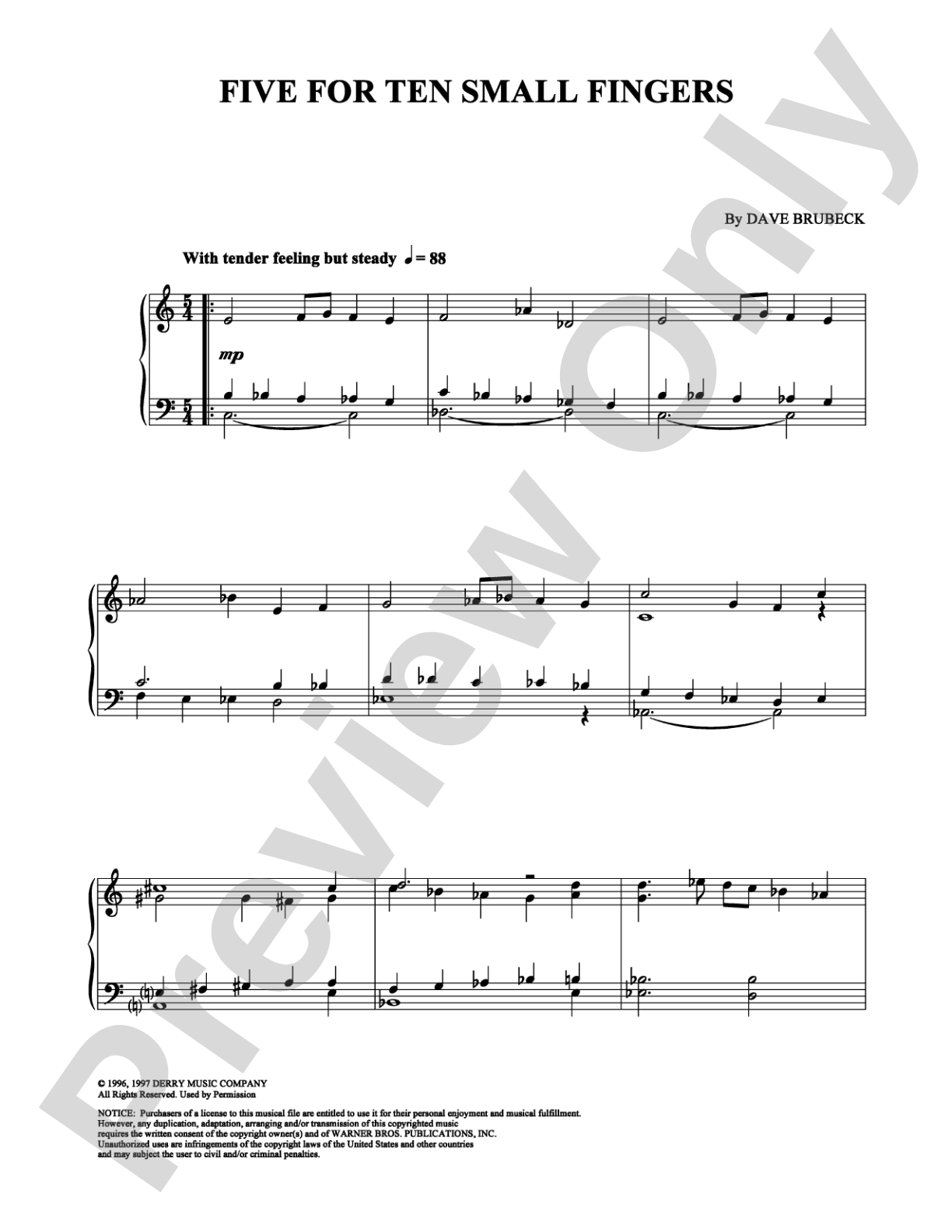
Five For Ten Small Fingers: Piano Digital Sheet Music

Five For Ten Small Fingers: Piano Digital Sheet Music

Dave Brubeck

Item: 00-PS-0001314

Digital Download
$3.99
Description

Five For Ten Small Fingers: Piano Digital Sheet Music isn't in MakeMusic Cloud just yet...but it could be. Let us know you'd like to see it, and you'll help shape what comes next. In the meantime, start a free trial and dive into thousands of interactive titles your students can play along with today.

Sample Audio
No sample audio found.
Sample Video
Additional Details
SKU: 00-PS-0001314

More about this title

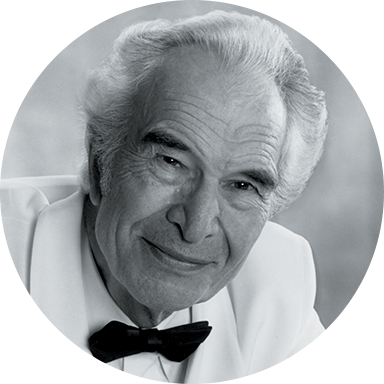
About the Artist: Dave Brubeck

Dave Brubeck

Dave Brubeck brought together jazz improvisation and classical composition with rare fluency. A pianist trained under Darius Milhaud at Mills College, Brubeck developed a compositional voice that honored both idioms, creating works spanning solo piano pieces, chamber music, orchestral suites, choral works, and large-scale oratorios. His groundbreaking album "Time Out" became the first jazz record to sell over a million copies, and his composition "Take Five" remains iconic in jazz history. Beyond his musical achievements, Brubeck was a social pioneer who actively broke racial barriers in mid-20th-century American music.

Throughout his career, Brubeck received numerous honors including the Presidential Medal of the Arts from President Clinton, a Grammy Lifetime Achievement Award, and election to the American Classical Music Hall of Fame in 2003. His sacred works, including the mass "To Hope!" and oratorios such as "The Voice of the Holy Spirit," have been recorded by major ensembles and performed across Europe and North America. Brubeck's legacy rests on his refusal to separate jazz and classical traditions, proving that serious composition could embrace both languages.

Why we love this

Brubeck understood how to write for young pianists without condescension. These five pieces respect developing technique while delivering genuine jazz character, students aren't playing simplified versions of "real" jazz, they're playing actual Brubeck compositions scaled appropriately. For a teacher building a jazz curriculum, this offers authentic material that connects students to one of the 20th century's most important voices.

What to expect

These pieces carry the relaxed sophistication Brubeck brought to all his writing. You'll find clean, singable melodies paired with jazz harmonies that feel modern and slightly blues-tinged, with rhythmic figures that invite swing and gentle rubato. The overall character is cheerful and unpretentious, closer to Brubeck's chamber writing than to his most experimental work, making them genuinely fun to play rather than academic exercises in style.

Who it's for

Elementary to early intermediate pianists seeking engaging contemporary material that introduces jazz vocabulary and phrasing in a manageable context. Teachers who want to expand students' repertoire beyond classical forms and show them that "serious" composers write in jazz idioms will find these pieces invaluable. This collection works well for students who respond to the sound of jazz but need pieces scaled to their current technical level.

How to get the most out of it

  • Understand the harmonic foundation before approaching swing rhythms; Brubeck's jazz language sits on top of clear harmonic structures, and knowing where the chord changes occur gives you something solid to push against rhythmically.
  • Listen to Brubeck's own recordings to internalize how he phrases jazz lines; the notation shows you what to play, but recordings reveal the flexible, conversational quality of jazz expression you're aiming for.
  • Practice the rhythmic figures separately from the melodic ones; Brubeck often layers complex rhythmic patterns under simpler melodies, and isolating them helps each layer come through clearly.
  • Let the swing feel emerge from relaxation rather than mechanical precision; younger pianists often tense up when trying to "swing," but the characteristic lilt comes from slight delays and anticipations that happen naturally when you're comfortable with the material.

How to use it

Slot these into a jazz literacy unit within a regular piano curriculum, or feature them in a mixed concert where classical and jazz repertoire share the stage, Brubeck's compositional craft makes that pairing feel intentional, not novelty. They work well as a bridge for students transitioning from strictly notated classical study into improvisation and jazz idioms.

Skills your students will build

  • Swing rhythm and jazz phrasing
  • Jazz harmonies and extensions
  • Comfortable hand position and finger independence for jazz figures
  • Listening to and interpreting recorded jazz models
  • Understanding how improvisation and notation coexist

You May Also Like