Five Foot Two, Eyes of Blue (Has Anybody Seen My Girl?): Easy Piano Digital Sheet Music

Five Foot Two, Eyes of Blue (Has Anybody Seen My Girl?): Easy Piano Digital Sheet Music

Ray Henderson

Item: 00-PS-0010151

Digital Download
$2.95
Description

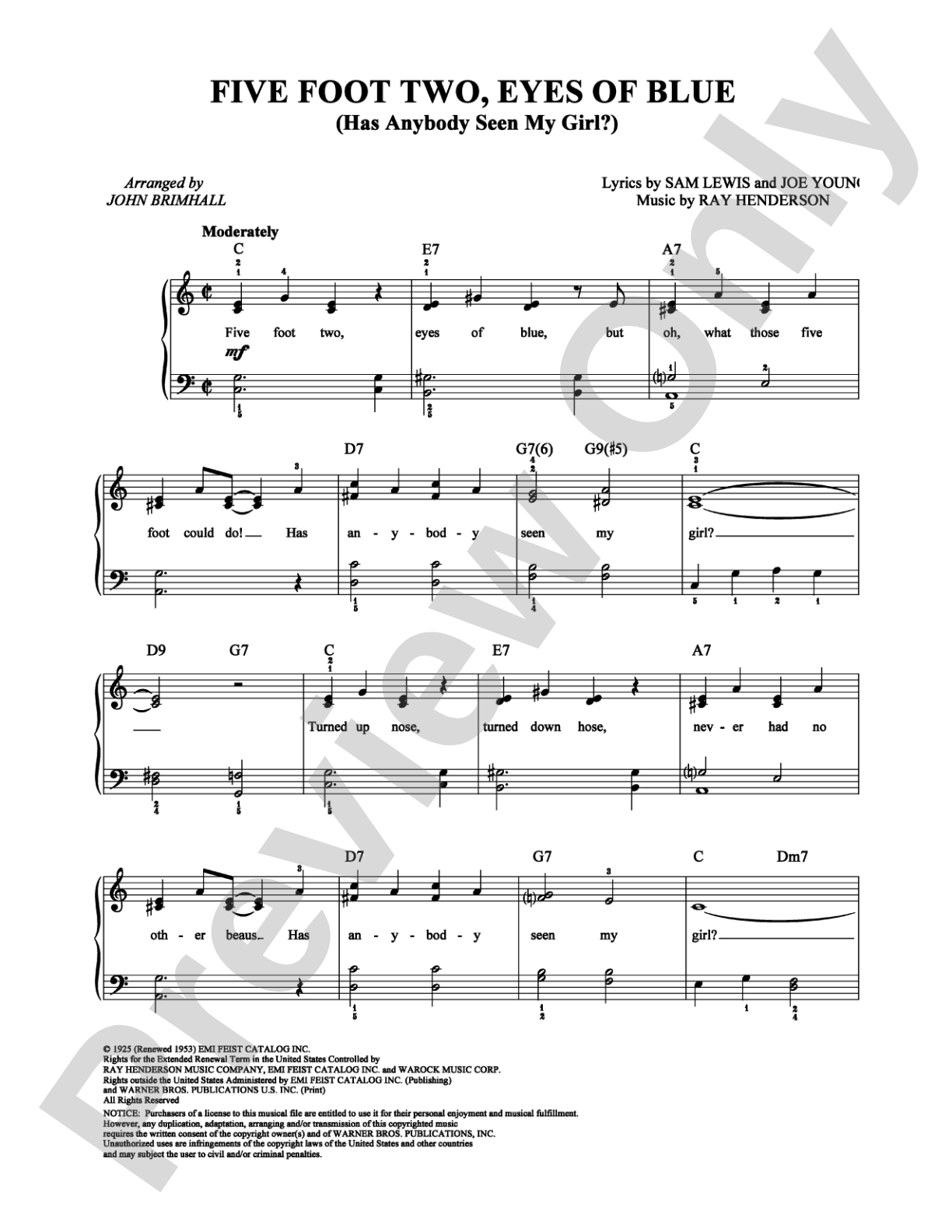
Five Foot Two, Eyes of Blue (Has Anybody Seen My Girl?): Easy Piano Digital Sheet Music isn't in MakeMusic Cloud just yet...but it could be. Let us know you'd like to see it, and you'll help shape what comes next. In the meantime, start a free trial and dive into thousands of interactive titles your students can play along with today.

Sample Audio
No sample audio found.
Sample Video
Additional Details
SKU: 00-PS-0010151

More about this title

About the Creator

"Five Foot Two, Eyes of Blue" emerged from the 1920s songwriting partnership of Sam Lewis, Joe Young, and Ray Henderson, three prolific craftsmen of the Jazz Age. The song became a signature number of the era, capturing the infectious charm and melodic directness that defined popular music during the height of vaudeville and early radio. Henderson's gift for memorable melodies paired with Lewis and Young's clever, singable lyrics created a standard that has endured across nearly a century of performances and recordings.

The composition represents the best of early twentieth-century popular song writing: economical in form, generous in character, and designed to engage both amateur musicians and seasoned performers. Its accessibility and warmth have made it a natural choice for music education settings, where students discover how songs built on simple harmonic foundations and clear melodic lines can carry real personality and historical significance.

Why we love this

This 1920s standard lands perfectly for pianists who want to sound sophisticated without wrestling with dense voicings or demanding technique. The melody is instantly recognizable, which means students get the reward of playing a song people actually know from the moment they start.

What to expect

Nostalgic and warmly humorous, this tune captures the spirit of 1920s jazz piano lounges. The melody is charming and straightforward, with just enough harmonic color in the accompaniment to feel sophisticated without demanding virtuosity.

Who it's for

Piano students at the early intermediate level who are ready for melody-driven pieces with character but don't yet need complex jazz voicings or advanced rhythmic independence. Anyone building a recital program with vintage American standards will find this accessible and crowd-pleasing.

How to get the most out of it

  • Keep the tempo steady and bouncy; this tune thrives on a light swing feel rather than metronomic precision.
  • Let the accompaniment breathe in the left hand. Resist the urge to fill every beat; space gives the melody room to sing.
  • Pay attention to any jazz-inflected chords in the arrangement. Land them cleanly without rushing through the changes.

How to use it

Pair this with other 1920s, 1930s popular standards to create a themed recital exploring American songwriting traditions, or slot it into a casual spring concert where lighter repertoire complements more substantial works. It also fits naturally into interdisciplinary programs pairing music with history or literature units on the Jazz Age.

Skills your students will build

  • Performing with swing phrasing and rhythmic flexibility
  • Reading jazz-influenced chord changes and voicings
  • Balancing melody projection with accompaniment texture
  • Interpreting stylistic performance markings from the 1920s American songbook

You May Also Like