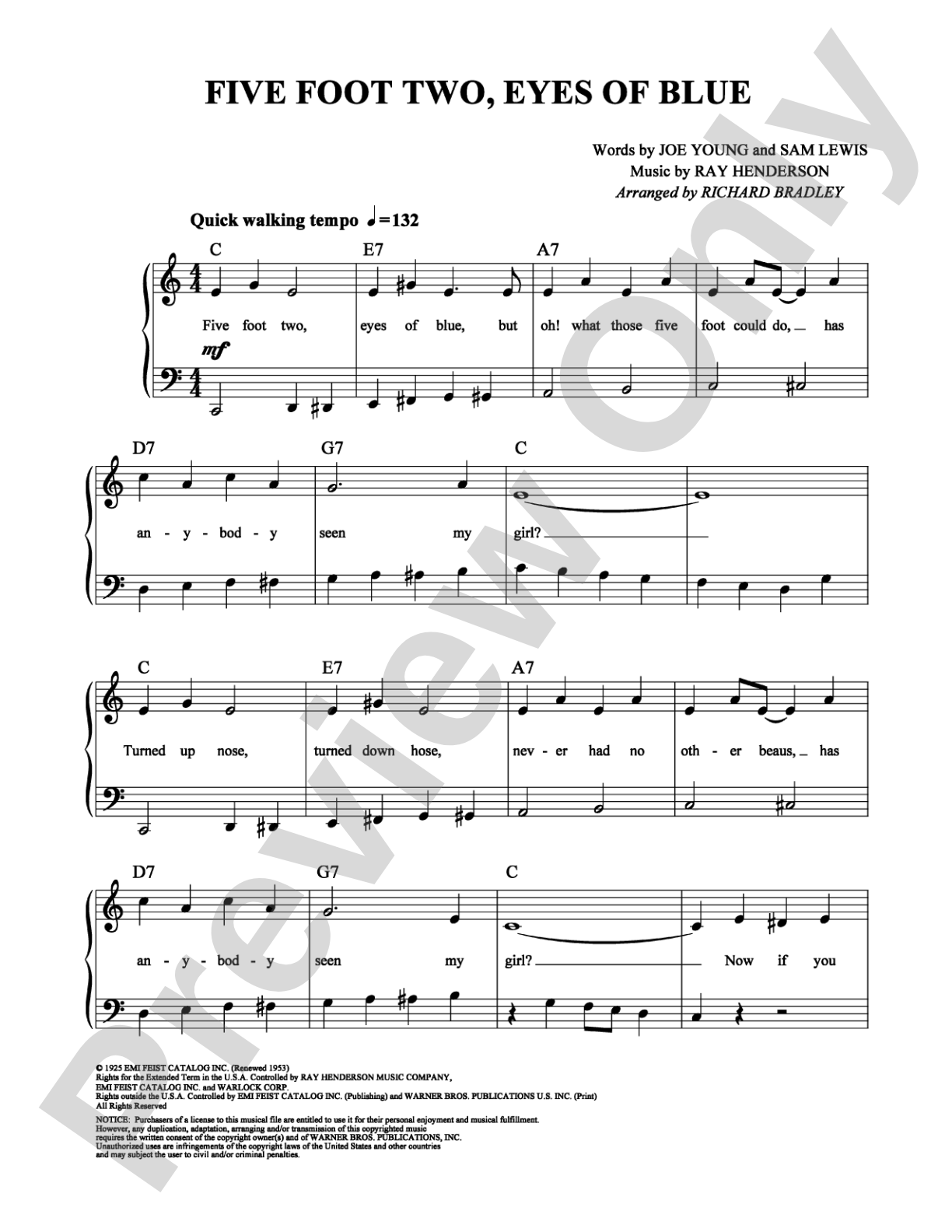
Five Foot Two, Eyes of Blue: Easy Piano Digital Sheet Music

Five Foot Two, Eyes of Blue: Easy Piano Digital Sheet Music

Ray Henderson

Item: 00-PS-0000629

Digital Download
$3.99
Description

Five Foot Two, Eyes of Blue: Easy Piano Digital Sheet Music isn't in MakeMusic Cloud just yet...but it could be. Let us know you'd like to see it, and you'll help shape what comes next. In the meantime, start a free trial and dive into thousands of interactive titles your students can play along with today.

Sample Audio
No sample audio found.
Sample Video
Additional Details
SKU: 00-PS-0000629

More about this title

Why we love this

This 1920s standard works brilliantly in easy piano arrangements for students who want to play recognizable popular music without wrestling with complex harmony or runs. The melody sits naturally under young hands, and the nostalgic charm of the tune itself keeps practice sessions from feeling like work. Programming it in a recital or informal performance taps into that sweet spot where students feel genuinely proud of what they've accomplished.

What to expect

Warm, wistful, and unmistakably of another era. The tune has an unhurried elegance that draws from jazz-age sensibilities, with a melody that unfolds like someone singing directly to you across a crowded room.

Who it's for

Early intermediate piano students looking for accessible repertoire with historical flavor and immediate appeal. This arrangement suits both private lesson contexts and young performers preparing for recitals or informal performances.

How to get the most out of it

  • Shape the melody with gentle dynamics rather than playing every note at the same level; this tune rewards subtle phrasing that lets the vocal quality of the line come through.
  • Keep the tempo steady and conversational, resisting the urge to rush; songs from this era benefit from a relaxed, confident pace.
  • Use the pedal sparingly and change it with harmonic shifts rather than holding it through entire phrases, which keeps the accompaniment from muddying the melody.
  • Listen to classic vocal recordings of the tune before you practice, so you internalize the way the melody breathes and where phrases naturally rest.

How to use it

Feature this in a recital segment celebrating American popular song or vintage standards, pairing it with other pieces from the same era. It also works as a bridge piece between classical repertoire and contemporary music, helping younger students see continuity across different musical worlds.

Skills your students will build

  • Phrasing and musical interpretation in a populist idiom
  • Steady tempo control without metronomic rigidity
  • Pedal technique and harmonic awareness
  • Connecting melody to its vocal origins
  • Reading and performing in the style conventions of early 20th-century American song

You May Also Like