
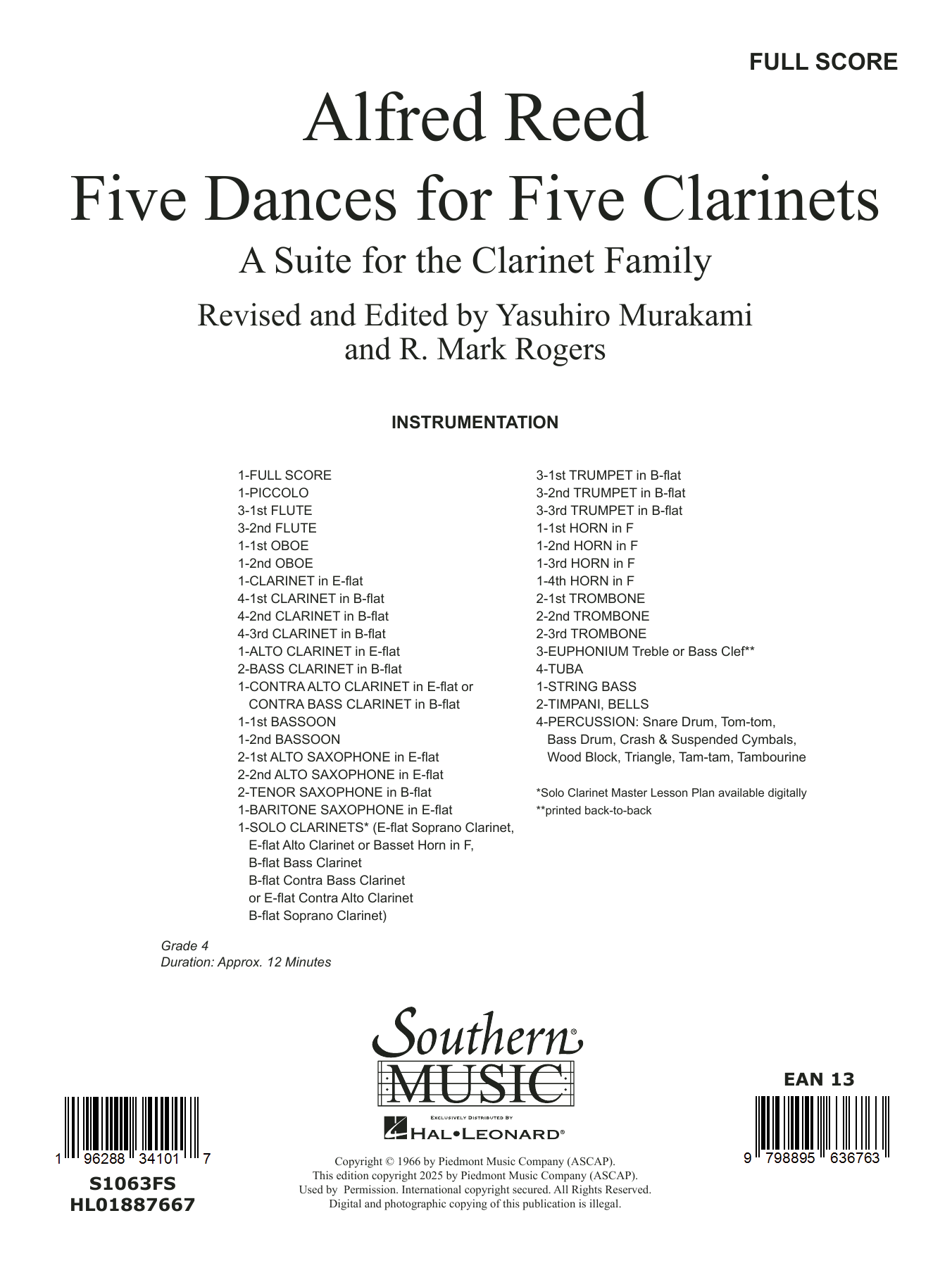

Five Dances for Five Clarinets: Concert Band Conductor Score & Parts
By Alfred Reed / Edited by R. Mark Rogers / Edited by Yasuhiro Murakami
Grade: 4
Item: 35-PK01727609
$140.00
Pickup currently not available
Buy Extra Parts (Digital PDF Download)
Parts Added to Cart!
Description
Alfred Reed composed Five Dances for Five Clarinets in 1956 at the request of the LeBlanc instrument company to introduce the performance capabilities and tone of each instrument of the clarinet family. The five movements are based on musical styles from around the world: 1. Hoe-Down (E-flat Soprano Clarinet), 2. Sarabande (E-flat Alto Clarinet or Basset Horn in F), 3. Guaracha (Bass Clarinet), 4. Afro (E-flat Contra Alto or B-flat Contra Bass Clarinet), and 5. Hora (B-flat Clarinet). Previously, the score and parts for Five Dances for Five Clarinets were only available on a rental basis, and Reed had not included the composition in his own list of published works. Yasuhiro Murakami, author of an annotated list of Reeds works, created this edition based on Reeds manuscript. This work may be performed by one soloist on five different clarinets, by five separate soloists, or a smaller number of the movements may be played by one or by multiple soloists. Each of the Five Dances is also published with pian


Five Dances for Five Clarinets: Concert Band Conductor Score & Parts isn't in MakeMusic Cloud just yet...but it could be. Let us know you'd like to see it, and you'll help shape what comes next. In the meantime, start a free trial and dive into thousands of interactive titles your students can play along with today.
Request This Title
Tell us you want it.
Start Your Free Trial
Explore everything that's ready to play right now.
Sample Audio
No sample audio found.
Sample Video
No sample videos found.
Additional Details
Publisher:
Hal Leonard
SKU:
35-PK01727609
More about this title
About the Composer: Alfred Reed
Alfred Reed (1921–2005) shaped the concert band repertoire with prolific compositions that demanded musical sophistication from student ensembles. His output ranged from technically demanding original works to accessible arrangements, all unified by clear orchestration and rewarding musical lines that challenged performers without sacrificing artistry.
Reed's commissions from instrument manufacturers like LeBlanc reveal his deep understanding of instrumental design and pedagogy. Works like Five Dances for Five Clarinets served practical purposes while remaining musically substantive, a balance that defined much of his career as both composer and educator.
Why we love this
Reed's five miniatures function as both a technical showpiece and a practical solution for clarinet sections that need moments in the spotlight. Each movement spotlights a different member of the clarinet family with music that sounds genuinely idiomatic to each instrument; the writing never feels like an exercise, even as it introduces tonal and range qualities that students and soloists often overlook.
What to expect
Five contrasting windows into global musical idioms, each rendered in Reed's clean, singable voice. The Sarabande carries baroque dignity; the Guaracha pulses with Latin syncopation; the Hora spins with folk exuberance. Each dance announces itself immediately and leaves a clear impression.
Who it's for
Conductors seeking a substantial yet concise clarinet feature that works for a full section or a single advanced performer. Student clarinetists benefit from the stylistic variety and the opportunity to perform on less familiar family members, while audiences encounter music that educates and entertains without theatrical pretense.
How to get the most out of it
- Decide early whether you'll feature five soloists or a single clarinetist rotating instruments. Five soloists requires careful balance work between parts; a single performer shifts the focus to technical preparation and embouchure transitions between clarinets.
- Record a preliminary rehearsal with your selected soloists or soloist to identify which movements need the most work. The Hoe-Down and Guaracha tend to expose intonation issues in the outer clarinet ranges.
- Consider the concert space when balancing the five parts. The higher instruments (E-flat soprano and B-flat clarinet) cut through; the bass and contra-bass need forward placement and clear articulation to avoid muddiness.
- Extract individual movement parts if you plan to program only some of the five dances. You need not perform all movements in sequence if your concert architecture calls for spreading them out or pairing one with different repertoire.
How to use it
Build an entire first half around clarinet repertoire by pairing these five miniatures with a larger concerto or multi-movement work featuring the same family of instruments. Alternatively, extract the Hora as a closer for a family concert that also includes younger student ensembles, since its energy and accessibility appeal across age groups.
Skills your students will build
- Switching between instruments with stable intonation and consistent tone quality
- Idiomatic articulation across different clarinet ranges and tessituras
- Stylistic interpretation (baroque, folk, Latin, and African musical idioms)
- Balance and blend when five melodic lines compete for attention
- Quick embouchure adjustment and register transitions