
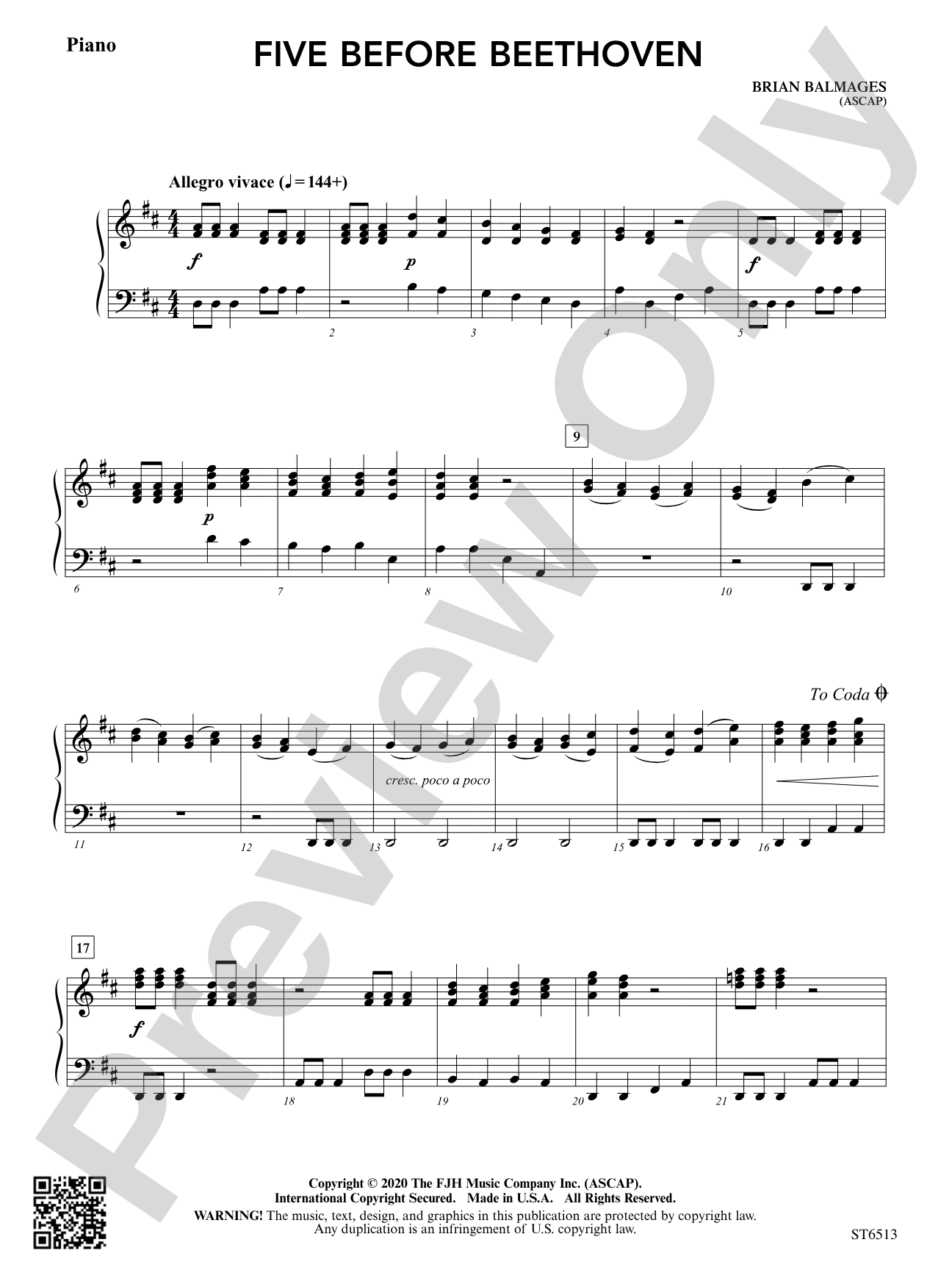

Five Before Beethoven: Piano
By Brian Balmages
Grade: 1.5;2
Item: 98-PC-DST6513_K
$7.00
Pickup currently not available
Description
A great complement to the composer's popular work A Beethoven Lullaby, this original piece pays homage to Beethoven's fifth symphony, immersing students in the style of the first movement without feeling like they are playing a watered-down arrangement. Conductors will surely notice the many nods (both subtle and not so subtle) to Beethoven's masterpiece while also exploring original themes.


Five Before Beethoven: Piano isn't in MakeMusic Cloud just yet...but it could be. Let us know you'd like to see it, and you'll help shape what comes next. In the meantime, start a free trial and dive into thousands of interactive titles your students can play along with today.
Request This Title
Tell us you want it.
Start Your Free Trial
Explore everything that's ready to play right now.
Sample Audio
1
Audio File
--:--
0:00
0:00
Sample Video
Additional Details
Series:
FJH Beginning Strings
Publisher:
The FJH Music Company, Inc.
SKU:
98-PC-DST6513_K
More about this title
About the Composer: Brian Balmages

Brian Balmages has established himself as a composer and conductor with a commanding presence across orchestral, band, and chamber repertoire. His works have been performed by ensembles ranging from professional symphony orchestras to school groups at venues including Carnegie Hall, the Kennedy Center, and Sydney Opera House. He received the A. Austin Harding Award from the American School Band Directors Association and won the 2020 NBA William D. Revelli Composition Contest for Love and Light. Balmages holds membership in the American Bandmasters Association and was honored with the inaugural James Madison University Distinguished Alumni Award from the School of Visual and Performing Arts.
As a conductor, Balmages maintains an active schedule with all-state ensembles, university groups, and professional orchestras worldwide. His guest conducting appearances span major conferences including the Midwest Clinic, Western International Band Clinic, and numerous state ASTA conferences, as well as international venues such as Teatro dell'Aquila in Italy. His music has been performed at significant national events, including the 2013 Presidential Inaugural Prayer Service attended by President Obama and Vice President Biden. He currently serves as Director of MakeMusic Publications and Digital Education for Alfred and MakeMusic.
Why we love this
Balmages captures the distinctive character of Beethoven's Fifth without resorting to literal arrangement, giving students the thrill of recognizing compositional style while playing entirely fresh material. The piece balances accessibility at Grade 1.5-2 with the kind of musical substance that keeps student musicians engaged, making it rewarding for both rehearsal and performance. Contest and festival programs benefit enormously from this approach: it builds repertoire depth without asking students to play dumbed-down versions of canonical works.
What to expect
The piece carries forward the rhythmic energy and dramatic intent of Beethoven's Fifth while charting its own melodic and harmonic path. Students will recognize the fingerprints of a classical master throughout, yet the experience feels fresh, as though they are discovering rather than replicating. The work builds momentum with purposeful orchestration that gives every section meaningful material to perform.
Who it's for
String orchestras at the Grade 1.5-2 level looking for a substantive piece that feels contemporary yet musically grounded. Teachers preparing groups for contests and festivals will find this particularly valuable, as it offers genuine musical content while remaining accessible to developing ensembles.
How to get the most out of it
- Shape the opening motto with clarity and purpose; even though it echoes a famous gesture, students should understand it as the foundation of this original composition, not as a reference to imitate.
- Pay close attention to balance between sections. At this level, string orchestras often favor stronger players on the melody line, so redistribute parts strategically to ensure harmonic voices remain audible.
- Use the homophonic passages to develop rhythmic precision across the entire ensemble. Lock tempo and articulation here; it prepares the orchestra for the more complex textures that follow.
- Rehearse the transitions between original themes and Beethovens allusions separately, then blend them seamlessly so the piece feels cohesive rather than fragmented.
How to use it
This works beautifully as a centerpiece for a concert exploring compositional homage or influence, paired alongside other original works that reference classical sources. Consider programming it where you need a piece that demonstrates musical maturity and stylistic awareness without overwhelming a Grade 1.5-2 ensemble. It is also an excellent choice for competitions where judges value originality combined with historical awareness.
Skills your students will build
- Recognizing compositional style and motivic development
- Balancing melody and harmonic accompaniment in string texture
- Interpreting classical style markers at the early intermediate level
- Ensemble rhythmic precision across multiple sections
- Maintaining musical momentum through thematic transitions