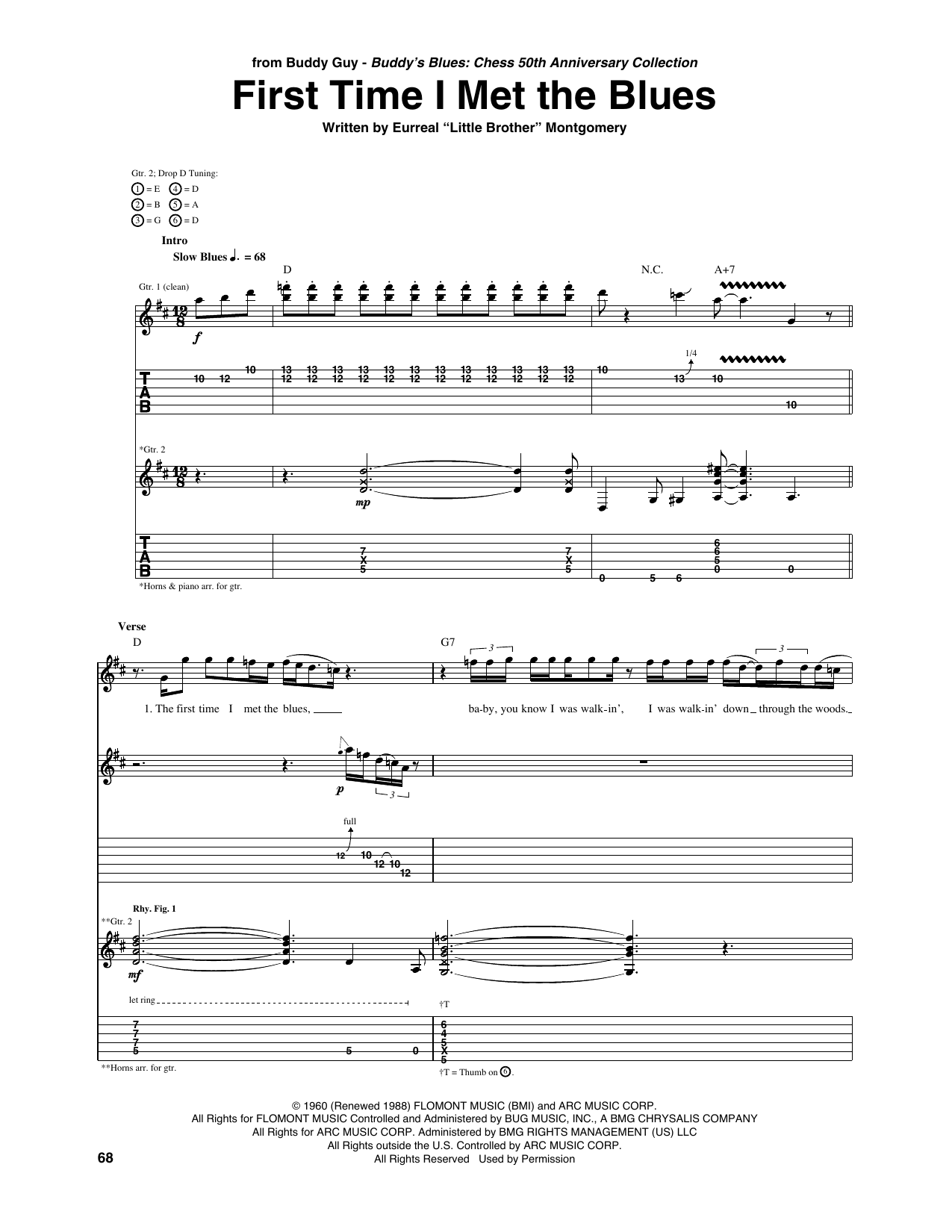
Buddy Guy stands as one of the most influential electric blues guitarists in music history. Born George Guy in Louisiana in 1930, he developed a revolutionary approach to the instrument that bridged traditional Delta blues with modern amplification, earning recognition from both peers and rock musicians across generations.
Why we love this
Buddy Guy's phrasing and tone work translate beautifully to tab, giving students a direct window into how blues vocabulary actually gets voiced on the instrument. The narrative arc of the song rewards careful study of his signature bending and vibrato techniques, making it equally valuable for technique development and stylistic immersion.
What to expect
The song carries the weight of lived experience through every bend and phrase. There's a conversational quality to Buddy's playing that feels both raw and refined, the kind of blues that doesn't rush and trusts silence as much as sound.
Who it's for
Intermediate and advanced guitarists ready to study authentic blues vocabulary from a master player. Students working toward a deeper understanding of electric blues style and tone will find real value in transcribing and internalizing Buddy's approach to phrasing.
How to get the most out of it
Listen closely to the original recording and isolate Buddy's vibrato patterns; they're not uniform, and that intentional variation is what gives the phrase its character.
Work the dynamics as deliberately as you work the notes. The spaces between phrases matter as much as the phrases themselves in blues playing.
Approach the tab as a starting point rather than a destination. Once the basic shapes are under your fingers, experiment with where you can add or subtract sustain and vibrato to make it your own.
Pay particular attention to any bends notated in the tab; blues bending is about landing the note with intention and control, not just sliding into pitch.
How to use it
Pair this with a focused blues studies unit where students listen, transcribe, and learn from primary source recordings. It works well as a capstone project for guitarists who've built foundational technique and are ready to engage with authentic stylistic models.
Skills your students will build
Blues phrasing and call-and-response patterns
Controlled bending and intonation in non-standard contexts
Vibrato technique and variation
Interpreting and voicing chords beyond basic shapes
Understanding dynamics as an expressive tool in solo playing
Listening and transcription skills applied to a professional recording
You May Also Like
Scan to Complete Your Purchase
Use your phone's camera to scan the code below
You'll log in on your phone and the order will be added to your account