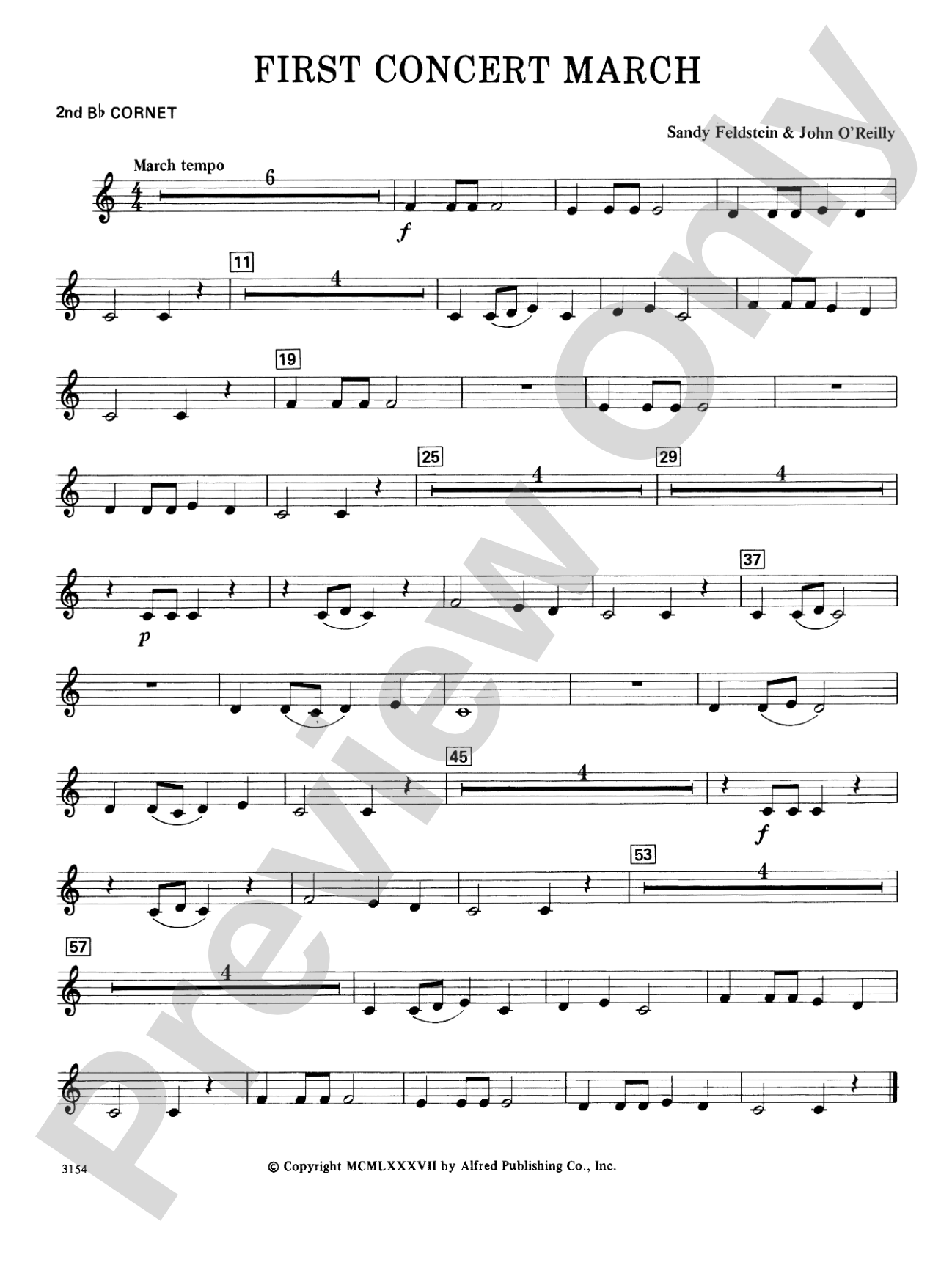
First Concert March: 2nd B-flat Cornet Sheet Music Preview

First Concert March: 2nd B-flat Cornet

By Sandy Feldstein and John O'Reilly

Grade: 1 (Very Easy)

Item: 00-PC-0001728_CO2

Digital Download
$3.00
Description
As the title implies, this march is perfect for your first concert. Using only 6 notes (concert B-flat and G), this original piece will make the youngest band sound like professionals. Easy to put together and fun to play---open or close your first concert with this one. (Grade 1---Correlates with Book 1, Unit 6)

Don't just read it, hear it, play along with it, and watch your students grow with it. In MakeMusic Cloud, First Concert March: 2nd B-flat Cornet comes alive with professional accompaniment, adjustable tempo, and built-in practice tools that turn solo practice into real progress.

Sample Audio
No sample audio found.
Sample Video
Additional Details
Series: Basic Band Series
Publisher: Alfred Music
Page Count: 53
SKU: 00-PC-0001728_CO2

More about this title

About the Composer: Sandy Feldstein

Sandy Feldstein is a prolific composer and arranger whose work has shaped beginning band curricula for decades. His compositions are built on the principle that young musicians deserve music that sounds accomplished without requiring advanced technique, making him a trusted voice in music education publishing.

Why we love this

This march proves that constraint breeds clarity. By limiting the pitch palette to just two notes, Feldstein forces strong melodic writing and rhythmic interest to do the heavy lifting, giving your newest band members instant success and genuine musicianship. The result sounds polished enough to anchor a concert program without weeks of rehearsal.

What to expect

Bright and assured, like a group walking across a stage for the first time and discovering they belong there. The march has genuine forward momentum and personality despite its simplicity, never feeling like a training exercise.

Who it's for

This is essential repertoire for Grade 1 bands preparing their first public performance. It works equally well for conductors launching a beginning band program or for experienced directors seeking a confidence-building opener that lets students hear themselves succeed.

How to get the most out of it

  • Lock in the march tempo early and keep it steady throughout. Young conductors often rush the energy; a metronome in rehearsal prevents this.
  • Balance the melody across all sections playing the primary line. Since only two pitches exist, intonation and blend become the focus of listening.
  • Shape the dynamic arc clearly. With limited harmonic movement, articulation and volume changes create forward motion and phrase structure.
  • Give attention to percussion entrances and rhythmic precision. The rhythm section defines the march character for an ensemble at this level.

How to use it

Open or close your first concert with this piece. Its accessible charm and professional sound make it an ideal program anchor that impresses parents and audiences while keeping rehearsal time realistic for a developing ensemble. You might also use it as a festival entry or light concert-closer after programming more challenging repertoire.

Skills your students will build

  • Reading and executing concert march form and structure
  • Maintaining steady tempo in ensemble context
  • Blend and balance across sections with limited pitch material
  • Rhythmic accuracy and articulation clarity
  • Confidence performing in public settings

You May Also Like