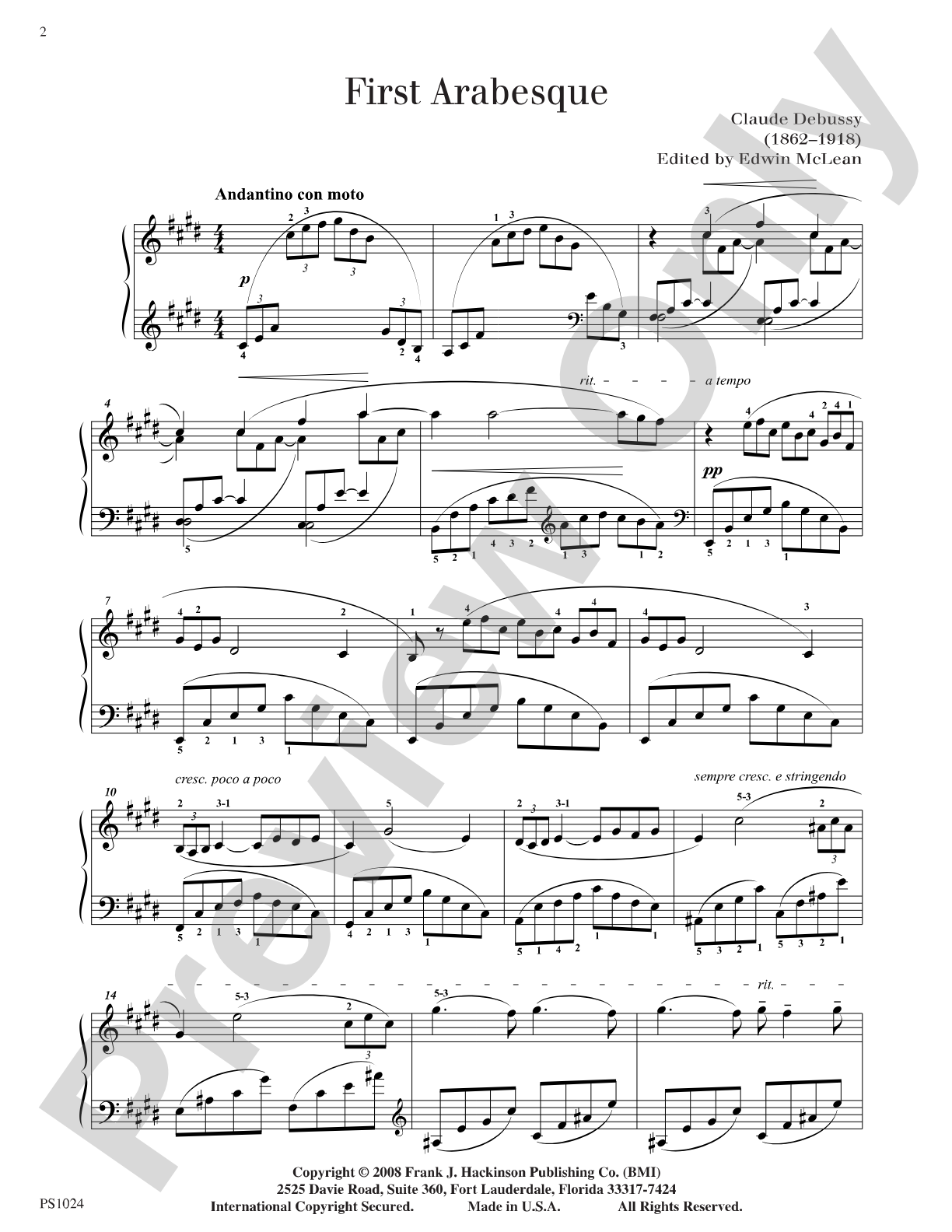
First Arabesque Sheet Music Preview

First Arabesque: Piano

By Claude Debussy / ed. Edwin McLean

Item: 98-DPS1024

Digital Download
$3.50
Description
This light and gentle classic often described as depicting a "pleasant walk in the park on a sunny spring day" is presented here newly engraved and edited by Edwin McLean. As part of Debussy's Deux Arabesques, this famous and well-liked piece is an essential part of every pianist's repertoire.

First Arabesque: Piano isn't in MakeMusic Cloud just yet...but it could be. Let us know you'd like to see it, and you'll help shape what comes next. In the meantime, start a free trial and dive into thousands of interactive titles your students can play along with today.

Sample Audio
No sample audio found.
Sample Video
Additional Details
Series: The FJH Piano Solo Series
Publisher: The FJH Music Company, Inc.
SKU: 98-DPS1024

More about this title

About the Composer: Claude Debussy

Claude Debussy (1862-1918) fundamentally reshaped how composers thought about harmony, timbre, and form. Rather than following the strict structures of his predecessors, he treated the piano as an instrument of color and atmosphere, using unconventional chord progressions and innovative pedal techniques to create impressionistic soundscapes. His music prioritizes sensory experience over technical display, making it both deeply rewarding and genuinely challenging for pianists who seek to understand his compositional voice.

Debussy's piano works remain central to music education because they demand that students engage with sound itself, not just notes on a page. His pieces have shaped how teachers introduce concepts like modal harmony, impressionistic texture, and the expressive possibilities of the modern piano.

Why we love this

First Arabesque sits at that perfect intersection of accessibility and sophistication. Students encounter genuine Debussy impressionism without the technical barriers of his more demanding works, and the freshly engraved Edwin McLean edition makes the score clear and inviting. Programming this piece signals that your students are engaging with real twentieth-century music history, not simplified approximations.

What to expect

Sunlight filtering through spring leaves, unhurried and peaceful. The piece unfolds with a dreamy quality, its gently rolling accompanimental patterns suggesting gentle motion while the melody floats above with an almost conversational ease. There's no urgency here, only the pleasure of sensory experience unfolding moment by moment.

Who it's for

This edition serves intermediate to early-advanced pianists ready to move beyond Romantic-era conventions into twentieth-century harmonic thinking. It works equally well as a recital piece for a developing student or as a teaching tool to introduce impressionism's sound world.

How to get the most out of it

  • Treat the pedal as a harmonic instrument rather than a sustain pedal. Change it deliberately with each harmonic shift to maintain clarity within the impressionistic texture.
  • Shape phrases through subtle dynamic contours rather than dramatic swells. Debussy's marking of "light and gentle" asks for restraint and nuance, not Romantic excess.
  • Let the right-hand melody breathe above the accompaniment. The "pleasant walk" quality depends on the listener perceiving two distinct musical layers, not a single blended sonority.
  • Explore the middle sections with slightly more weight and presence while maintaining the overall gentle character. The piece moves through emotional terrain, not just one static mood.

How to use it

Pair this with other early twentieth-century piano works to build a concert segment exploring new harmonic possibilities. It also serves as an excellent bridge piece for students transitioning from Romantic repertoire to modern music, showing them that accessibility and innovation can coexist.

Skills your students will build

  • Impressionistic harmony and voice leading
  • Pedal technique and harmonic clarity
  • Legato touch with transparent texture
  • Phrasing without traditional harmonic structures
  • Color and atmosphere as compositional elements

You May Also Like