
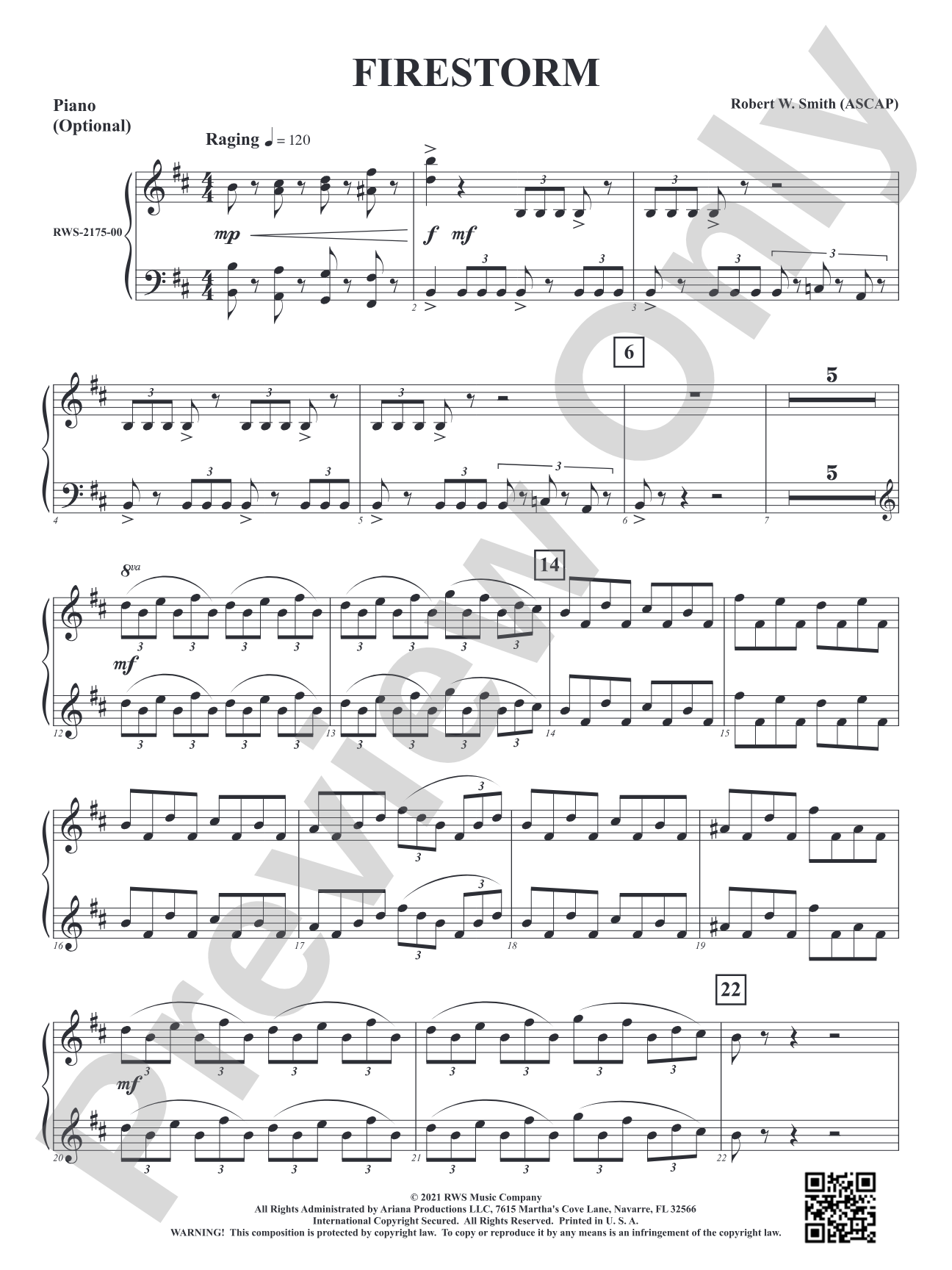

Firestorm: Optional Piano
By Robert W. Smith
Grade: 3
Item: 98-PC-RWS2175_OK
$5.99
Pickup currently not available
Description
A firestorm is not just a fire. It is a fire that has built to such an intensity that it contains its own storm-force wind system. "Firestorm" for string orchestra builds quickly and decisively into a firestorm of musical lines interacting with determination and unyielding energy. Appropriate for concert or festival performance, your orchestra will enjoy practicing and performing this captivating composition for years to come. A wonderful choice to connect on multiple levels with the developing musicians in your orchestra!
Original Item#: RWS-2175-00


Original Item#: RWS-2175-00
Firestorm: Optional Piano isn't in MakeMusic Cloud just yet...but it could be. Let us know you'd like to see it, and you'll help shape what comes next. In the meantime, start a free trial and dive into thousands of interactive titles your students can play along with today.
Request This Title
Tell us you want it.
Start Your Free Trial
Explore everything that's ready to play right now.
Sample Audio
1
Audio File
--:--
0:00
0:00
Sample Video
No sample videos found.
Additional Details
Series:
RWS - Concert Strings
Publisher:
RWS Music Company
SKU:
98-PC-RWS2175_OK
More about this title
About the Composer: Robert W. Smith

Robert W. Smith stands among America's most prolific composers of orchestral and concert band repertoire, with over 400 published works performed internationally across North America, Europe, Australia, and Asia. He holds degrees from Troy State University (Alabama) and the University of Miami, and has established himself as both a composer and conductor, leading clinics and performances throughout the United States, Canada, Japan, Australia, Italy, Austria, and the United Kingdom.
Smith's orchestral works span from large-scale symphonies (The Divine Comedy and The Odyssey) to core repertoire for developing ensembles like The Tempest. His compositions have reached audiences far beyond the concert hall, appearing in Olympic broadcasts, national television coverage, and ceremonial performances ranging from presidential welcomes to Opening Day at Dodger Stadium.
Why we love this
Firestorm captures exactly what you need at Grade 3: clear compositional trajectory, genuine musical substance, and the kind of kinetic energy that keeps student musicians engaged through rehearsal and performance. Smith builds from restraint to intensity with absolute clarity, giving every section meaningful material and a tangible sense of musical progress. It's the rare piece that sounds substantial without requiring advanced technique.
What to expect
Firestorm begins with focus and purpose, then accelerates into a whirlwind of interconnected string lines driven by unyielding forward momentum. The piece captures exactly what its title promises: not chaos, but a controlled, intensifying energy where every musical element feeds the gathering force.
Who it's for
Intermediate string orchestras seeking a concert or festival piece that challenges without overwhelming. Developing players benefit from clear musical structure and the satisfaction of building something genuinely exciting, while directors appreciate writing that teaches ensemble cohesion through deliberate compositional design.
How to get the most out of it
- Track the dynamic arc carefully in early rehearsals. Smith marks the trajectory explicitly, so isolate the moments where intensity shifts and have players identify their role in that transition.
- Balance the interacting melodic lines in the climax by rotating which section leads during sectional rehearsals. This reveals how the composition interlocks and builds excitement for performance.
- Maintain rhythmic precision through the faster passages; clarity here prevents the piece from feeling unfocused as intensity builds.
- Shape the opening phrases with intention. The opening may seem simple, but it establishes the foundation for everything that follows.
How to use it
Program this as a powerful centerpiece in a concert that explores building dramatic intensity, or lead a festival round with it. Its clear arc and manageable technical demands make it an ideal anchor piece that allows programming flexibility around it.
Skills your students will build
- Building and sustaining crescendos across multiple measures
- Balancing independent melodic lines while maintaining ensemble cohesion
- Clarity and precision in faster rhythmic passages
- Responding to dynamic markings and shaping musical phrasing intentionally
- Understanding how compositional structure creates musical drama