
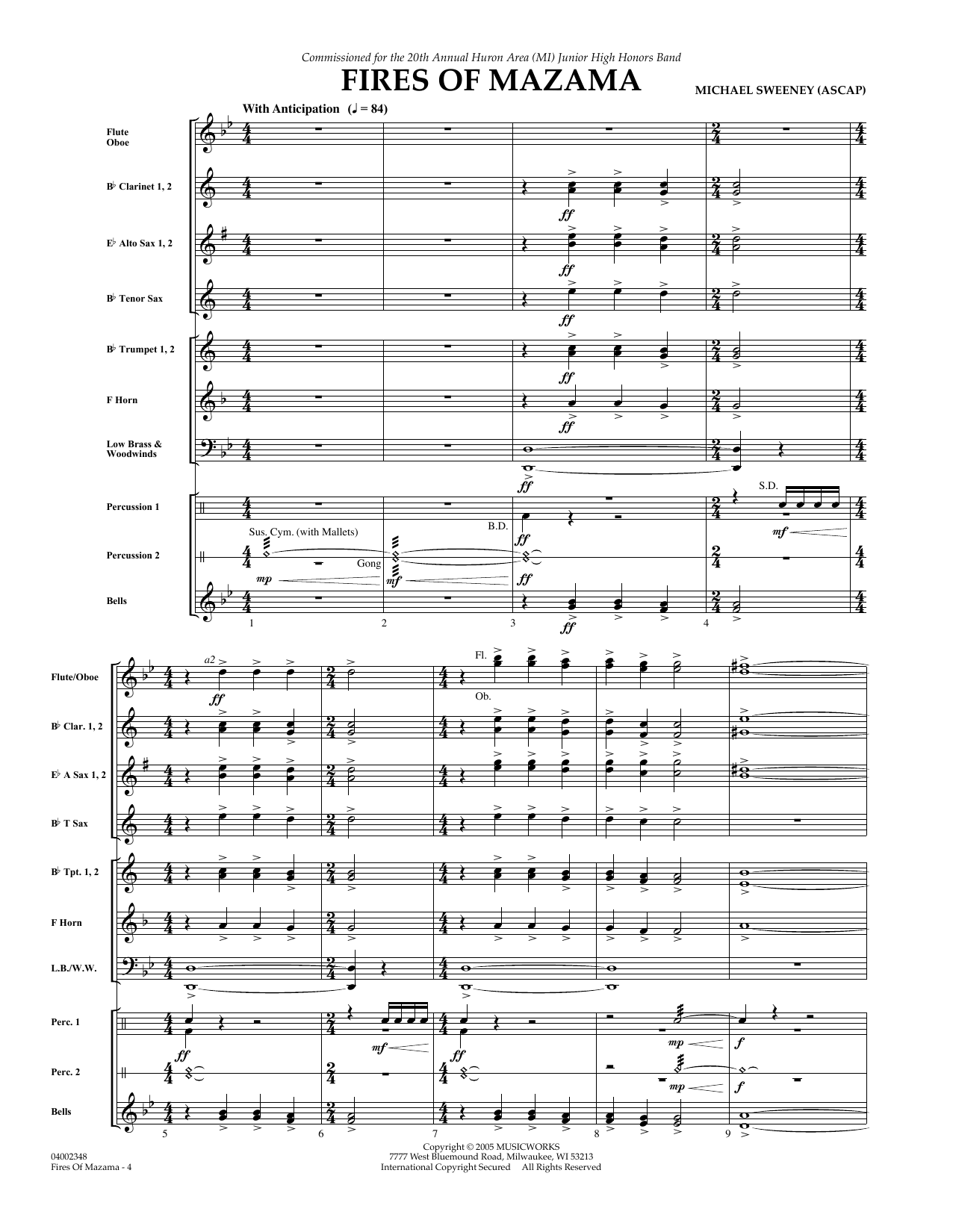

Fires of Mazama: Concert Band Conductor Score & Parts
By Michael Sweeney
Grade: 1.5
Item: 35-PK00320759
$55.00
Pickup currently not available
Buy Extra Parts (Digital PDF Download)
| Product | Price | Quantity |
|---|---|---|
| Fires of Mazama - Full Score | $7.50 | |
| Fires of Mazama - Flute | $6.00 | |
| Fires of Mazama - Oboe | $6.00 | |
| Fires of Mazama - Bb Clarinet 1 | $6.00 | |
| Fires of Mazama - Bb Clarinet 2 | $6.00 | |
| Fires of Mazama - Bb Bass Clarinet | $6.00 | |
| Fires of Mazama - Eb Alto Saxophone 1 | $6.00 | |
| Fires of Mazama - Eb Alto Saxophone 2 | $6.00 | |
| Fires of Mazama - Bb Tenor Saxophone | $6.00 | |
| Fires of Mazama - Eb Baritone Saxophone | $6.00 | |
| Fires of Mazama - Bb Trumpet 1 | $6.00 | |
| Fires of Mazama - Bb Trumpet 2 | $6.00 | |
| Fires of Mazama - F Horn | $6.00 | |
| Fires of Mazama - Trombone | $6.00 | |
| Fires of Mazama - Baritone T.C. | $6.00 | |
| Fires of Mazama - Tuba | $6.00 | |
| Fires of Mazama - Percussion 1 | $6.00 | |
| Fires of Mazama - Percussion 2 | $6.00 | |
| Fires of Mazama - Bells | $6.00 |
Parts Added to Cart!
Description
Aleatoric music for grade 1? Why not?! Through carefully controlled parameters, your beginning players can actually create their own erupting volcano effect! Mazama was the imposing mountain peak in southwest Oregon that erupted 7000+ years ago and became the serene and beautiful present day Crater Lake. Fires of Mazama opens with bold sounds and powerful melodies before the "eruption" changes everything. Afterwards, a calm chorale leads to the exciting final strains in this ingenious and impressive piece for beginners!
Dur: 3:20


Fires of Mazama: Concert Band Conductor Score & Parts isn't in MakeMusic Cloud just yet...but it could be. Let us know you'd like to see it, and you'll help shape what comes next. In the meantime, start a free trial and dive into thousands of interactive titles your students can play along with today.
Request This Title
Tell us you want it.
Start Your Free Trial
Explore everything that's ready to play right now.
Sample Audio
No sample audio found.
Sample Video
No sample videos found.
Additional Details
Publisher:
Hal Leonard
SKU:
35-PK00320759
More about this title
About the Composer: Michael Sweeney
Michael Sweeney has built a distinguished career composing and arranging for concert and marching bands, with a particular gift for making sophisticated musical concepts accessible to young players. His works consistently balance musical substance with pedagogical clarity, allowing beginning and intermediate ensembles to sound impressive while learning fundamental ensemble skills.
Why we love this
Sweeney accomplishes something genuinely rare here: he introduces aleatoric techniques to grade 1 players without sacrificing coherence or impact. The "eruption" section gives your beginning band agency in shaping the music while remaining firmly under your control, and the payoff is visceral. Your students will understand that contemporary compositional techniques aren't reserved for advanced ensembles.
What to expect
The piece begins with striking, purposeful gestures that immediately establish presence. When the eruption arrives, your band becomes an instrument creating controlled chaos, then finds itself in a reflective space before building toward a triumphant conclusion. It's theater and music education fused together.
Who it's for
This works perfectly for any grade 1 or early grade 2 concert band looking to program something memorable that also teaches real musical concepts. It's especially valuable for directors who want to show young players that interesting modern music lives outside traditional notation and structure.
How to get the most out of it
- Establish clear visual cues for the aleatoric sections before rehearsal. Decide whether you'll use a conducting pattern, a hand signal, or a spoken cue to shift between the controlled parameters, then practice those transitions until they feel natural.
- Balance the opening bold sounds and melodies so they feel commanding rather than forced. Let the melodic lines breathe; this is your foundation before the chaos of the eruption.
- The calm chorale that follows the eruption works best when players have genuinely settled. Build contrast by taking enough time here; let the ensemble hear how quiet and centered they can sound.
- Lock the final exciting strains with a steady conductor pulse. After the freedom of the aleatoric section, your players will be relieved to return to a clear rhythmic framework.
How to use it
Open a concert or place this early in your program as a conversation starter about how composers think differently about sound. The geological narrative makes for excellent program notes, and the piece works equally well on a traditional concert or as part of a thematic program exploring natural phenomena or Oregon history.
Skills your students will build
- Ensemble balance and blend across a full band
- Responding to conductor cues in real time
- Creating controlled variations of dynamic and tone quality
- Understanding aleatoric composition and graphic notation concepts
- Sustaining ensemble focus during both structured and free sections