
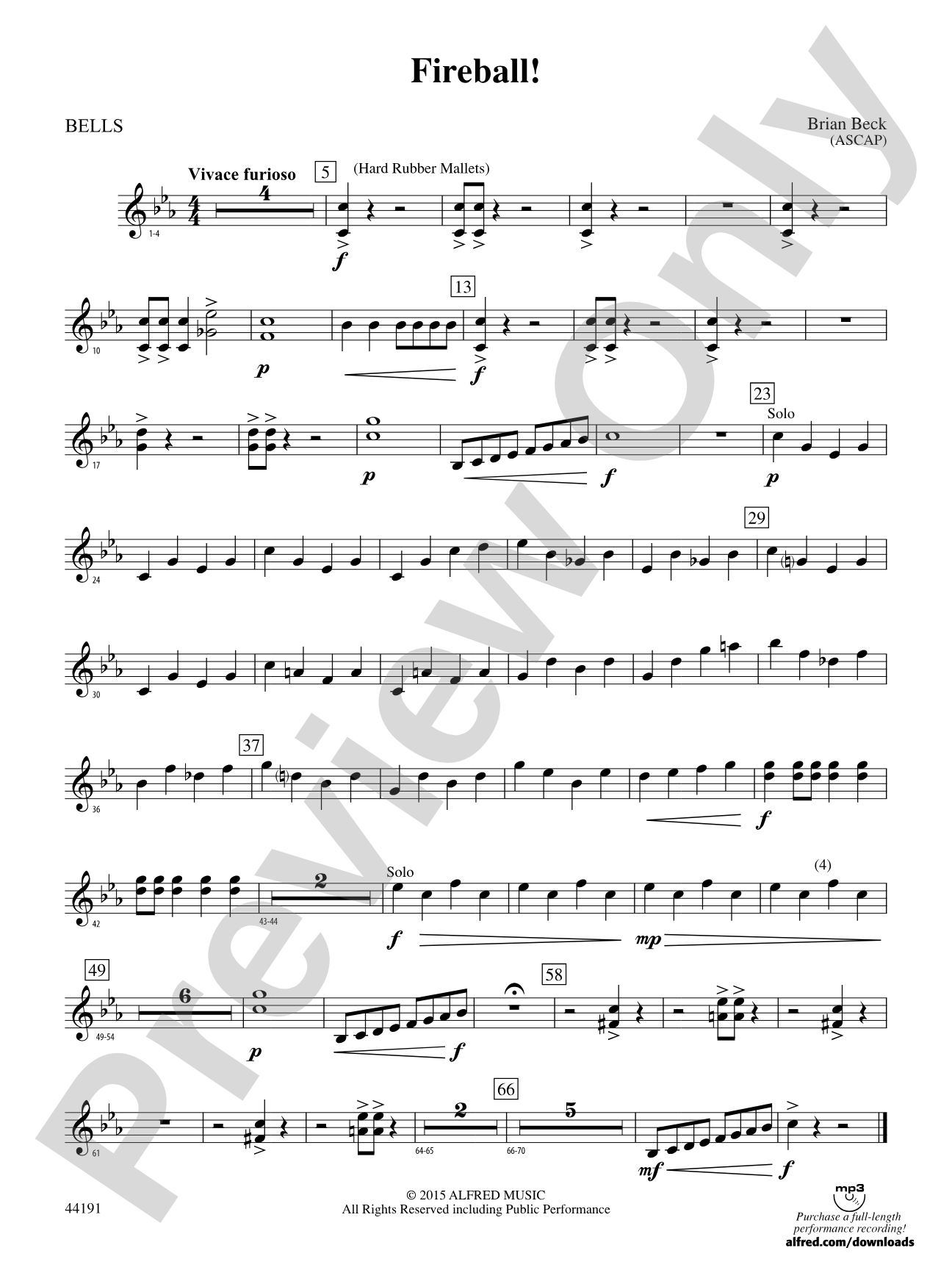

Fireball!: Bells
By Brian Beck
Grade: 2 (Medium Easy)
Item: 00-PC-0017041_B
$3.00
Pickup currently not available
Description
From the very first measure to the last note, "Fireball" is an intense experience for developing bands. This piece will challenge players musically, rhythmically, and stylistically. With accidentals, shifting chords, and lots of effects, "Fireball" will certainly keep musicians and audience members on the edge of their seat. (2:00) This title is available in MakeMusic Cloud.


Don't just read it, hear it, play along with it, and watch your students grow with it. In MakeMusic Cloud, Fireball!: Bells comes alive with professional accompaniment, adjustable tempo, and built-in practice tools that turn solo practice into real progress.
Open in the Player
Jump straight in and assign it today.
Start Your Free Trial
Open this title and explore the full library in minutes.
Sample Audio
1
Audio File
--:--
0:00
0:00
Sample Video
Additional Details
Series:
Young Symphonic
Publisher:
Alfred Music
Page Count:
142
SKU:
00-PC-0017041_B
More about this title
About the Composer: Brian Beck

Brian Beck composes and arranges for instrumental and vocal ensembles while maintaining an active conducting and teaching career. His works have appeared at TMEA Honor Band concerts, UIL state competitions, and major clinics across the Midwest and Western regions, earning recognition including "Reviewer's Choice" from The Instrumentalist and "Best New Concert Band Music" from Tom Lee Music. Several of his pieces are featured in the GIA Publications series Teaching Music Through Performance In Band.
Beck's teaching experience includes directing bands at both Faubion Middle School in McKinney, Texas, and Byrd Middle School in Duncanville, where he earned a "Teacher of the Year" nomination. His ensembles have consistently earned Superior ratings at UIL contests and have competed as finalists in the TMEA State Honor Band competition. He holds degrees in music education from Texas A&M University-Commerce and the University of Houston, and was himself an all-state musician in the Duncanville Band Program.
Why we love this
Beck writes with a clear sense of what a Grade 2 band can handle musically without sacrificing genuine excitement. The harmonic complexity and rhythmic precision demands respect from your players, but the two-minute duration and energetic pacing keep the challenge focused and rewarding. This is the kind of piece that shows developing musicians they're capable of more than they think.
What to expect
Urgent and driving from the start. The accumulation of accidentals and shifting harmonies creates forward momentum and slight instability that keeps listeners engaged, while the rhythmic precision demands focused, intentional playing from every musician.
Who it's for
Developing bands ready to tackle harmonic and rhythmic sophistication beyond typical Grade 2 fare. Directors seeking contest or concert material that challenges musicianship without requiring advanced technique.
How to get the most out of it
- Lock in the rhythmic precision during the accidental-heavy passages by having players subdivide audibly in rehearsal. Once the pitch clarity is there, the harmonic shifts will read as intentional rather than chaotic.
- Balance the effects throughout the piece so they punctuate rather than overwhelm. If everyone is playing tremolos and mutes at maximum volume, you lose the dramatic architecture.
- Address the shifting chords by isolating chord blocks by section in early rehearsals. Get the sonority clean within each vertical slice before worrying about the transitions between them.
- Use the recorded accompaniment to check tempo consistency. At 2:00, there's no room for dragging; keeping the energy steady from first measure to last is what makes the piece land.
How to use it
Schedule this as a contest selection where the two-minute runtime fits cleanly into competition time limits and the stylistic intensity stands out on a diverse program. It pairs well with slower, more lyrical pieces, providing a dynamic contrast that audiences remember.
Skills your students will build
- Reading accidentals in real time without losing ensemble cohesion
- Balancing harmonic clarity when chords shift frequently
- Sustaining rhythmic precision under continuous rhythmic pressure
- Performing special effects (tremolos, mutes, articulation changes) with musical intent rather than novelty
- Managing tempo consistency in energetic material without rushing