
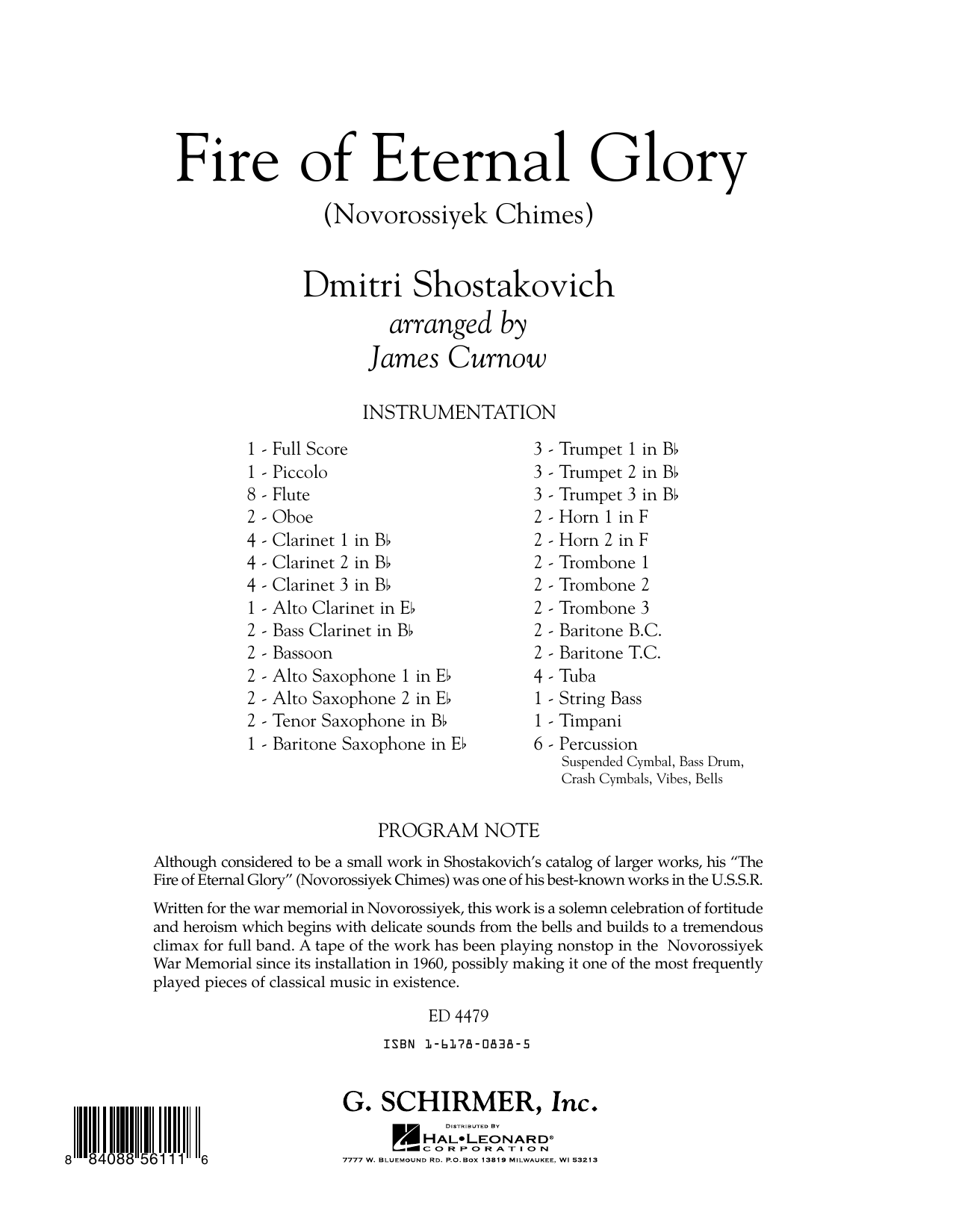

Fire of Eternal Glory (Novorossiyek Chimes): Concert Band Conductor Score & Parts
By Dmitri Shostakovich / Arranged by James Curnow
Grade: 3
Item: 35-PK00409109
$60.00
Pickup currently not available
Buy Extra Parts (Digital PDF Download)
Parts Added to Cart!
Description
Although considered to be a small work in Shostakovich's catalog, "The Fire of Eternal Glory" was one of his best known works in the USSR. A recording of the piece, originally written for the war memorial in Novorossiyek, has been playing continuously at that location since its construction in 1960, possibly making it one of the most frequently played pieces of classical music in existence. James Curnow's arrangement for young band begins with delicate sounds from the bells, and builds to a tremendous climax for full band. Dur: 2:30


Discover MakeMusic Cloud: thousands of interactive titles your students can play along with today.
Sample Audio
No sample audio found.
Sample Video
No sample videos found.
Additional Details
Publisher:
Hal Leonard
SKU:
35-PK00409109
More about this title
About the Composer: Dmitri Shostakovich
Dmitri Shostakovich stands as one of the twentieth century's most significant composers, navigating Soviet cultural politics while creating music of unflinching emotional depth. His output spans symphonies, chamber works, concerti, and film scores; what unites them is a distinctive voice that balances lyrical warmth with sharp orchestral color and moments of stark intensity.
Shostakovich wrote "The Fire of Eternal Glory" as a memorial composition, and it became embedded in Soviet cultural life in ways few classical works achieve. The piece reveals his gift for writing music that feels both intimate and monumental, personal and civic at once. For student musicians, his work offers clarity of voice and direct emotional communication without sacrificing compositional craft.
Why we love this
Curnow's arrangement respects the original's architectural elegance while scaling it perfectly for young players. The piece works as both a concert opener that catches the audience's attention immediately and a program centerpiece because of its genuine emotional arc. Band directors appreciate how efficiently it builds ensemble awareness across sections while remaining accessible.
What to expect
Austere and beautiful at the start, with bell tones that feel almost removed from time. The piece gradually gathers warmth and urgency, moving from contemplative solemnity toward affirmation and triumph. By the end, the entire band rings with purpose.
Who it's for
Grade 3 bands looking for a piece with genuine artistic weight that doesn't demand extreme technical facility. This works equally well for groups building confidence in their ability to handle a through-composed form and for stronger ensembles wanting a concert piece that earns its place through character rather than virtuosity.
How to get the most out of it
- Give the opening bell figures space and clarity. These delicate sonorities set the entire mood, so balance ensemble sound to let them speak without drowning in accompaniment.
- Shape the dynamic progression intentionally rather than rushing to the climax. The build matters as much as the destination.
- Listen carefully to the transition points between texture changes. Make sure each section understands where it's supporting the overall line versus carrying it forward.
- At the full band climax, maintain articulation crispness even at louder dynamics. The piece loses its Shostakovich character if it becomes muddy.
How to use it
Open a concert with this and you immediately establish that the ensemble takes its music seriously. It also pairs well in thematic programming around war remembrance, Soviet composers, or twentieth century nationalism. At two and a half minutes, it's substantial enough to anchor a program section without consuming rehearsal time.
Skills your students will build
- Sustaining controlled dynamic levels over longer phrases
- Balancing transparency of texture with ensemble blend
- Responding to formal structure across a through-composed work
- Articulation control across a wide dynamic range
- Listening for sectional independence while maintaining unified timing