
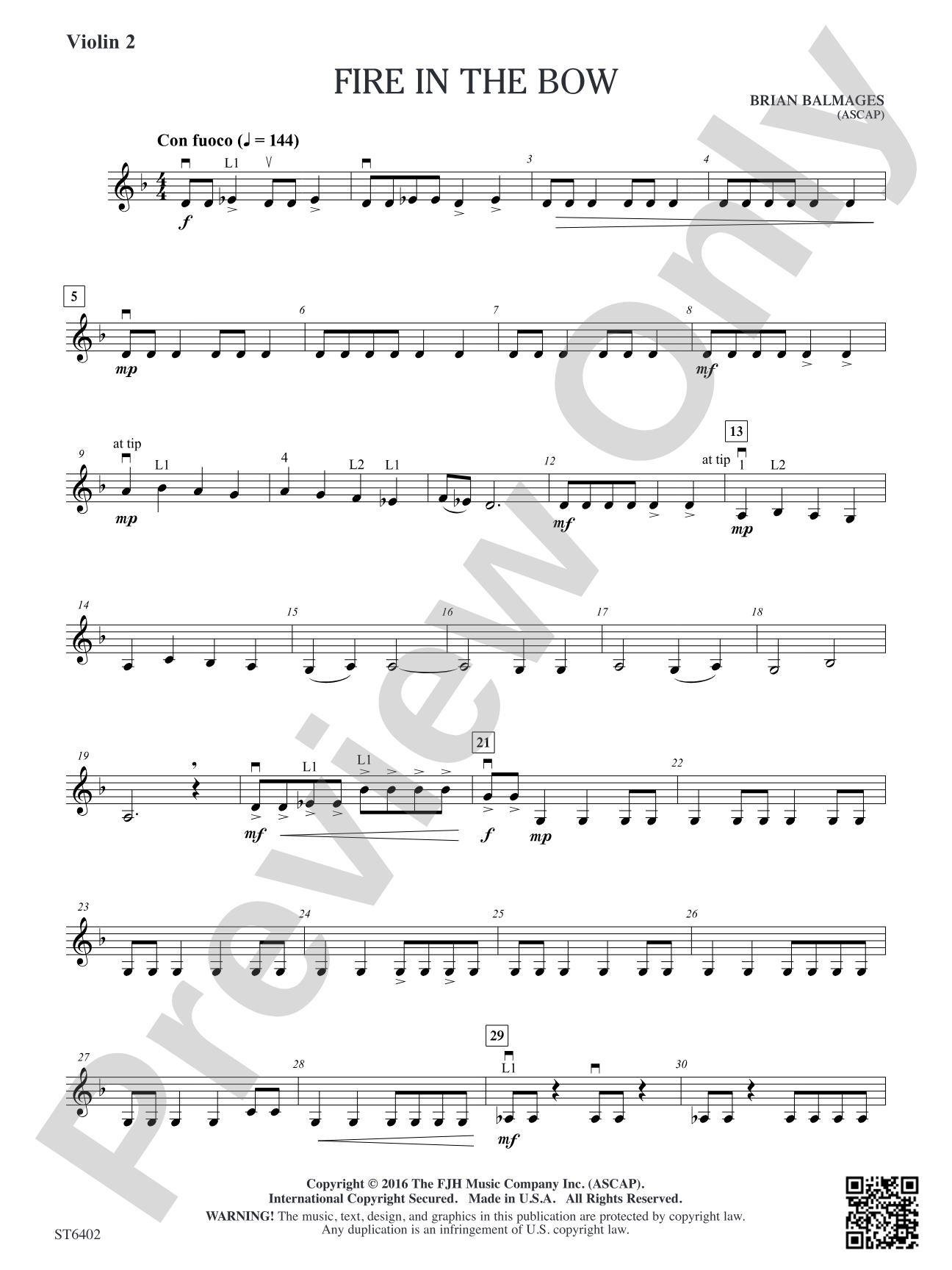

Fire in the Bow: Violin 2
By Brian Balmages
Grade: 2
Item: 98-PC-DST6402_VN2
$7.00
Pickup currently not available
Description
Conceived as an energetic and musically rewarding work, this piece also happens to be an excellent vehicle for teaching and reinforcing low 1 fingerings (violin/viola), "backward" extensions (cello), and half position (bass). The piece avoids augmented seconds and focuses on simple finger patterns while exploring dynamic harmonies that create wonderful tension and release throughout. A fantastic opener or closer!


Don't just read it, hear it, play along with it, and watch your students grow with it. In MakeMusic Cloud, Fire in the Bow: Violin 2 comes alive with professional accompaniment, adjustable tempo, and built-in practice tools that turn solo practice into real progress.
Open in the Player
Jump straight in and assign it today.
Start Your Free Trial
Open this title and explore the full library in minutes.
Sample Audio
1
Audio File
--:--
0:00
0:00
Sample Video
No sample videos found.
Additional Details
Series:
FJH Developing Strings
Publisher:
The FJH Music Company, Inc.
SKU:
98-PC-DST6402_VN2
More about this title
About the Composer: Brian Balmages

Brian Balmages has established himself as a composer and conductor working across orchestral, band, and chamber music with equal fluency. His works have been heard in some of the world's most prestigious halls, from Carnegie Hall to the Sydney Opera House, performed by ensembles ranging from professional orchestras to elementary school groups. He holds the A. Austin Harding Award from the American School Band Directors Association, won the 2020 NBA William D. Revelli Composition Contest, and serves as an elected member of the American Bandmasters Association.
Balmages has received distinguished recognition from both his alma maters: James Madison University presented him with its inaugural Distinguished Alumni Award from the School of Visual and Performing Arts, and the University of Miami commissioned him to compose for the inauguration of its 6th president. His music was performed at the 2013 Presidential Inaugural Prayer Service. As a conductor, he maintains active relationships with all-state ensembles, university groups, and professional orchestras worldwide, with notable guest conducting at the Midwest Clinic, Western International Band Clinic, and numerous ASTA conferences. He currently serves as Director of MakeMusic Publications and Digital Education for Alfred and MakeMusic.
Why we love this
This piece delivers genuine musical interest while serving a clear pedagogical purpose. Rather than treating technique as separate from music, Balmages integrates the teaching goals into a work that sounds compelling and energetic, making students want to play it well. The dynamic harmonies and intelligent voice leading ensure that even at Grade 2, ensembles hear real musical substance.
What to expect
Bright and propulsive, with a forward momentum that keeps ensembles engaged from start to finish. The dynamic harmonies create natural peaks and valleys of tension, making the piece feel alive even as students focus on mastering new fingering patterns.
Who it's for
String orchestras at Grade 2 level who are ready to tackle low 1 positions, half position, and extensions with purpose rather than as abstract technical exercises. Directors seeking a work that builds specific technique while maintaining genuine musicality and energy will find this particularly valuable.
How to get the most out of it
- Emphasize the rhythmic drive from the opening. These energetic passages establish the character immediately, so lock the ensemble's ensemble pulse early in rehearsal and maintain it as your foundation.
- Use the dynamic contrasts as opportunities for tone refinement. The tension and release Balmages builds into the harmonic structure means students should hear exactly how their dynamics shape the musical line.
- Work the low 1 fingerings and extensions systematically before addressing the overall piece. Once these positions feel secure, the phrase shaping and musical expression come together quickly.
- Balance the section parts carefully during chord passages. Simple finger patterns can mask balance issues, so listen critically to how the harmonic layers sit together.
How to use it
Open or close a concert with this work to establish energy and momentum. Its clear Grade 2 accessibility and rewarding technical scope make it ideal for festivals, contests, and community performances where you want to showcase both your ensemble's growing technical command and their musicianship.
Skills your students will build
- Low 1 fingerings on violin and viola
- Backward extensions on cello
- Half position on bass
- Dynamic balance within harmonic progressions
- Reading and executing dynamic contrast
- Ensemble rhythmic cohesion in energetic passages