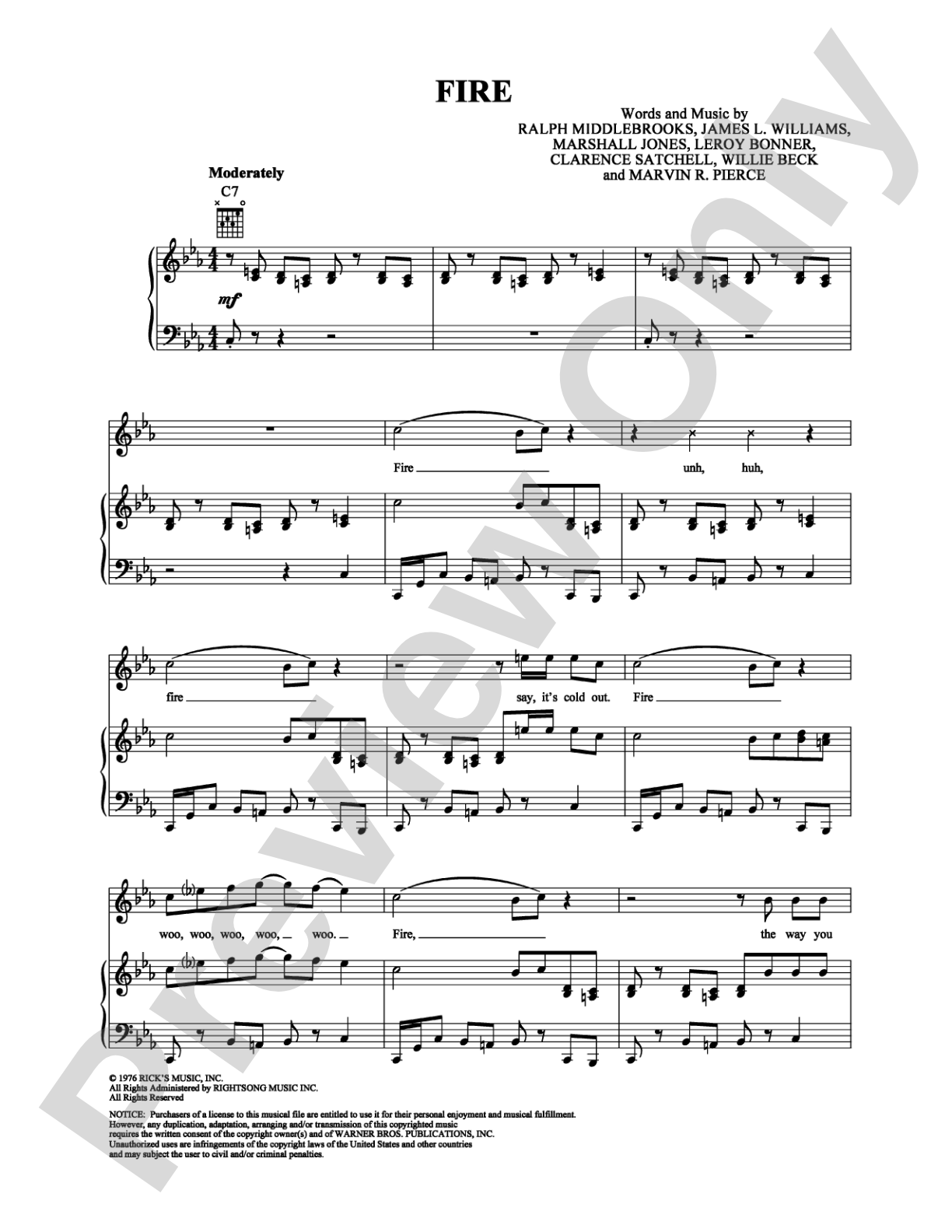
Fire: Piano/Vocal/Chords Digital Sheet Music

Fire: Piano/Vocal/Chords Digital Sheet Music

Ralph Middlebrooks, James L. Williams, Marshall Jones, Leroy Bonner, Clarence Satchell, Willie Beck, Ohio Players, Marvin R. Pierce

Item: 00-PS-0004394

Digital Download
$3.99
Description

Fire: Piano/Vocal/Chords Digital Sheet Music isn't in MakeMusic Cloud just yet...but it could be. Let us know you'd like to see it, and you'll help shape what comes next. In the meantime, start a free trial and dive into thousands of interactive titles your students can play along with today.

Sample Audio
No sample audio found.
Sample Video
Additional Details
SKU: 00-PS-0004394

More about this title

About the Artist: Ohio Players

The Ohio Players emerged from Dayton, Ohio, in the late 1960s as one of the most distinctive funk and R&B ensembles of their era. Known for their horn-driven arrangements, infectious grooves, and charismatic stage presence, the band built a devoted following throughout the 1970s with their blend of funk, soul, and rock sensibilities. "Fire," one of their signature hits, exemplifies their ability to craft songs that are both musically sophisticated and immediately engaging to audiences across genres.

The group's approach to composition and arrangement emphasized tight ensemble playing, memorable hooks, and the interplay between rhythm section and horns. Their influence extended well beyond their original run, shaping how subsequent artists approached funk-soul fusion and demonstrating the commercial and artistic potential of genre-blending music.

Why we love this

This arrangement captures the infectious funk-soul swagger that made the original a staple, giving pianists and singers alike access to one of the era's most recognizable grooves. The chord voicings and rhythmic foundation stay true to the song's DNA while remaining playable in a rehearsal or recital setting. Pairing this with singers expands its reach across vocal programs and allows students to experience firsthand how rhythm section, vocals, and harmonic movement work together in a track that genuinely excites audiences.

What to expect

Warm, propulsive, and unapologetically funky. The song radiates confidence through its syncopated rhythms and soulful vocal demands, creating an irresistible momentum that pulls listeners in. There's a sophistication beneath the infectious groove that rewards careful listening and committed performance.

Who it's for

Vocalists who want to develop their interpretation of funk-soul material and pianists seeking accessible yet musically authentic accompaniment that teaches harmonic and rhythmic sophistication. The arrangement works well for singers at the intermediate to advanced level who already have some rhythmic security but want to explore ensemble interplay and groove-based music.

How to get the most out of it

  • Lock the rhythmic pocket early; the strength of this song depends on a consistent, slightly laid-back swing feel rather than rushing the beat.
  • Pay attention to how the piano voicings sit rhythmically against the vocal line; the gaps matter as much as the notes.
  • Build dynamic contrast by stripping back to a sparse texture in quieter sections, letting the vocal melody breathe before filling in the full groove.
  • Lean into the soul and attitude of the original; this style demands confidence and a willingness to bend and phrase rather than play mechanically.

How to use it

Feature this in a recital or concert that explores soul, funk, and popular music of the 1970s, pairing it with other genre classics to build a themed set. It works equally well as a standalone vocal feature or as part of a collaborative concert that bridges classical and contemporary idioms. The arrangement also serves as an excellent teaching tool in vocal technique classes or ensemble rehearsals focused on rhythm section coordination.

Skills your students will build

  • Reading and playing syncopated rhythmic patterns in the piano part
  • Interpreting swing and groove feel in a funk-soul context
  • Coordinating vocal phrasing with underlying harmonic movement
  • Voicing and chord substitutions common to soul and R&B music
  • Ensemble listening and rhythmic locking between piano and voice

You May Also Like