
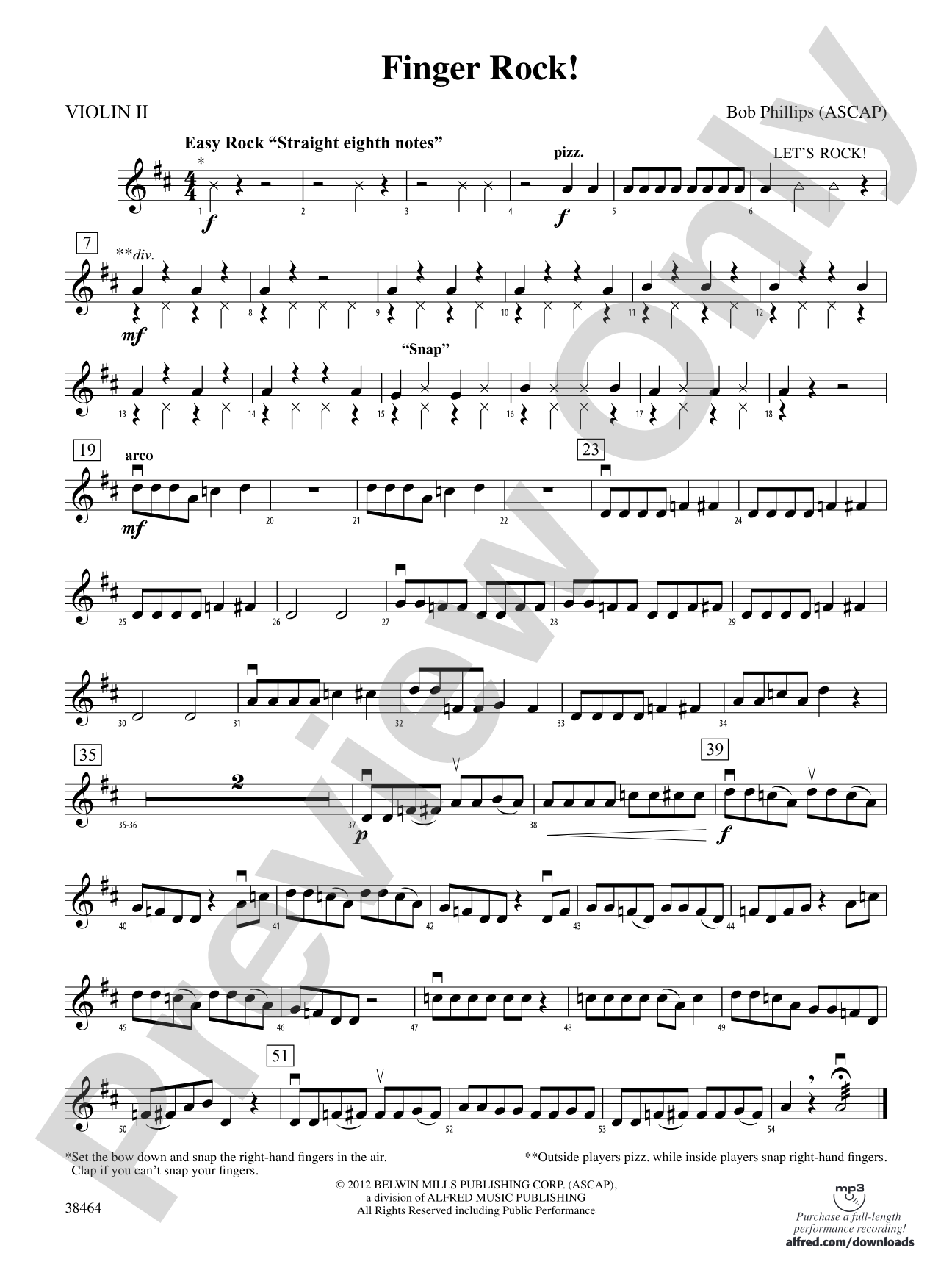

Finger Rock!: 2nd Violin
By Bob Phillips
Grade: 1.5
Item: 00-PC-0015512_VN2
$5.99
Pickup currently not available
Description
Easy rock that is perfect for beginners! They can sound cool, have fun, and practice finger patterns. All sections have interesting parts as the piece practices the movement from F natural to F-sharp and from C natural to C-sharp. There are no high 3s or forward extensions, and reproducible educational packs are included. This title is available in MakeMusic Cloud. Correlates to Sound Innovations for String Orchestra, Book 1 Level 2.


Don't just read it, hear it, play along with it, and watch your students grow with it. In MakeMusic Cloud, Finger Rock!: 2nd Violin comes alive with professional accompaniment, adjustable tempo, and built-in practice tools that turn solo practice into real progress.
Open in the Player
Jump straight in and assign it today.
Start Your Free Trial
Open this title and explore the full library in minutes.
Sample Audio
1
Audio File
--:--
0:00
0:00
Sample Video
No sample videos found.
Additional Details
Series:
Sound Innovations for String Orchestra
Publisher:
Alfred Music
Page Count:
80
SKU:
00-PC-0015512_VN2
More about this title
About the Composer: Bob Phillips

Bob Phillips is a composer and pedagogue who has shaped string education through innovative repertoire and large-group teaching methodology. Since the 1970s, he has authored over 25 instructional series, including all six levels of Sound Innovations, and developed groundbreaking eclectic styles collections like Fiddlers Philharmonic, Jazz Philharmonic, and Rock Philharmonic. His published works exceed 200 pieces for orchestras and bands, and he holds recognition as an ASCAP award-winning composer whose pieces are performed regularly at national conferences like the Midwest Clinic.
For 27 years, Phillips built a string program in Saline, Michigan, that grew to over 700 students and became a national model for excellence across classical and contemporary styles. He founded the Saline Fiddlers Philharmonic, which gained international prominence through extensive touring, including multiple performances at the White House and the Midwest Clinic. Phillips has conducted honors orchestras, all-state ensembles, and youth symphony programs across the country, and served as resident conductor and arranger for the Wintergrass Festival in Seattle for 12 years.
Why we love this
Phillips understands what beginning string orchestras need: music that excites students while teaching real technical skills. The focus on F natural to F-sharp and C natural to C-sharp movement gives students concrete fingering work without overwhelming them, and the rock style itself is deeply motivating for young players who rarely get to sound this contemporary. Every section gets meaningful material, which keeps engagement high across the entire orchestra.
What to expect
High-energy and straightforward, with a contemporary edge that surprises audiences familiar only with classical repertoire. The rock idiom gives the piece a sense of forward motion and fun, while the careful writing ensures no student is left with only accompanying figures.
Who it's for
Beginning string orchestras at the first or early second year of study. Students benefit from material that sounds immediate and rewarding while they solidify foundational technique and basic shifting patterns.
How to get the most out of it
- Isolate the finger pattern transitions (F to F-sharp and C to C-sharp) in sectionals before full rehearsal; even a few minutes of focused work on this shift will pay off in ensemble precision.
- Have each section listen to the other parts during rehearsal so violins hear the rhythmic foundation in violas and cellos. This builds awareness of how their finger work sits within the larger texture.
- Lock in the backbeat early; the rock feel depends on consistent rhythmic confidence from the lower strings, so prioritize their entrances and groove before polishing the melody.
How to use it
Program this in a family concert or community performance where you want to showcase student growth and demonstrate that string musicians can excel in styles beyond the classical canon. It works equally well as a mid-year morale boost during a rehearsal cycle focused on technical development.
Skills your students will build
- Shifting between F natural and F-sharp in first position contexts
- Shifting between C natural and C-sharp in first position contexts
- Playing rock rhythm patterns with confidence and consistent articulation
- Balancing melody and accompaniment within a contemporary ensemble texture