
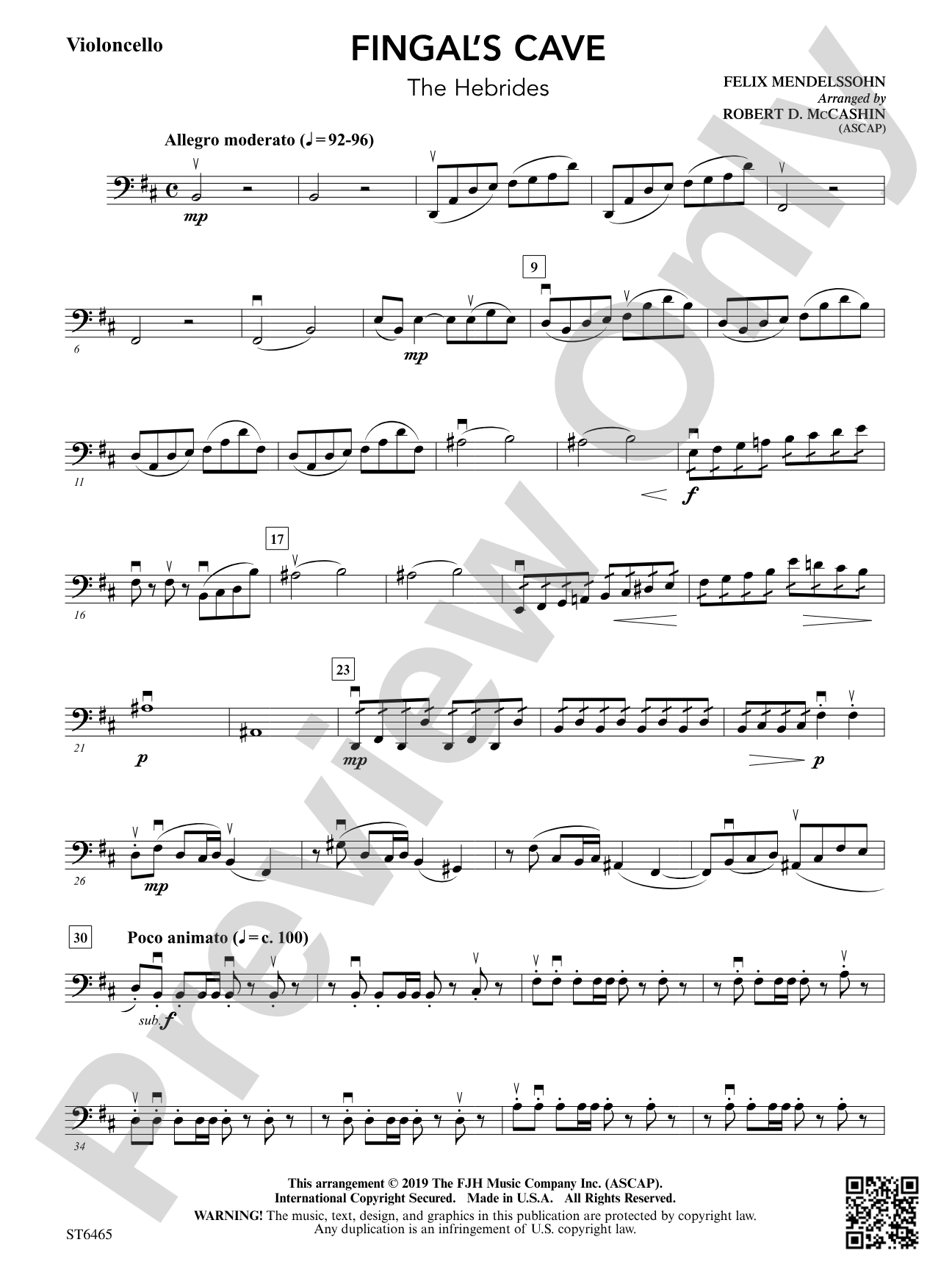

Fingal's Cave: Violoncello
By Felix Mendelssohn / arr. Robert D McCashin
Grade: 3.5;4
Item: 98-PC-DST6465_VC1
$7.00
Pickup currently not available
Description
Written after Mendelssohn visited Fingal's Cave off the coast of Scotland, this music showcases the composer's comment that it is "in pictures, ruins and natural surroundings that I find the most music." Throughout the overture, one feels the undulation of the sea, the swirling waters washing up onto the formation, and the mesmerizing enchantment of his experience. (3:15)


Fingal's Cave: Violoncello isn't in MakeMusic Cloud just yet...but it could be. Let us know you'd like to see it, and you'll help shape what comes next. In the meantime, start a free trial and dive into thousands of interactive titles your students can play along with today.
Request This Title
Tell us you want it.
Start Your Free Trial
Explore everything that's ready to play right now.
Sample Audio
1
Audio File
--:--
0:00
0:00
Sample Video
Additional Details
Series:
FJH String Orchestra
Publisher:
The FJH Music Company, Inc.
SKU:
98-PC-DST6465_VC1
More about this title
About the Composer: Felix Mendelssohn
Felix Mendelssohn (1809-1847) stands as one of the most gifted composers of the Romantic era, bringing lyrical warmth and structural clarity to his orchestral works. His music bridges Classical form with emotional landscape painting; he was equally at home writing symphonies, concertos, and intimate chamber works, and his influence on music education remains profound through both his compositions and his work as conductor and teacher.
Mendelssohn was a traveler and keen observer of nature. His journeys across Europe, including his 1829 visit to Scotland, directly inspired some of his most enduring works. The overtures that emerged from these travels demonstrate his gift for translating visual and natural impressions into orchestral color and movement, making him a composer whose music speaks directly to the imagination of young musicians.
Why we love this
This arrangement captures everything that makes Mendelssohn essential for string orchestras: soaring melismatic writing, clear harmonic architecture, and genuine emotional pull without sentimentality. The sea imagery in the score gives young players a visceral compositional purpose beyond note-reading; they're not just performing techniques but creating atmosphere. At Grade 3.5-4, it's ambitious without being unreasonable, offering real concert impact that audiences recognize and young musicians remember.
What to expect
Water in motion: restless, shimmering, alive with subtle energy. The music ebbs and flows across your strings, moving between delicate upper register passages and fuller, richer textures below. You hear the cave itself, cool and mysterious, and feel the pull of the Atlantic against ancient basalt stone.
Who it's for
String orchestras at the intermediate to early advanced level seeking repertoire that combines technical substance with genuine artistry. This arrangement works equally well for school orchestras building toward more sophisticated programming and for youth orchestras wanting to claim a Romantic masterwork as their own.
How to get the most out of it
- Shape each phrase with gentle dynamic swell and release rather than sustained uniform volume; the undulating water imagery relies on consistent but subtle wave-like breathing throughout the ensemble.
- Balance the melodic lines between first and second violins carefully so the primary theme remains audible while the accompanying voices create textural cohesion.
- Bring out pizzicato passages as rhythmic anchors without letting them dominate; they ground the harmonic foundation while the upper voices drift above.
- Maintain forward momentum through sections that might feel repetitive on the page; Mendelssohn's genius lies in subtle harmonic shifts and orchestral recoloring that reward attentive listening.
How to use it
Pair this with other nature-inspired Romantic works for a concert that explores the era's fascination with landscape and travel, or position it as the centerpiece of a program featuring overtures that build audience familiarity with concert opener traditions. Its moderate length (3:15) makes it ideal for a mixed concert that needs a substantial but not overwhelming string orchestra feature.
Skills your students will build
- Playing sustained melodies with consistent tone quality across string sections
- Responding to conductor gesture for dynamic shaping and phrase architecture
- Balancing melodic lines against accompanying textures in multi-voice string writing
- Maintaining rhythmic cohesion in sections with pizzicato accompaniment figures
- Understanding harmonic function through listening and ensemble awareness