Fine Knacks for Ladies Sheet Music Preview

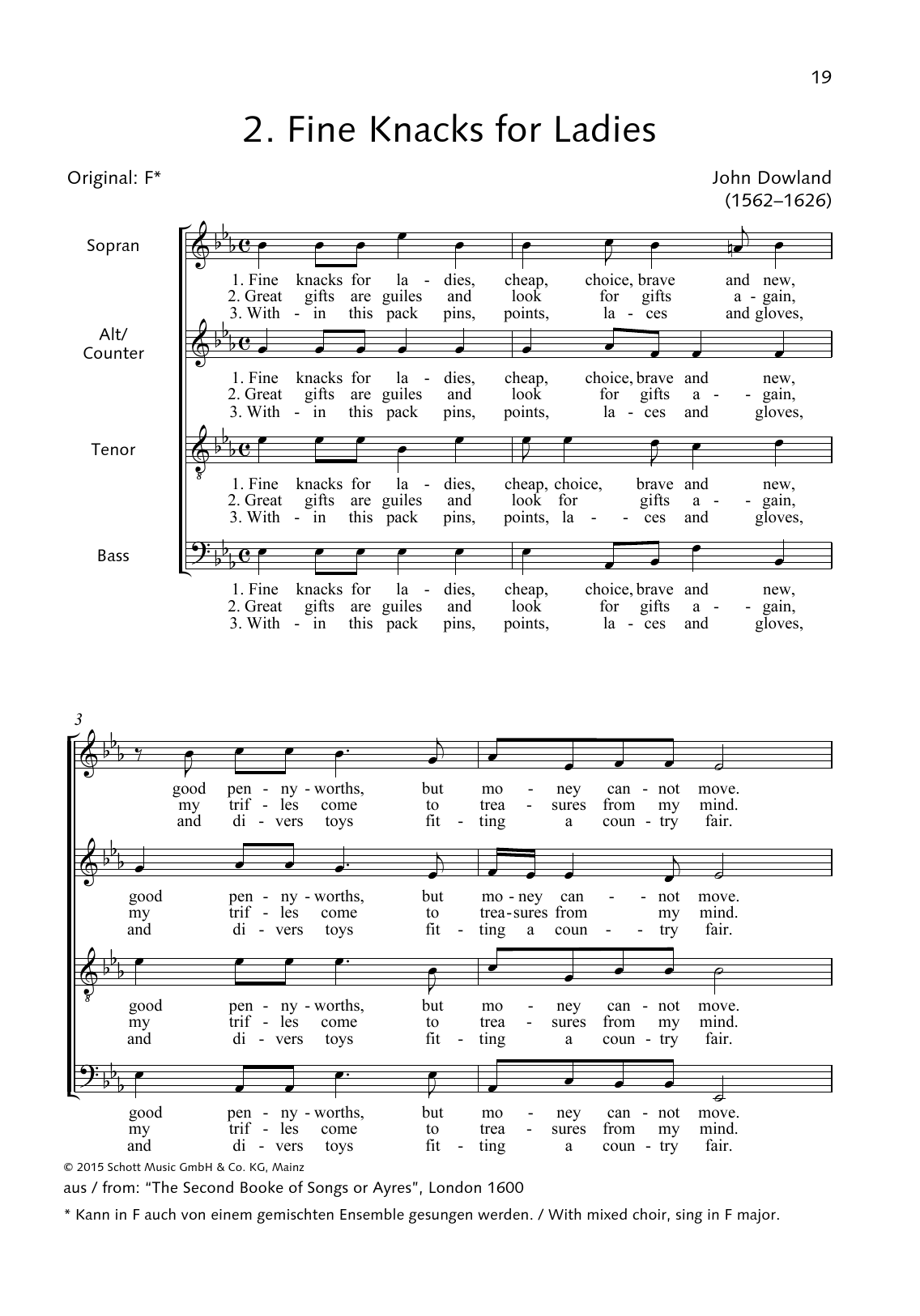
Fine Knacks for Ladies: SATB Choral Octavo

As performed by John Dowland

Item: 35-DS00370957

Digital Download
$2.99

One moment…

Description

Fine Knacks for Ladies: SATB Choral Octavo isn't in MakeMusic Cloud just yet...but it could be. Let us know you'd like to see it, and you'll help shape what comes next. In the meantime, start a free trial and dive into thousands of interactive titles your students can play along with today.

Sample Audio
No sample audio found.
Sample Video
Additional Details
Publisher: Hal Leonard
Page Count: 3
SKU: 35-DS00370957

More about this title

About the Artist: John Dowland

John Dowland (1563-1626) stands as one of the Renaissance's most celebrated lutenists and songwriters, a figure whose influence on English vocal music remains profound. His output of over 90 lute songs established a template for marriage between poetry and music that still resonates in choral settings, and his harmonic language shows surprising sophistication for its era. Dowland's positions at European courts and his eventual appointment as lutenist to the English court gave him access to the finest poets of the age, resulting in settings that balance technical craftsmanship with genuine emotional depth.

Why we love this

This arrangement captures the intimacy and counterpoint of Dowland's lute song without requiring instrumental support, making it accessible for any mixed choir with basic rehearsal time. The text celebrates practical elegance and wit rather than courtly sentiment, giving singers something genuinely charming to perform and audiences something unexpected to hear.

What to expect

Elegant without pretension. The text spins with urbane humor while the music circles gently through its harmonies, creating moments of unexpected warmth and clarity. There's an unforced sophistication here, the sound of a room full of intelligent singers enjoying each other's company.

Who it's for

Mixed choirs preparing short festival programs, college vocal ensembles seeking Renaissance repertoire, and directors wanting to expand beyond the typical a cappella canon. It works equally well as a concert opener or as part of a curated program pairing Renaissance works with later settings of similar texts.

How to get the most out of it

  • Establish the text first. These are witty lyrics that deserve clear articulation and character; let the singers hear themselves speaking naturally before adding musical refinement.
  • Balance the soprano line as melody without drowning the harmonic motion in the lower voices. The piece relies on contrapuntal clarity rather than vertical thickness.
  • Anchor the piece with steady, unhurried tempos. Renaissance polyphony sounds rushed at modern pace; give the phrase shapes room to breathe.
  • Pay attention to the final cadence as an opportunity for slight ritardando and unified vowel release, which gives the ending weight without modern affectation.

How to use it

Pair this with other Dowland settings or with secular madrigals to create a 15-minute Renaissance suite, or use it as an opening number to set a lighter, more conversational tone before moving into weightier material. Its brevity and memorability make it ideal for pre-concert performances or informal rehearsal room sharing.

Skills your students will build

  • Renaissance harmonic language and voice leading conventions
  • Text underlay and lyrical word painting
  • Singing pure vowels while maintaining Renaissance articulation
  • Reading three-part polyphony while balancing independent lines
  • Sustaining unaccompanied intonation through harmonic shifts

You May Also Like