
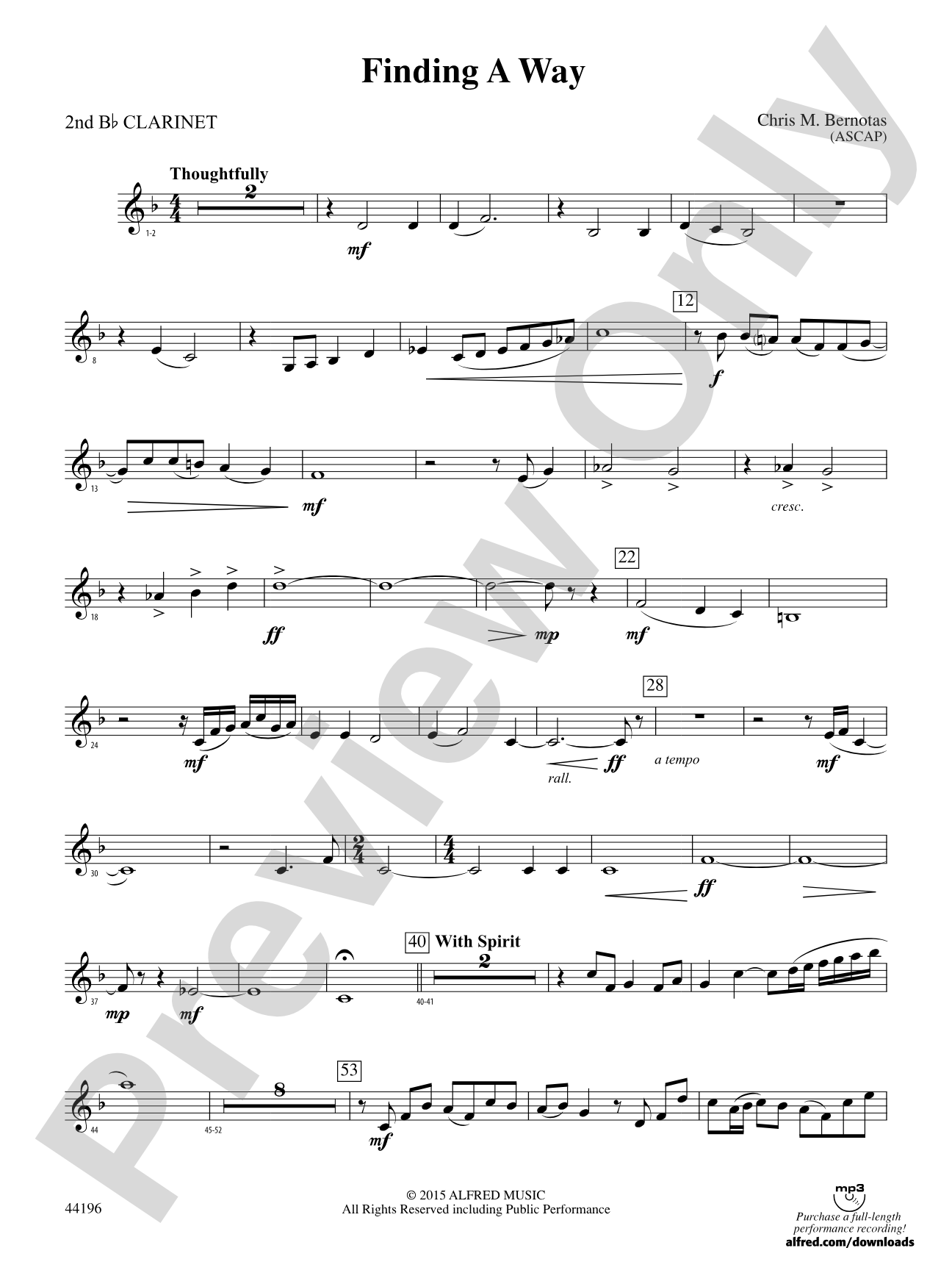

Finding a Way: 2nd B-flat Clarinet
By Chris M. Bernotas
Grade: 3.5 (Medium)
Item: 00-PC-0017046_C2
$3.00
Pickup currently not available
Description
Beginning with an unresolved emotion and motive, "Finding a Way" travels through many emotions looking for a way to find resolution and comfort, conveying an uplifting and hopeful spirit that ultimately finds peace. When healing has had a chance to occur, sadness and sorrow can become replaced with delight and excitement of our memories. The piece concludes with a restatement of the opening, questioning motive, but this time with the question answered. (4:15)


Don't just read it, hear it, play along with it, and watch your students grow with it. In MakeMusic Cloud, Finding a Way: 2nd B-flat Clarinet comes alive with professional accompaniment, adjustable tempo, and built-in practice tools that turn solo practice into real progress.
Open in the Player
Jump straight in and assign it today.
Start Your Free Trial
Open this title and explore the full library in minutes.
Sample Audio
1
Audio File
--:--
0:00
0:00
Sample Video
Additional Details
Series:
Alfred Concert Band
Publisher:
Alfred Music
Page Count:
262
SKU:
00-PC-0017046_C2
More about this title
About the Composer: Chris M. Bernotas

Chris M. Bernotas brings over 25 years of music education experience to his work as a composer and conductor. As Director of Instrumental Publications for Alfred Music, he develops band and orchestra materials used by programs worldwide, drawing on deep classroom experience to understand what teachers and students actually need.
Bernotas's compositions balance musicality with pedagogical purpose, making them accessible to developing ensembles while offering the emotional substance that makes rehearsal time meaningful. He regularly appears as a guest conductor and clinician, and has co-authored several educational resources including the Sound Innovations series and Sound Artistry. His work reflects a commitment to creating music that challenges students developmentally while keeping their growth and engagement at the center.
Why we love this
Bernotas constructs a genuine emotional arc here, not a surface-level journey. The piece asks a real question in its opening and actually answers it by the end, giving your students something substantive to communicate rather than just play through motions. At Grade 3.5, the orchestration and harmonic language feel mature enough to keep experienced players engaged while remaining accessible for developing sections.
What to expect
The piece unfolds like someone working through doubt and eventually finding solid ground. Early passages sit in uncomfortable harmonic spaces that gradually settle into warmer, more resolved colors. By the end, what began as a tentative question returns transformed, carrying the weight of the journey that precedes it.
Who it's for
Concert bands at the upper-intermediate level looking for repertoire with real emotional substance. This works equally well for a group preparing for festival or concert programming, as the journey gives audiences something meaningful to follow and musicians something genuine to interpret.
How to get the most out of it
- Shape the unresolved opening motive with restraint. The emotional power depends on a genuine sense of searching, so resist the urge to over-conduct or overdrive the dynamics early on.
- Balance transparency in the middle section as the piece explores different emotional colors. Make sure inner voices cut through so the harmonic movement registers clearly.
- Bring out the restatement of the opening motive in the final section with quiet confidence. This time the answer has arrived, so the quality of sound should reflect resolution without losing the original questioning character.
- Allow time for the ensemble to breathe between emotional shifts. The journey from unresolved to resolved needs air and space to land authentically.
How to use it
Program this as a centerpiece on a concert that balances lighter, more energetic works. The 4:15 runtime and emotional arc make it substantial enough to anchor a set without overwhelming the overall pacing. It also works as a festival selection where judges appreciate both technical writing and interpretive maturity at this level.
Skills your students will build
- Sustaining long-term phrasing across a multi-section form
- Balancing dynamic control in inner voices and harmonic transitions
- Communicating emotional narrative through ensemble blend and tonal quality
- Responding to structural repetition and variation (recognizing the transformed return of opening material)
- Collaborative listening during moments of harmonic ambiguity and resolution