
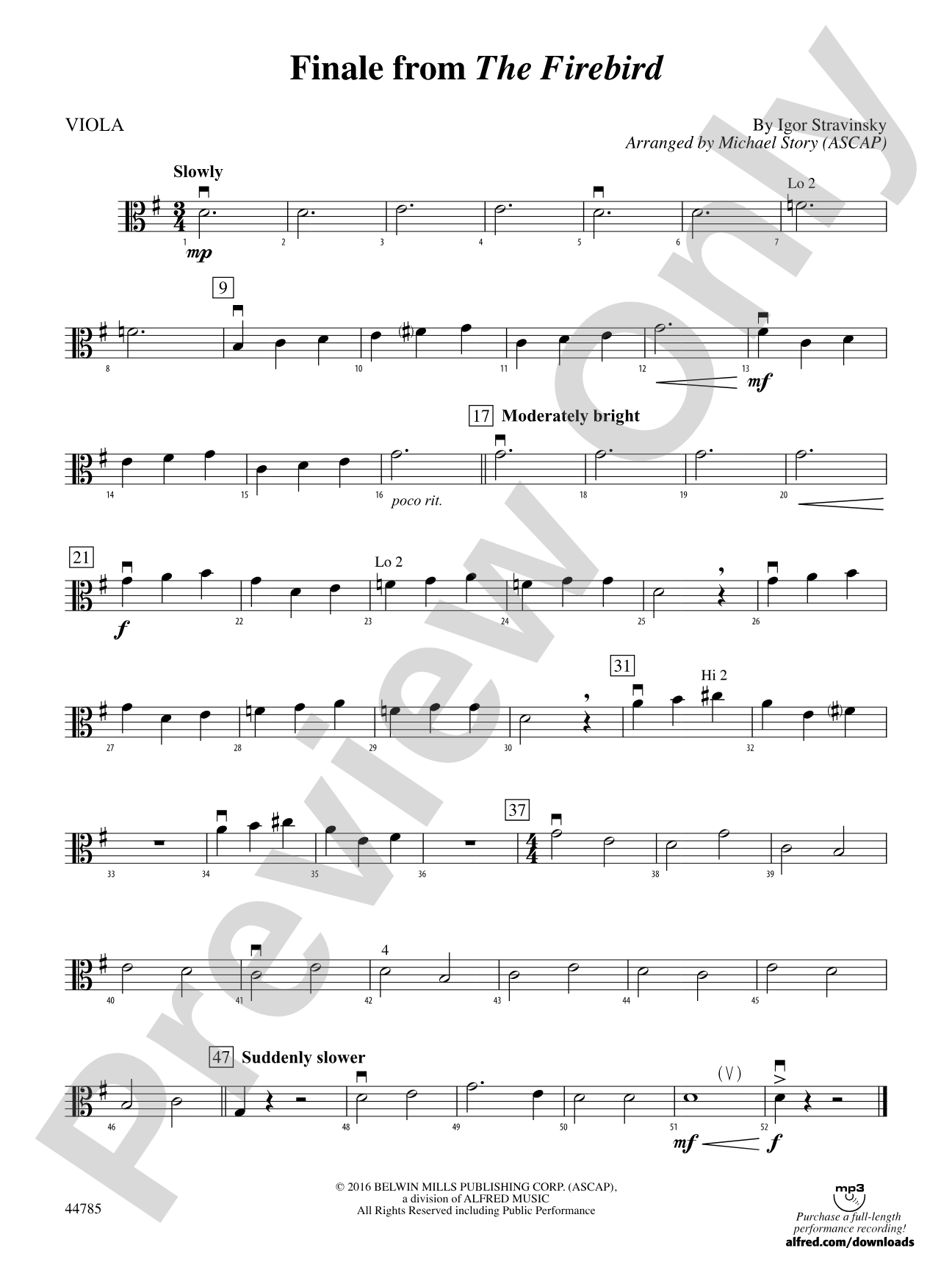

Finale from The Firebird: Viola
By Igor Stravinsky / arr. Michael Story
Grade: 1.5
Item: 00-PC-0017303_VA1
$5.99
Pickup currently not available
Description
One of the most important works of the 20th century was Stravinsky's ballet, The Firebird. The iconic "Finale" is now accessible to young players with this effective arrangement by Michael Story. All meter changes have been "squared off," while still maintaining the spirit and integrity of the original work. (1:50)


Don't just read it, hear it, play along with it, and watch your students grow with it. In MakeMusic Cloud, Finale from The Firebird: Viola comes alive with professional accompaniment, adjustable tempo, and built-in practice tools that turn solo practice into real progress.
Open in the Player
Jump straight in and assign it today.
Start Your Free Trial
Open this title and explore the full library in minutes.
Sample Audio
1
Audio File
--:--
0:00
0:00
Sample Video
Additional Details
Series:
Belwin Beginning String Orchestra
Publisher:
Alfred Music
Page Count:
76
SKU:
00-PC-0017303_VA1
More about this title
About the Composer: Igor Stravinsky
Igor Stravinsky transformed twentieth-century music through relentless innovation and compositional fearlessness. His ballets for the Ballets Russes, particularly The Firebird, Le Sacre du printemps, and Petrushka, redefined what orchestral music could express and how audiences could experience it. Stravinsky's influence extends far beyond concert halls; his approach to rhythm, orchestration, and harmonic color fundamentally shaped how modern composers think about their craft.
For music educators, Stravinsky matters because his works demonstrate that musical complexity and accessibility are not opposites. Even when stripped down for young players, his melodies sing, his rhythms compel, and his orchestrations sparkle. Teaching students to play Stravinsky builds their ears for twentieth-century idioms while connecting them to one of history's most consequential composers.
Why we love this
Michael Story's arrangement captures the raw theatrical excitement of Stravinsky's original without asking young string players to navigate the metric complexities that make the ballet so stunning for professionals. The "squared off" meters preserve the work's kinetic energy while keeping rhythmic reading manageable, letting students focus on precision articulation and the brilliant character writing that defines this masterpiece. Programming the Firebird finale signals to your audience that your ensemble tackles repertoire with real substance.
What to expect
Propulsive and shimmering, with moments of delicate texture punctuated by bright, almost celebratory outbursts. The writing sparkles under the fingers, rewarding clean articulation and precise ensemble alignment with the luminous sound Stravinsky imagined.
Who it's for
String orchestras at the grade 1.5 level who want to tackle genuine twentieth-century repertoire without drowning in metric complexity. Directors preparing students for festival or concert performance will appreciate how this arrangement builds musicianship while maintaining authorial intent.
How to get the most out of it
- Establish a steady underlying pulse in the opening material; the syncopations sit more comfortably when the ensemble anchors to a clear downbeat rather than chasing the written rhythms.
- Balance the melody line above the pizzicato accompaniment by asking violins to shape their phrases with slight dynamic rises toward structural points, which prevents the texture from flattening.
- Drill the metric transitions deliberately in sectionals before full rehearsals, since even squared rhythms require collective confidence when the pulse shifts.
How to use it
Position this as a centerpiece on a concert celebrating twentieth-century voices, or pair it with earlier Romantic arrangements to show your students how musical language evolved. Its brisk running time makes it ideal for festival appearances where you need an impactful closer that demonstrates technical control and musical maturity.
Skills your students will build
- Reading and executing syncopated rhythmic figures in major key signatures
- Maintaining articulation clarity in fast pizzicato accompaniment patterns
- Balancing solo melodic lines against rhythmic accompaniment textures
- Responding to quick meter changes and metric transitions without losing ensemble cohesion
- Performing twentieth-century harmonic language with confidence and color awareness