
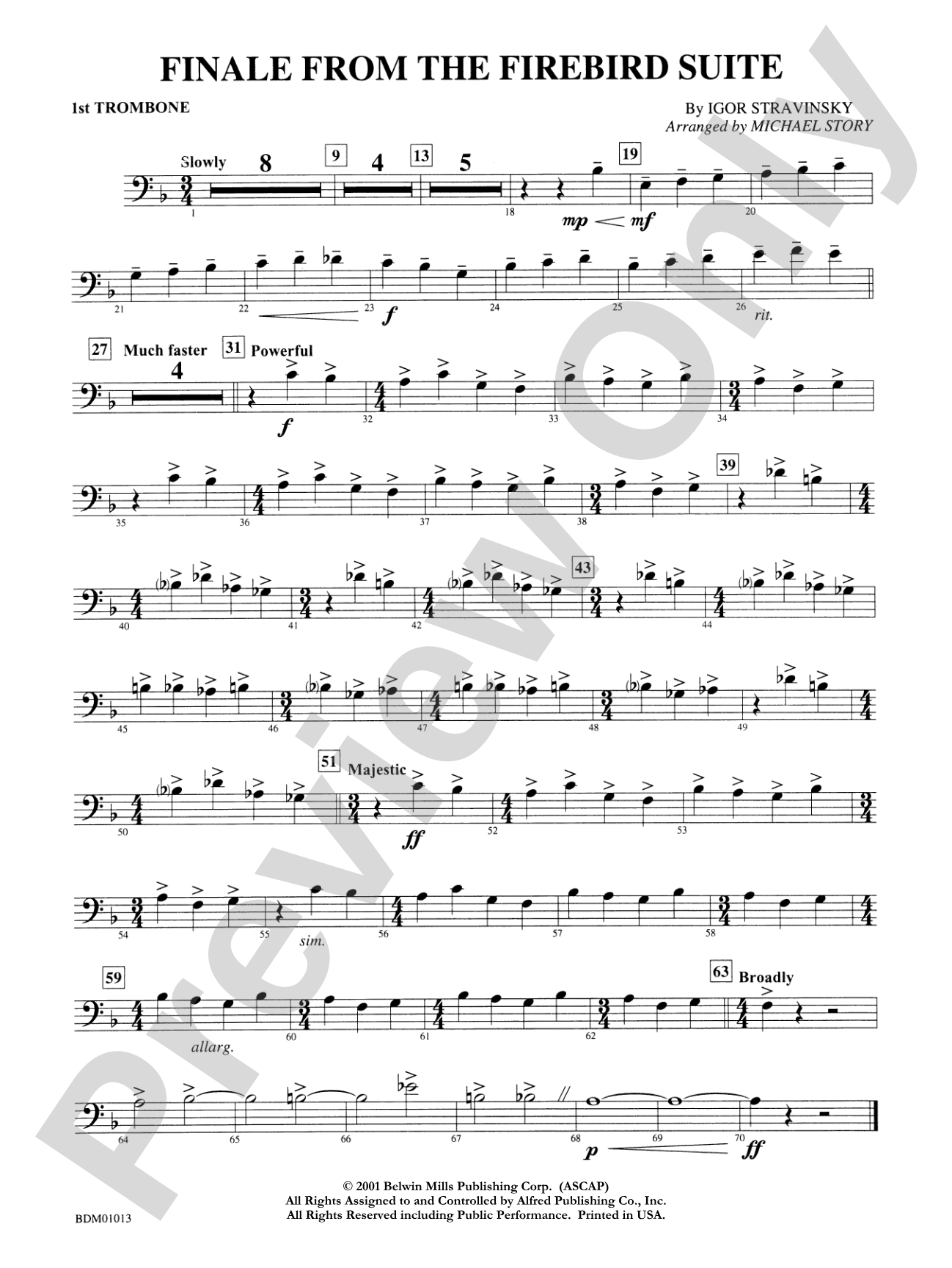

Finale from The Firebird Suite: 1st Trombone
By Igor Stravinsky / arr. Michael Story
Grade: 3 (Medium Easy)
Item: 00-PC-0002137_TN1
$3.00
Pickup currently not available
Description
Taken from the finale of the suite from Stravinsky's immortal ballet, this contemporary arrangement has been masterfully scored by Michael Story. It retains all of the original energy and enthusiasm, and with the addition of current percussion writing, you will welcome the attention to scoring details. This is the perfect major work to focus attention to your ensemble. Highly recommended!


Don't just read it, hear it, play along with it, and watch your students grow with it. In MakeMusic Cloud, Finale from The Firebird Suite: 1st Trombone comes alive with professional accompaniment, adjustable tempo, and built-in practice tools that turn solo practice into real progress.
Open in the Player
Jump straight in and assign it today.
Start Your Free Trial
Open this title and explore the full library in minutes.
Sample Audio
1
Audio File
--:--
0:00
0:00
Sample Video
No sample videos found.
Additional Details
Series:
Belwin Concert Band
Publisher:
Alfred Music
Page Count:
71
SKU:
00-PC-0002137_TN1
More about this title
About the Composer: Igor Stravinsky
Igor Stravinsky (1882-1971) fundamentally reshaped twentieth-century music through works that challenged harmonic convention, rhythmic expectation, and orchestral color. His ballet scores, particularly The Firebird, Petrushka, and The Rite of Spring, remain cornerstones of the orchestral repertoire and have proven endlessly adaptable to new instrumental contexts. For music educators, Stravinsky's work demonstrates how clarity of orchestration, precision of rhythm, and dramatic storytelling can coexist in music that demands technical sophistication from performers.
The Firebird ballet, commissioned in 1909 and premiered in Paris, established Stravinsky's international reputation. Its lush Russian nationalism, combined with his distinctive approach to melody and harmony, created a work that captivates audiences across generations. The finale, in particular, showcases the exuberance and technical brilliance that make Stravinsky's music so rewarding to study and perform.
Why we love this
Michael Story's arrangement captures the kinetic drive and orchestral sophistication of Stravinsky's original while making it fully accessible to Grade 3 ensembles. The contemporary percussion writing refreshes the score without losing the ballet's essential character, and the level of detail in the orchestration gives conductors genuine teaching material about texture, balance, and color.
What to expect
Exuberant and virtuosic, with the buoyant energy of Russian folk narrative colliding with early twentieth-century harmonic language. Bright primary colors, sharp rhythmic angles, and surges of percussive excitement propel the music forward. The writing sparkles when performed with precision and clarity; each instrument's line matters.
Who it's for
Concert bands at the Grade 3 level ready to perform an arrangement of genuine musical substance. Directors seeking a showpiece that combines accessibility with orchestral sophistication will find a work that challenges students without exceeding their technical grasp. This suits festivals, spring concerts, and ensembles aiming to program music that respects both the audience and the performers.
How to get the most out of it
- Establish the rhythmic precision from the opening measures. Stravinsky's syncopation and metric shifts require steady ensemble focus; use a clear, unwavering beat pattern so rhythmic layers stack cleanly.
- Balance the melodic material across sections rather than letting the brass dominate. The original ballet writing distributes thematic ideas throughout the orchestra, and that transparency should remain evident in the band arrangement.
- Shape the dynamic arc across the finale's full length. This is not a piece that sustains maximum volume throughout; contrast between climactic passages and more intimate moments will reveal the architecture Stravinsky built.
- Secure the articulation patterns in the woodwind figures early in rehearsal. The clarity and character of this arrangement depends on consistent tonguing and note separation, particularly in the faster passages.
How to use it
Position this as a substantial centerpiece on a concert featuring works from different eras and styles. It pairs well alongside more contemporary pieces while also standing alone as a major work that justifies a full rehearsal arc. The Grade 3 accessibility makes it suitable for contests and festivals where ensembles need impact without overreaching technically.
Skills your students will build
- Rhythmic precision in syncopated and metric-shifted passages
- Dynamic control and shaping across extended phrases
- Ensemble balance when thematic material distributes across multiple sections
- Articulation clarity in woodwind figures at varying tempos
- Blending as a full ensemble within contemporary percussion scoring