Finale from Symphony No. 41 "Jupiter": Violin 1 Sheet Music Preview

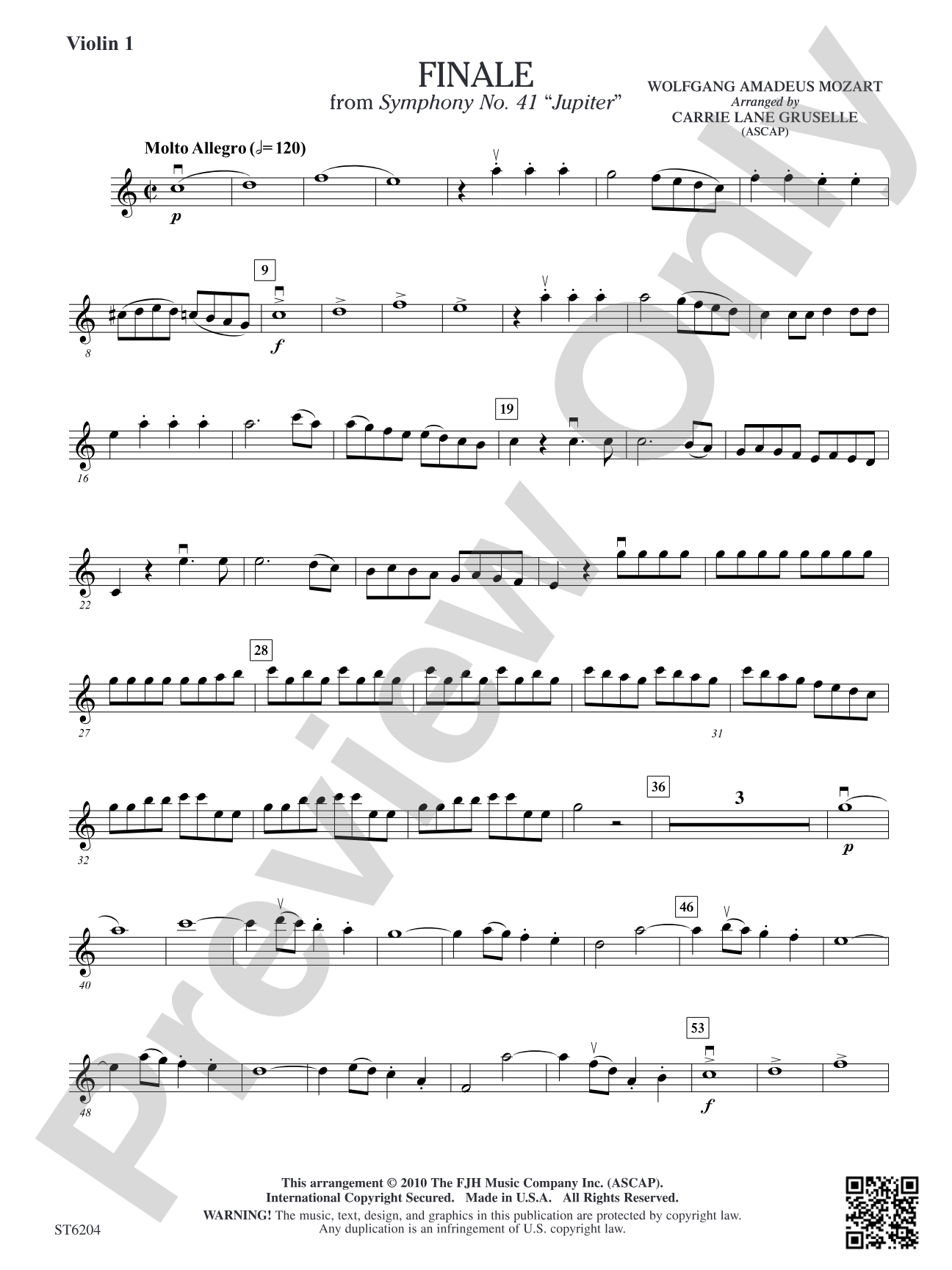
Finale from Symphony No. 41 "Jupiter": Violin 1

By Wolfgang Amadeus Mozart / arr. Carrie Lane Gruselle

Grade: 4

Item: 98-PC-DST6204_VN1

Digital Download
$7.00
Description
This stirring arrangement of Mozart's final symphony works incredibly well for string orchestra. Including all the themes in the original Finale, this work is sure to become a favorite of students and conductors. An excellent way to challenge your musicians expressively and stylistically without pushing them too hard technically. Excellent!

Finale from Symphony No. 41 "Jupiter": Violin 1 isn't in MakeMusic Cloud just yet...but it could be. Let us know you'd like to see it, and you'll help shape what comes next. In the meantime, start a free trial and dive into thousands of interactive titles your students can play along with today.

Sample Audio
0:00
0:00
Sample Video
Additional Details
Series: FJH String Orchestra
Publisher: The FJH Music Company, Inc.
SKU: 98-PC-DST6204_VN1

More about this title

About the Composer: Wolfgang Amadeus Mozart

Wolfgang Amadeus Mozart (1756-1791) composed across every major genre of his era and produced over 600 works in just 35 years. His symphonies rank among the most performed in the concert repertoire, and his ability to balance technical brilliance with emotional clarity makes his music enduringly accessible to student musicians. Symphony No. 41 in C major, his final symphony, stands as a landmark of classical form and orchestral writing.

Why we love this

This arrangement preserves the architecture and melodic richness of Mozart's original finale while scaling the technical demands appropriately for Grade 4 musicians. Directors get to program a genuine masterwork without wrestling students through excessive passage work or awkward key relationships. The expressivity and style required here sharpen musicianship in ways that simpler repertoire cannot.

What to expect

Mozart's Jupiter finale radiates confidence and harmonic clarity, combining gallant melodic gestures with intricate counterpoint that never overwhelms. The movement unfolds with graceful inevitability, balancing celebratory moments against passages of intimate conversation between voices. There is genuine sophistication here, wrapped in music that remains warm and human rather than austere.

Who it's for

String orchestra directors working with Grade 4 ensembles who want to build students' musicianship through a recognizable, structurally coherent work. Players at this level benefit from tackling a symphony finale because it teaches them how larger forms actually breathe and develop ideas over time. This is ideal for musicians ready to move beyond single-movement character pieces.

How to get the most out of it

  • Shape the main theme with a clear sense of forward motion in the opening section; avoid letting it sound static even at moderate tempos.
  • Balance the inner string voices carefully so that harmonic movement and countermelody support the primary melodic line without muddying texture.
  • Pay attention to articulation consistency across the section, especially in repeated figures where players may unconsciously change bow contact or pressure.
  • Use Mozart's original score as a reference for phrasing and breathing points; this arrangement inherits his elegant phrase structures.

How to use it

Anchor a concert program around this work as a mainstay of classical repertoire, or pair it with a lighter opening piece to showcase the range of your string orchestra's capabilities. This arrangement also works well as a concert finale because it leaves audiences with an impression of mastery and polish. Consider it a cornerstone piece for spring concerts where students have developed enough maturity to handle its stylistic demands.

Skills your students will build

  • Sustained phrasing and breath management across longer melodic lines
  • Balancing multiple simultaneous voice lines without losing clarity
  • Intonation stability in harmonic progressions and modulations
  • Style and articulation appropriate to classical repertoire
  • Reading and responding to conductor interpretation of a multi-sectional form

You May Also Like