
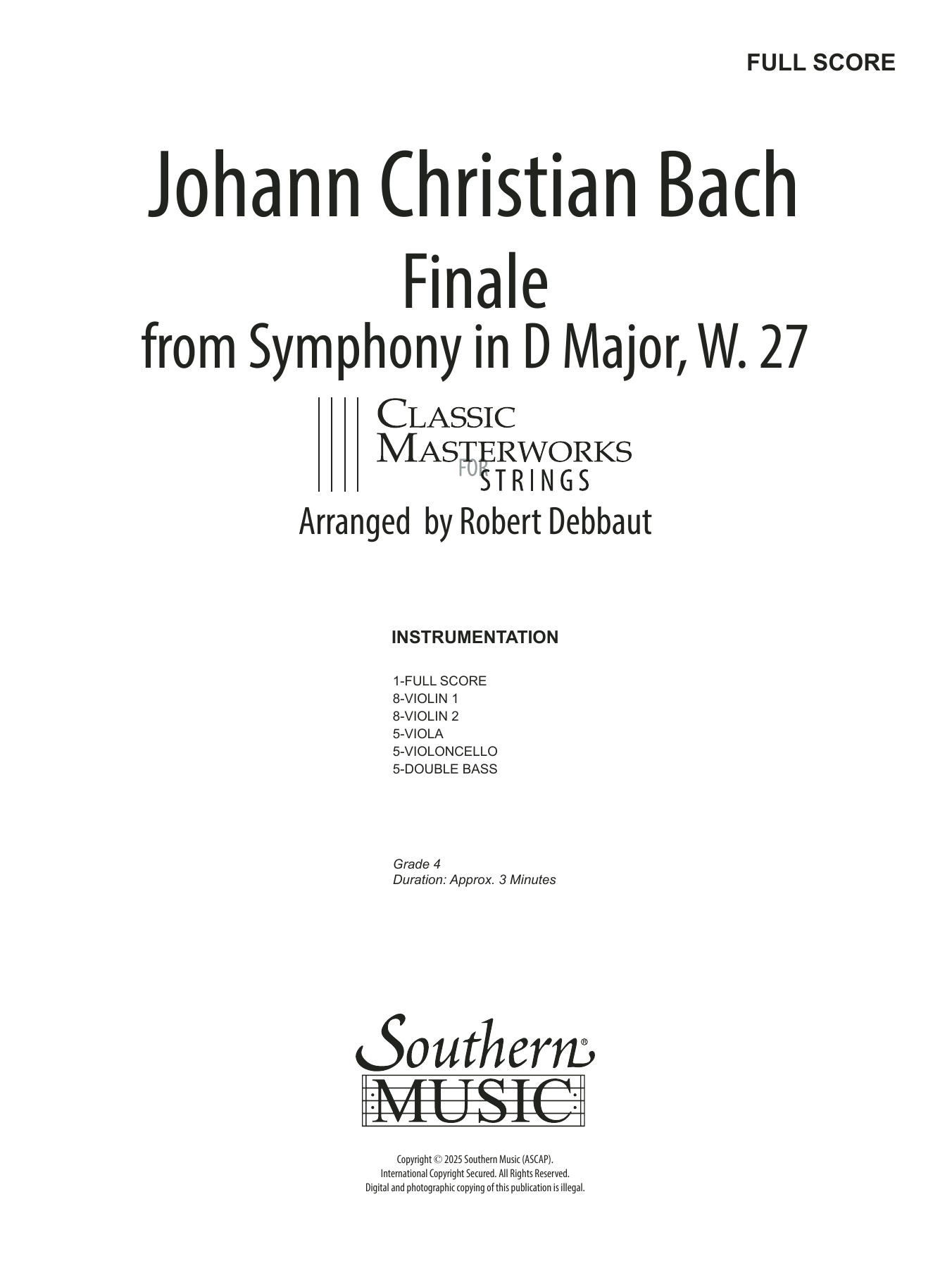

Finale from Symphony in D Major, W. 27 (arr. Robert Debbaut): String Orchestra Conductor Score & Parts
By J.C. Bach / Arranged by Robert Debbaut
Grade: 4
Item: 35-PK01724452
$60.00
Pickup currently not available
Buy Extra Parts (Digital PDF Download)
Parts Added to Cart!
Description
Tripartite sinfonias of this era were stylistically akin to the Italian opera overtures first heard in the 17th Century. The typical format was for a lively allegro, followed by a lyrical slow section, and then a rousing finale, most often in rondo form. This work certainly conforms to this formula. Originally for pairs of oboes, bassoons, horns, trumpets, and timpani, the adaptation for strings was rather easy, as only the brass and timpani parts deviate - and only slightly - from the melodic and harmonic elements. The work was originally published in 1782 after Bach's death in a composite score as Six Grand Overtures.


Finale from Symphony in D Major, W. 27 (arr. Robert Debbaut): String Orchestra Conductor Score & Parts isn't in MakeMusic Cloud just yet...but it could be. Let us know you'd like to see it, and you'll help shape what comes next. In the meantime, start a free trial and dive into thousands of interactive titles your students can play along with today.
Request This Title
Tell us you want it.
Start Your Free Trial
Explore everything that's ready to play right now.
Sample Audio
No sample audio found.
Sample Video
No sample videos found.
Additional Details
Publisher:
Hal Leonard
SKU:
35-PK01724452
More about this title
About the Composer: J.C. Bach
Johann Christian Bach (1735-1782) was the youngest son of J.S. Bach and became one of the most influential composers of the Classical era. He spent his formative years in Italy studying with Padre Martini and absorbing the operatic language that would define his compositional voice. Later, his work in London helped establish the symphony as a central genre for the emerging Classical style, bridging the gap between Baroque complexity and the cleaner textures that Haydn and Mozart would perfect.
Bach's sinfonias occupy a crucial historical position in music education. They demonstrate how composers transitioned from the multi-movement concerto grosso toward the standardized three-movement symphony, making them ideal teaching works for understanding Classical structure. His melodic gift and straightforward harmonic language remain remarkably accessible to student performers while maintaining genuine artistic substance.
Why we love this
This finale captures everything that makes Classical symphonic writing so satisfying for young orchestras: clear phrase structures, transparent textures, and moments of genuine drama without technical excess. Debbaut's arrangement preserves the elegance of the original while giving string players the full weight of the musical argument, and at Grade 4 it sits perfectly in the zone where students can execute with confidence while still being challenged by thoughtful phrasing and dynamic control.
What to expect
Bright and purposeful, with the unmistakable elegance of 18th century melodic writing. The rondo form creates a sense of return and familiarity, giving the work an almost dance-like quality that feels both intellectually satisfying and genuinely fun to perform. There is a lightness in the orchestration that invites careful listening from the audience.
Who it's for
String orchestras working at the upper Grade 4 level or the lower end of Grade 5, particularly those building a foundation in Classical repertoire. This work serves experienced middle school and beginning high school orchestras, or community groups who want to deepen their understanding of sinfonia structure without the demands of a full Mozart or Haydn symphony.
How to get the most out of it
- Shape the opening thematic statement with gentle dynamic waves rather than terraced forte and piano; the rondo form relies on listeners recognizing the refrain, so clarity of phrasing matters more than dramatic contrast.
- Balance tutti passages by letting the violas carry harmonic weight; Bach's voice leading is economical, and a thin middle voice will expose rhythmic rushes in the ensemble.
- Establish a steady tempo in the faster sections before the first rehearsal; students will feel more confident tackling articulation and rhythmic clarity when the pulse is locked in from the start.
- Reserve vibrato for sustained lyrical passages in the slow material; the Classical style values purity of tone in rapid figuration, and restraint will keep the texture from muddying.
How to use it
Program this as a centerpiece for a Classical-era concert, pairing it with a period overture or concerto grosso on one end and a Haydn symphony on the other. It also works beautifully as an opening number when you want to establish elegance and precision early in your concert, or as a bridge between Baroque and later Classical works in a thematic program exploring the evolution of form.
Skills your students will build
- Recognition and execution of rondo form (ABA or ABACA structures)
- Balancing melody and accompaniment in Classical textures
- Sustaining consistent tempo through moderate allegro sections
- Dynamic shaping of Classical phrases without modern expressive devices
- Coordination of articulation across the ensemble in homophonic writing