Finale from Firebird Sheet Music Preview

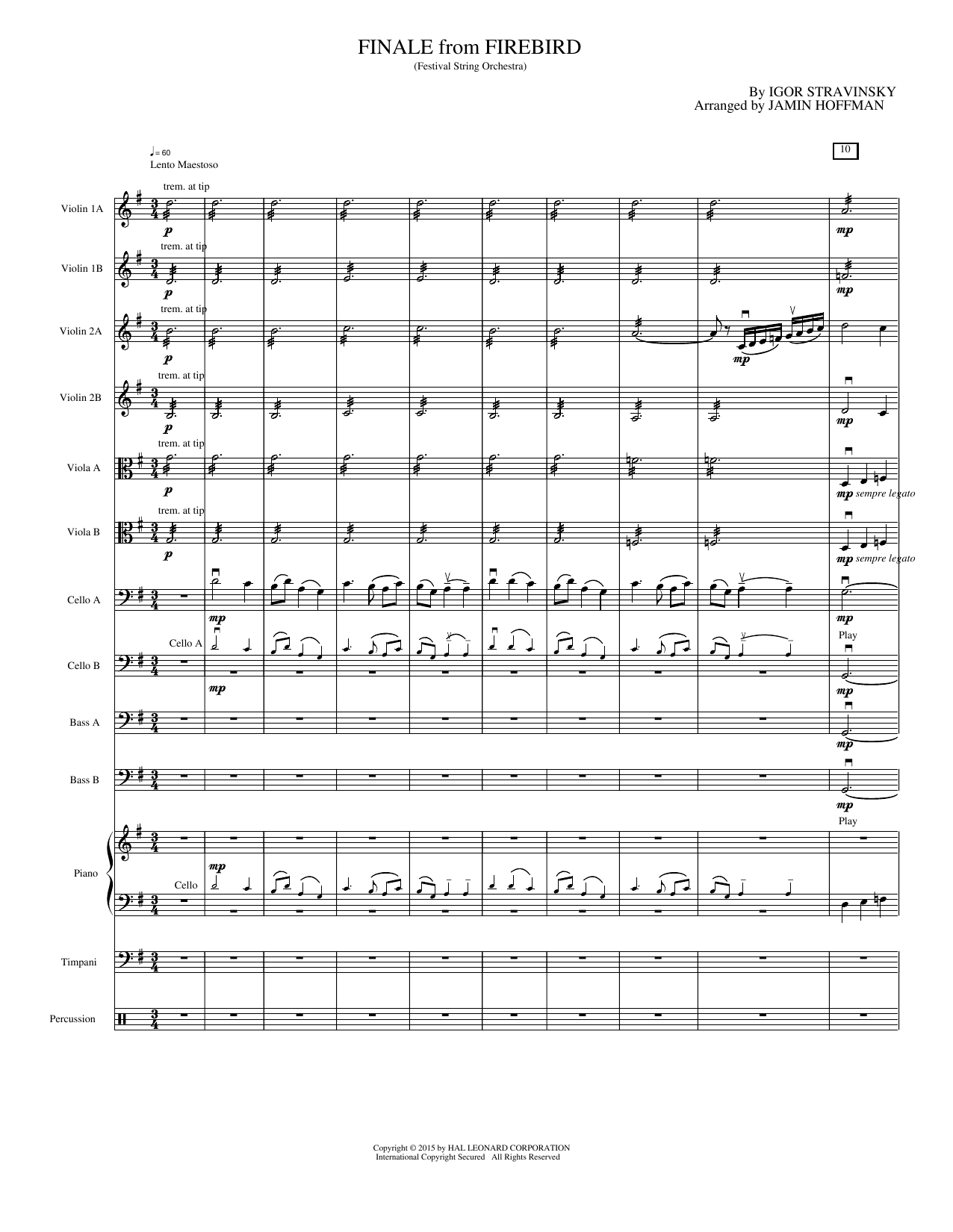
Finale from Firebird: String Orchestra Conductor Score & Parts

By Igor Stravinsky / Arranged by Jamin Hoffman

Grade: 3-4

Item: 35-PK00426807

Digital Download
$55.00

Buy Extra Parts (Digital PDF Download)

Product Price Quantity
Finale from Firebird - Full Score $55.00

Parts Added to Cart!

Description
Finale from Firebird

Finale from Firebird: String Orchestra Conductor Score & Parts isn't in MakeMusic Cloud just yet...but it could be. Let us know you'd like to see it, and you'll help shape what comes next. In the meantime, start a free trial and dive into thousands of interactive titles your students can play along with today.

Sample Audio
No sample audio found.
Sample Video
Additional Details
Publisher: Hal Leonard
SKU: 35-PK00426807

More about this title

About the Composer: Igor Stravinsky

Igor Stravinsky revolutionized 20th-century orchestral writing through his fearless harmonic language, rhythmic innovation, and brilliant orchestration. His three great ballets for the Ballets Russes, composed between 1910 and 1913, reshaped what orchestras could express, and their influence on subsequent generations of composers remains unmatched.

For string players and conductors, Stravinsky's work demands precision, independence, and comfort with unconventional harmonic movement. His string writing prioritizes color and rhythmic articulation over traditional lyricism, making his scores both technically rewarding and deeply modern.

Why we love this

This arrangement gives intermediate string orchestras access to one of the most exhilarating moments in the orchestral repertoire without requiring the full ballet instrumentation. Hoffman's adaptation maintains the firebird's character and harmonic brilliance while scaling the technical and ensemble demands to levels achievable by grade 3-4 players, making it a genuine conductor's tool rather than a simplified knockoff.

What to expect

A cascade of shimmering scales and driving rhythms that suggest fire as motion and light rather than danger. The orchestration crackles with energy, layering unexpected harmonic combinations that feel simultaneously unsettling and magnetic. There is a sense of spectacle and wonder here, colors shifting faster than the eye can follow.

Who it's for

Intermediate string orchestras ready to expand beyond traditional classical and romantic repertoire. This work suits programs building student confidence in contemporary harmonic language and ensemble independence, and it appeals to audiences expecting orchestras to surprise and provoke rather than soothe.

How to get the most out of it

  • Treat the rhythmic figures as precisely as any classical meter work; Stravinsky's syncopations sound chaotic only if the ensemble doesn't lock them in together. Rehearse these passages slowly with a metronome, counting subdivisions rather than beats.
  • Balance the harmonic shifts carefully. Different string sections often carry conflicting harmonic centers simultaneously. Have players listen across the ensemble to hear the full sonority rather than just their own line.
  • Shape phrases by allowing slight rubato in the sustained sections and maintaining crisp articulation in the faster, more energetic passages. The contrast between these characters defines the movement's architecture.

How to use it

Program this after a baroque or classical work to demonstrate the same ensemble's range and textural sophistication. The finale works particularly well in spring concerts or end-of-year performances where you want to leave audiences energized rather than reflective. It also pairs naturally with other 20th-century works or contemporary pieces that share Stravinsky's rhythmic language.

Skills your students will build

  • Reading syncopated rhythms across multiple simultaneous meters
  • Balancing independent lines within a shifting harmonic context
  • Responding to sudden dynamic and color changes without losing ensemble cohesion
  • Sustaining focus during rapid harmonic movement and textural shifts
  • Executing clean articulation at varying tempos and dynamic levels

You May Also Like