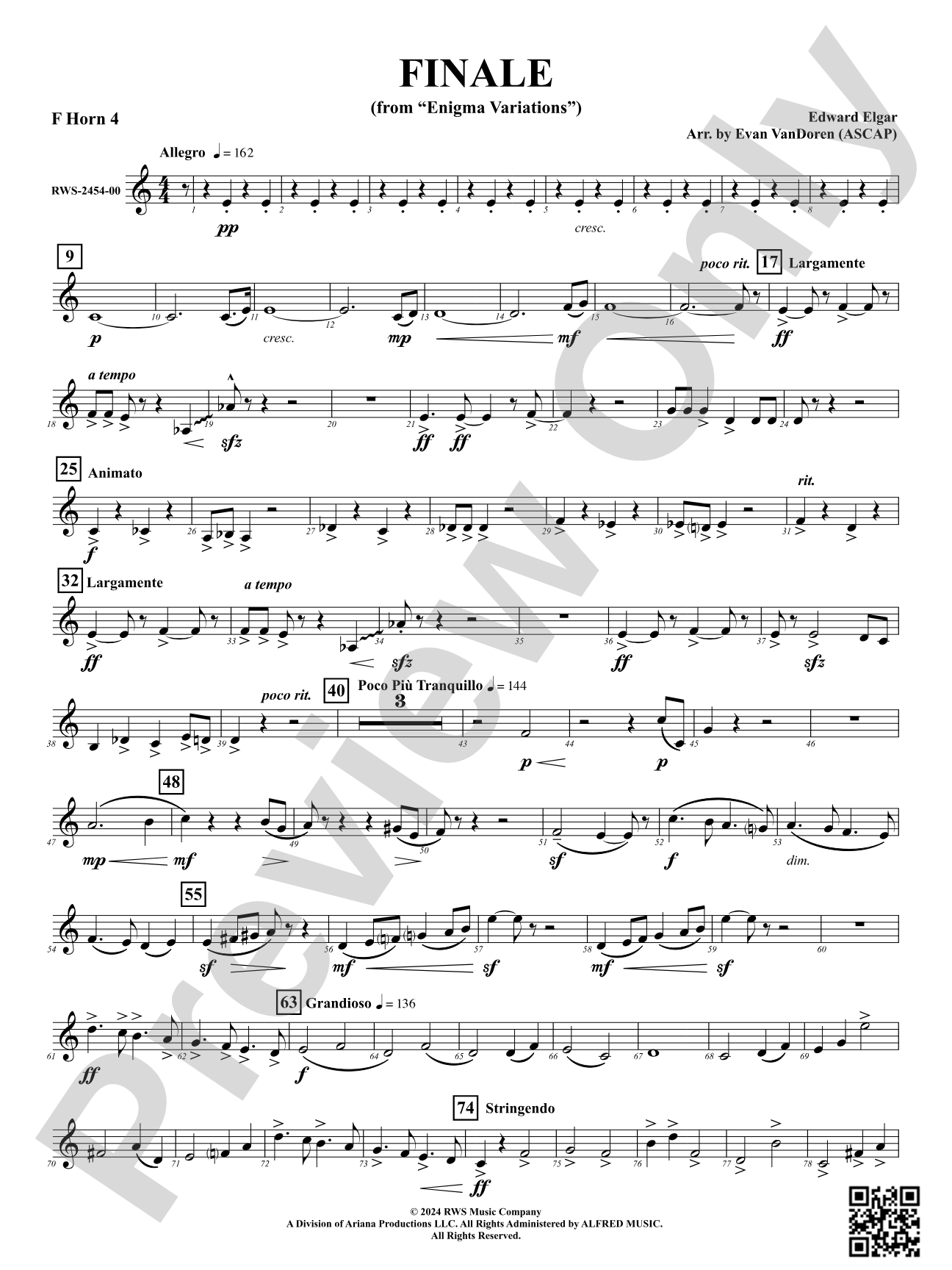
Finale (from "Enigma Variations"): 4th F Horn Sheet Music Preview

Finale (from "Enigma Variations"): 4th F Horn

(from "Enigma Variations")

Edward Elgar / Arr. Evan VanDoren

Grade: 6

Item: 98-PC-RWS2454_H4

Digital Download
$3.99
Description
Evan VanDoren has masterfully crafted Elgar's most memorable and definitive works for the mature brass ensemble. Enigma Variations, characterized by its distinctive portrayal of Elgar's friends and its journey from humor to solemnity, represents a significant milestone in English music. Discover the assertive Finale, encapsulating Elgar's unique musical narrative. Remarkable. (6:18)

Finale (from "Enigma Variations"): 4th F Horn isn't in MakeMusic Cloud just yet...but it could be. Let us know you'd like to see it, and you'll help shape what comes next. In the meantime, start a free trial and dive into thousands of interactive titles your students can play along with today.

Sample Audio
No sample audio found.
Sample Video
Additional Details
Series: RWS - Festival Ensemble
Publisher: RWS Music Company
SKU: 98-PC-RWS2454_H4

More about this title

About the Composer: Edward Elgar

Edward Elgar (1857-1934) stands as one of Britain's most significant composers, known for his grand orchestral works and his ability to capture both intimate character and monumental scale. His compositional voice blends Victorian sensibility with continental sophistication, making him a foundational figure in English musical tradition. Elgar's influence on brass music and ensemble writing remains profound, with his works continuing to anchor the repertoire across all ensemble types.

Why we love this

VanDoren's transcription captures the architectural brilliance of Elgar's original orchestration while giving brass ensembles access to one of English music's most iconic moments. The Finale distills the emotional and thematic journey of the entire Enigma Variations into a single, propulsive statement that rewards both conductor and ensemble with its sweeping rhetorical power. This is repertoire that sounds substantial without requiring a full orchestra.

What to expect

The Finale radiates confidence and resolution, moving with purposeful momentum toward affirmation. The music combines Elgar's gift for grand gesture with moments of contrapuntal intricacy, creating a soundscape that feels simultaneously majestic and intricately constructed. There is warmth beneath the assertiveness, a sense of arrival that feels earned rather than imposed.

Who it's for

Advanced brass ensembles preparing contest or festival programs, as well as groups seeking substantial, concert-worthy repertoire that demands mature musicianship and collaborative balance. Conductors working with college-level or advanced high school ensembles will find this transcription a natural fit for both spring concerts and competitive settings.

How to get the most out of it

  • Balance the contrapuntal voices across the ensemble carefully; the Finale's architecture depends on hearing multiple melodic strands simultaneously rather than defaulting to a single dominant melody
  • Shape the approach to the main theme with architectural control, allowing the statement room to breathe while maintaining the forward momentum that defines this movement
  • Attend to the interplay between upper and lower brass choirs; Elgar's original writing separates these colors intentionally, and preserving that distinction clarifies the harmonic foundation
  • Manage dynamic contrast with precision, particularly in transitions between thematic sections, to avoid the piece feeling monolithic despite its triumphant character

How to use it

Program this as the climax of a concert devoted to English brass music, or as the statement-making final item on a contest program. It pairs naturally with other Elgar orchestrations or with contemporary British brass repertoire, anchoring a program through its architectural authority and emotional resonance.

Skills your students will build

  • Balancing independent melodic lines within a harmonic texture
  • Executing controlled dynamic transitions across multiple sections
  • Shaping long-form thematic statements with musical architecture
  • Collaborative ensemble playing at Grade 6 difficulty and above
  • Interpreting rubato and flexibility within a structured formal design

You May Also Like