

Final Voyage: 2nd Violin
By Kathryn Griesinger
Grade: 4
Item: 00-PC-0019576_VN2
$3.00
Pickup currently not available
Description
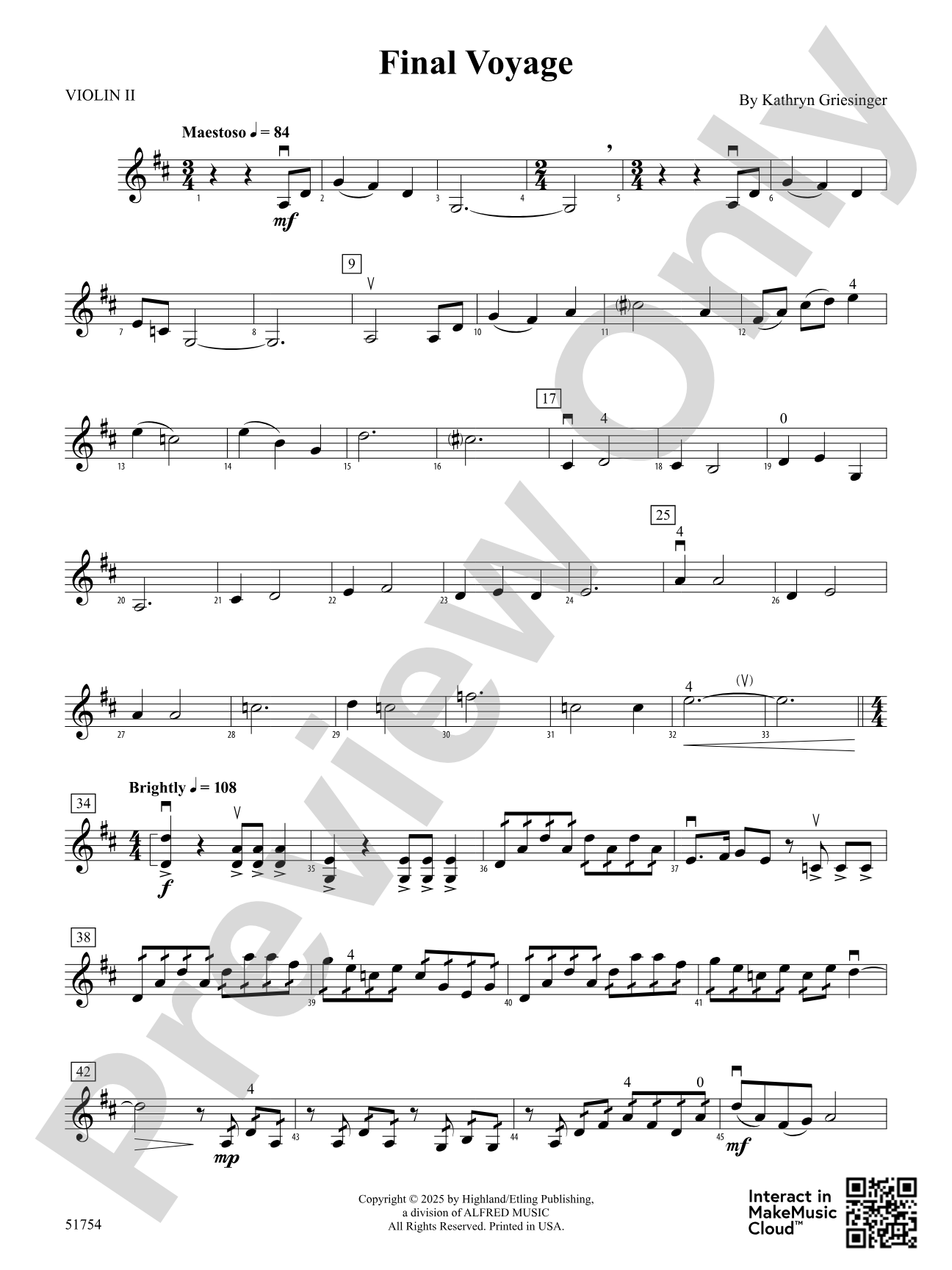
Final Voyage by Kathryn Griesinger depicts setting sail on a grand adventure, beginning with a noble opening theme. Like the fresh dawn, a motif in D major rises, signaling a hopeful start to a new day. A sudden tempo change introduces new rhythmic activity, featuring busy doubled eighth notes and double stops as the journey picks up momentum. The travelers take a turn to A major, continuing to develop the motif before the music drifts slowly into a mysterious channel in parallel A minor. The mists of uncertainty are only brief, however, as the music builds in power, like the bright sun breaking through. As the horizon is clearly seen once again, the original theme returns, broad and majestic, to carry the adventurers to a glorious finale. (3:25)


Final Voyage: 2nd Violin isn't in MakeMusic Cloud just yet...but it could be. Let us know you'd like to see it, and you'll help shape what comes next. In the meantime, start a free trial and dive into thousands of interactive titles your students can play along with today.
Request This Title
Tell us you want it.
Start Your Free Trial
Explore everything that's ready to play right now.
Sample Audio
1
Audio File
--:--
0:00
0:00
Sample Video
Additional Details
Series:
Highland String Orchestra
Publisher:
Alfred Music
SKU:
00-PC-0019576_VN2
More about this title
About the Composer: Kathryn Griesinger
Kathryn Griesinger has built a reputation as a composer who writes music with genuine narrative arc. Her work for young ensembles consistently balances musical substance with accessibility, creating pieces that engage both players and audiences without sacrificing integrity.
Griesinger's compositions reflect a strong understanding of how student musicians develop. She writes idiomatically for each instrument while creating arrangements that allow younger players to feel the emotional weight of the music they're performing.
Why we love this
Griesinger crafts a narrative arc that feels earned rather than imposed, moving through contrasting harmonic regions and textures without losing cohesion. The structural clarity makes it ideal for festival adjudication, yet the programmatic journey gives students something concrete to imagine while they play. String orchestras at this level rarely get pieces that balance accessible technical writing with genuine dramatic weight.
What to expect
Cinematic and adventurous, with moments of genuine mystery balanced against optimistic returns. The music evokes both the scope of exploration and the vulnerability of venturing into unknown waters, ultimately settling on triumph and resolution.
Who it's for
String orchestras in grades 4 and above who are ready to engage with programmatic storytelling and harmonic language beyond diatonic writing. This work rewards ensembles with strong intonation control and the maturity to sustain character across distinct sections.
How to get the most out of it
- Shape the opening D major theme with a singing tone and clear phrasing; the nobility of the initial gesture sets the emotional foundation for the entire voyage.
- Bring out the rhythmic vitality when the tempo shifts and doubled eighth notes enter. Subdivide internally to maintain precision while keeping the energy propulsive rather than frantic.
- Honor the shift to A minor as a genuine turn toward introspection. Darken the sound here without losing the forward motion; this moment proves the contrast when brightness returns.
- Build the climactic return of the main theme gradually and inevitably. The final push should feel like a swell of confidence rather than an abrupt assertion.
How to use it
This piece carries enough musical substance and dramatic arc to anchor a festival performance or serve as the centerpiece of a concert exploring journeys and transformation. Its three-and-a-half-minute length makes it a natural pairing with shorter works or as part of a thematic program.
Skills your students will build
- Playing in parallel minor and major tonalities (D major and A minor)
- Executing sustained double stops with intonation accuracy
- Managing tempo changes and transitions between contrasting rhythmic textures
- Responding to programmatic architecture by shaping phrasing and dynamics around a narrative structure
- Balancing rhythmic precision in doubled eighth-note passages with forward melodic momentum