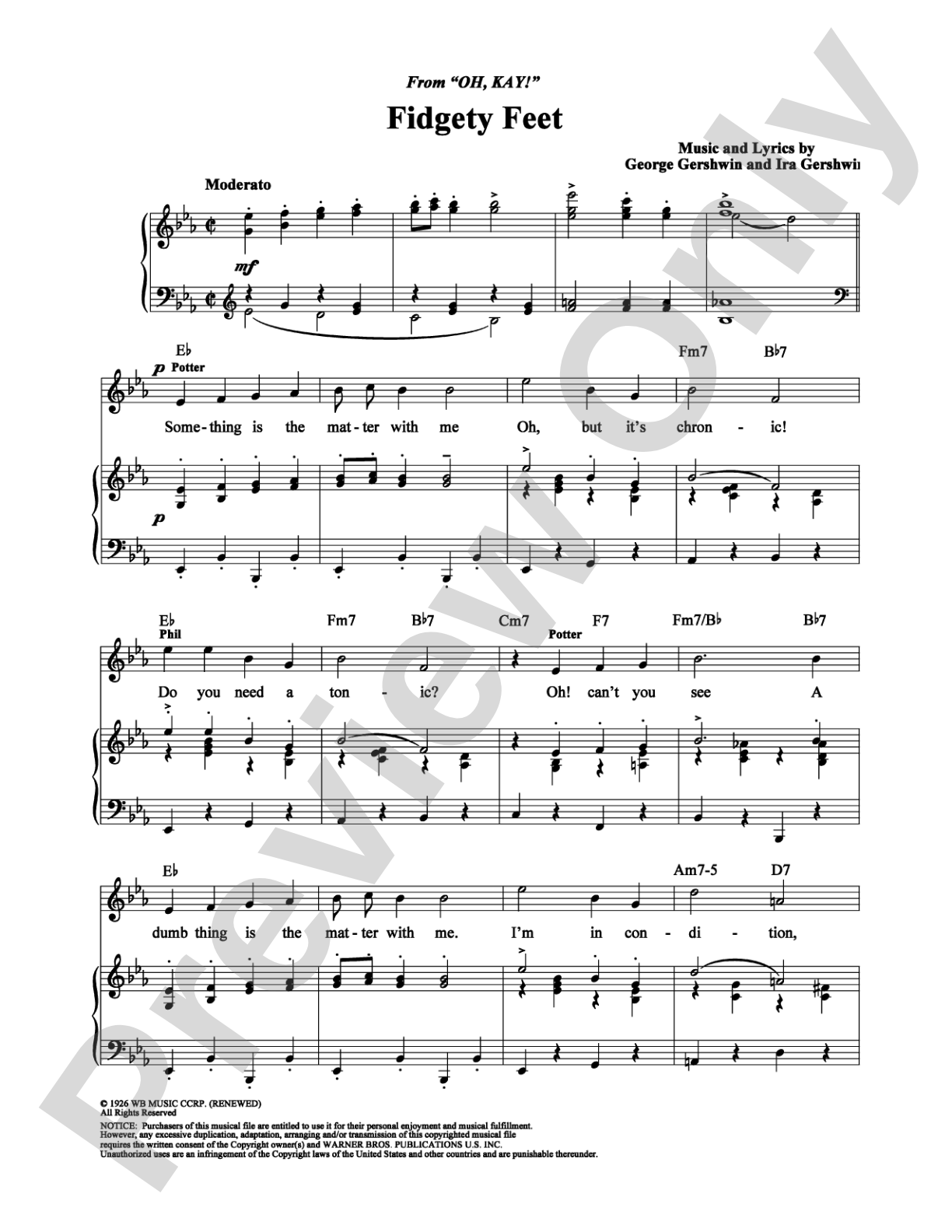
Fidgety Feet: Piano/Vocal/Chords Digital Sheet Music

Fidgety Feet: Piano/Vocal/Chords Digital Sheet Music

George Gershwin

Item: 00-PS-0008647

Digital Download
$3.99
Description

Fidgety Feet: Piano/Vocal/Chords Digital Sheet Music isn't in MakeMusic Cloud just yet...but it could be. Let us know you'd like to see it, and you'll help shape what comes next. In the meantime, start a free trial and dive into thousands of interactive titles your students can play along with today.

Sample Audio
No sample audio found.
Sample Video
Additional Details
SKU: 00-PS-0008647

More about this title

Why we love this

The chord symbols make this accessible for pianists who read lead sheets or want to explore comping and reharmonization without being locked into a single arrangement. It's a standard that works equally well in a jazz context, a cabaret setting, or a singer-pianist studio lesson.

What to expect

Rhythmically buoyant and conversational, with a title that promises lightness and movement. The standard form gives it a familiar anchor, so both singer and accompanist can focus on phrasing and character rather than learning unfamiliar harmonic territory.

Who it's for

Singer-pianists preparing audition material or rehearsal repertoire, and piano students learning to comp from a lead sheet. It's also useful for music theater programs and jazz ensembles looking for accessible standards with proven melodic appeal.

How to get the most out of it

  • Experiment with the rhythmic pocket behind the vocal line. The title suggests playfulness, so let the accompaniment breathe rather than sit rigidly on the beat.
  • Use the chord symbols to craft your own voicings. Close-position triads work, but exploring seventh chords and extensions can add sophistication that matches a mature vocalist's interpretation.
  • Balance the melody so it sits naturally above your accompaniment. Check that your left-hand comping doesn't obscure the lyrical line, especially in slower passages.

How to use it

Pair it with other standards in a themed cabaret or recital, or use it as a sight-reading and transposition study in a group piano class. It also serves well as a duet between student singers and advanced pianists in a studio setting.

Skills your students will build

  • Reading and interpreting chord symbols in a melodic context
  • Comping and reharmonization from a lead sheet
  • Balancing vocal melody with piano accompaniment
  • Rhythmic flexibility and swing feel (if interpreted in a jazz idiom)

You May Also Like