
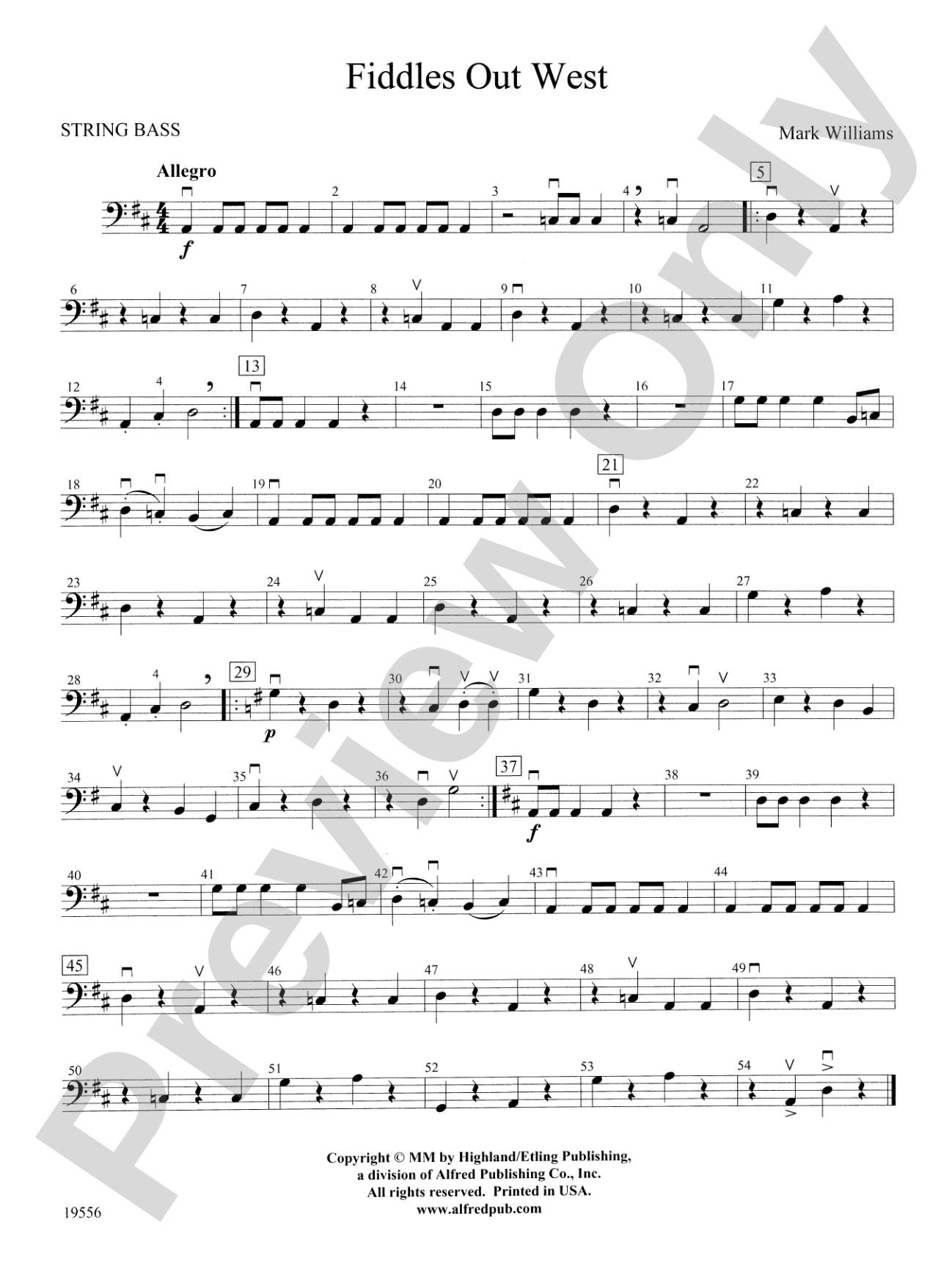

Fiddles Out West: String Bass
By Mark Williams
Grade: 2
Item: 00-PC-0000338_SB
$5.99
Pickup currently not available
Description
Rosin up the bow and get ready for a rip-roarin' good time! The spirit of the Old West rides again in this lively Mark Williams original. Correlated with page 30 of Strictly Strings, Book 1, this exciting work gives students a chance to show off their newly learned low 2nd finger (C natural on the A string). Your students will want to play this one again and again!


Don't just read it, hear it, play along with it, and watch your students grow with it. In MakeMusic Cloud, Fiddles Out West: String Bass comes alive with professional accompaniment, adjustable tempo, and built-in practice tools that turn solo practice into real progress.
Open in the Player
Jump straight in and assign it today.
Start Your Free Trial
Open this title and explore the full library in minutes.
Sample Audio
1
Audio File
--:--
0:00
0:00
Sample Video
No sample videos found.
Additional Details
Series:
Highland/Etling Strictly Strings
Publisher:
Alfred Music
Page Count:
72
SKU:
00-PC-0000338_SB
More about this title
About the Composer: Mark Williams

Mark Williams composed over 200 works for school bands, orchestras, and choirs during a prolific career that established him as one of the most performed composers in American music education. His influence extended across the continent through his dual role as clinician and guest conductor, visiting 34 states, five Canadian provinces, and Australia to share his compositional philosophy and mentor young musicians.
A native of Chicago who spent his formative years in Spokane, Washington, Williams earned degrees from Eastern Washington University and brought deep pedagogical insight to everything he wrote. He taught elementary band in Washington schools for many years, co-authored the Accent on Achievement Band Method, and served as woodwind performer and arranger for the 560th Air Force Band. His versatility encompassed bassoon performance and artistic leadership with the Spokane British Brass Band, while recognition from competitions like the Western International Band Clinic's Gralia Competition and multiple ASCAP Special Awards affirmed his standing among peers.
Why we love this
Williams wrote this piece with genuine understanding of how young string players learn, anchoring it to a specific pedagogical moment (low 2nd finger on the A string) rather than writing around that technical challenge. The Western fiddle idiom gives students permission to play with infectious energy and attitude, which often matters more than perfect technique at this level. Your section will want to perform it multiple times because the piece itself is genuinely fun to play, not just pedagogically useful.
What to expect
Dust and energy, honky-tonk rhythm, and the swagger of a frontier square dance. The piece captures the spirit of rollicking Old West fiddle music with straightforward melodies that sit comfortably under the hand and harmonies that support rather than distract.
Who it's for
String orchestras in grades 2-3 who have progressed through foundational shifting and finger patterns and are ready to add low 2nd finger work in a musically engaging context. This works well for ensembles that can handle two-part writing and want a piece that motivates independent practice because students genuinely enjoy playing it.
How to get the most out of it
- Establish a steady, driving tempo before rehearsal begins. The fiddle character depends on rhythmic confidence from the ensemble, so lock the pulse early rather than building it gradually over several rehearsals.
- Draw attention to the quality of the C natural intonation on the A string, since that's the new technical skill students are showcasing. Ask your principal violinist to demonstrate and listen carefully during sectionals.
- Encourage open, bright tone production rather than the softer singing tone students may have learned elsewhere. Western fiddle music sits naturally in a more energetic tonal palette.
- Balance the parts so the melody stays in front without overwhelming your lower strings. This piece works best when all four parts are clearly audible.
How to use it
This pairs naturally with spring concerts celebrating American heritage or regional themes, and its manageable length makes it ideal as an opening number that energizes an audience while warming up your ensemble. Since it correlates directly with Strictly Strings Book 1 page 30, use it as the culminating performance moment for that specific unit of study.
Skills your students will build
- Low 2nd finger (C natural) on the A string
- Rhythmic unison in a driving tempo
- Articulation and tone quality appropriate to fiddle style
- Part independence in two-part writing