
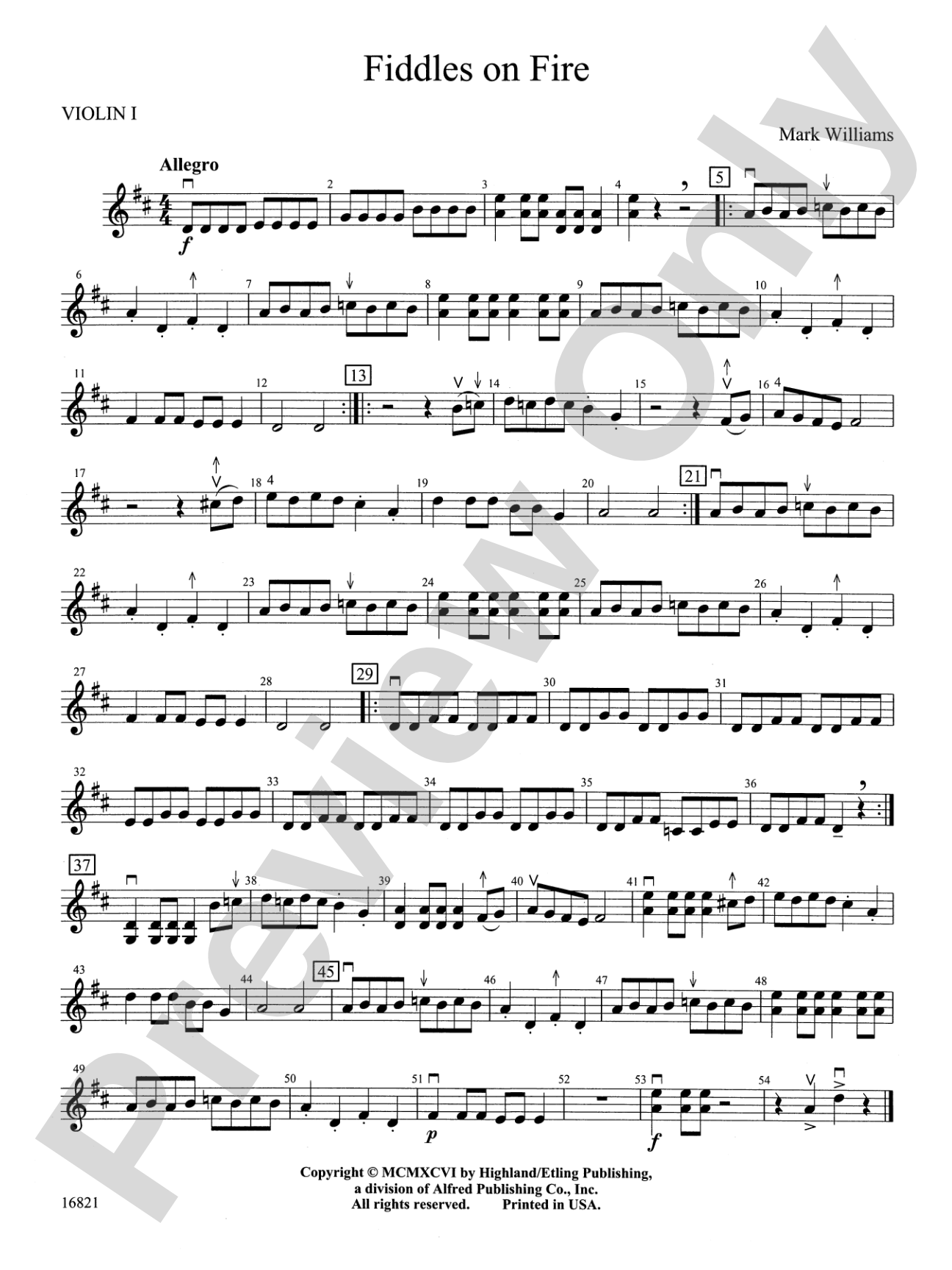

Fiddles on Fire: 1st Violin
By Mark Williams
Grade: 1
Item: 00-PC-0000196_VN1
$5.99
Pickup currently not available
Description
Rosin up the bow, call out the fire department, and let's go! This lively, energetic piece gives students a chance to show off their newly learned C natural (on the A string) in a modal display of beginning virtuosity. Students will want to play this one again and again. (Grade 1 - Correlates with Strictly Strings, Book 1, page 30) This title is available in MakeMusic Cloud.


Don't just read it, hear it, play along with it, and watch your students grow with it. In MakeMusic Cloud, Fiddles on Fire: 1st Violin comes alive with professional accompaniment, adjustable tempo, and built-in practice tools that turn solo practice into real progress.
Open in the Player
Jump straight in and assign it today.
Start Your Free Trial
Open this title and explore the full library in minutes.
Sample Audio
1
Audio File
--:--
0:00
0:00
Sample Video
Additional Details
Series:
Highland/Etling Strictly Strings
Publisher:
Alfred Music
Page Count:
72
SKU:
00-PC-0000196_VN1
More about this title
About the Composer: Mark Williams

Mark Williams shaped generations of young musicians through his prolific output of works for school ensembles. With over 200 compositions to his name and co-authorship of the Accent on Achievement Band Method, he became a trusted voice in music education across North America and beyond. His teaching career in Washington state focused on elementary band, where he refined his understanding of what young players could achieve and enjoy.
As a clinician and guest conductor, Williams traveled extensively to 34 states, five Canadian provinces, and Australia, bringing his pedagogical insights directly to classrooms and concert halls. He earned recognition from the Western International Band Clinic's Gralia Competition and multiple ASCAP Special Awards for his work in band, orchestra, and choral composition. Williams held degrees in education from Eastern Washington University and balanced his composing life with performing on bassoon and conducting the Spokane British Brass Band.
Why we love this
Beginning string orchestras need repertoire that excites students without overwhelming them, and this piece nails that balance. The modal context and focus on C natural on the A string give students a concrete technical target while the energetic fiddle idiom keeps them engaged enough to actually want multiple run-throughs. It's the kind of writing that makes you realize why Williams was so respected by directors.
What to expect
Fiddle music with genuine swagger. The piece crackles with energy and purpose, giving young players a taste of folk idiom without requiring technical sophistication beyond their level. It's the kind of bright, driving character that makes rehearsal feel less like work and more like play.
Who it's for
String orchestras working at Grade 1 level, particularly those using the Strictly Strings curriculum. It works well for programs ready to move beyond pure etude-style material into pieces with genuine musical character. Perfect for students who have just mastered C natural on the A string and need a reason to celebrate that skill.
How to get the most out of it
- Keep the energy consistent throughout by maintaining the character of the opening right to the final measure. Young players can rush fiddle-style pieces or drag them, so a steady pulse from the podium matters.
- Spotlight the C natural passages so the technical achievement feels rewarding. Let that note ring and make sure intonation is clean when it appears.
- Balance the bowing across the section for texture. Since this correlates with Strictly Strings Book 1, your students are probably using a mix of stroke types. Coordinate them so the piece sounds unified rather than scattered.
How to use it
Slot this into a winter or spring concert where you want a moment of levity and audience engagement. The fiddle style gives it natural appeal beyond the typical school orchestra audience, and younger siblings watching from the audience will absolutely respond to the energy. It also works beautifully as a confidence builder mid-rehearsal cycle when students need a win before tackling heavier material.
Skills your students will build
- C natural (A string) intonation and tone production
- Rhythmic security in a modal context
- Stylistic interpretation of fiddle idiom
- Sustained ensemble energy and articulation clarity
- Reading and executing varied bow strokes as a unified section