
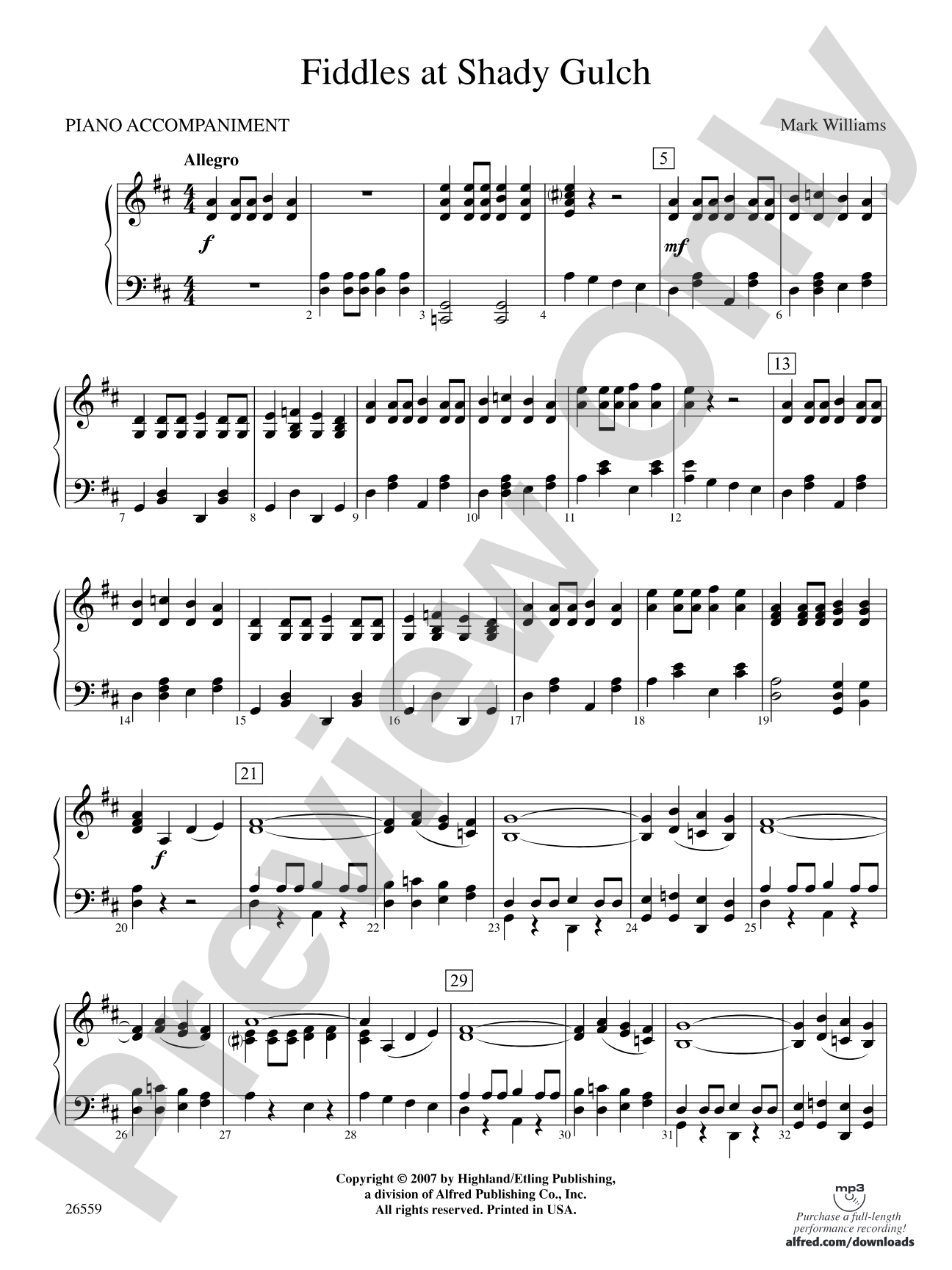

Fiddles at Shady Gulch: Piano Accompaniment
By Mark Williams
Grade: 1.5
Item: 00-PC-0001076_K
$5.99
Pickup currently not available
Description
This rip-roarin' fiddle tune gives students lots of experience playing easy double stops using one open string and one fingered note. A solid crowd pleaser, this fun selection is correlated to Strictly Strings Book 1, page 35. This motivating work provides excellent bow-hand practice, as well as opportunities for working on second-finger alterations in the violins. Your students will want to play this one repeatedly! This title is available in MakeMusic Cloud.


Don't just read it, hear it, play along with it, and watch your students grow with it. In MakeMusic Cloud, Fiddles at Shady Gulch: Piano Accompaniment comes alive with professional accompaniment, adjustable tempo, and built-in practice tools that turn solo practice into real progress.
Open in the Player
Jump straight in and assign it today.
Start Your Free Trial
Open this title and explore the full library in minutes.
Sample Audio
1
Audio File
--:--
0:00
0:00
Sample Video
No sample videos found.
Additional Details
Series:
Highland/Etling Strictly Strings
Publisher:
Alfred Music
Page Count:
36
SKU:
00-PC-0001076_K
More about this title
About the Composer: Mark Williams

Mark Williams composed over 200 works for school bands, orchestras, and choirs, establishing himself as a trusted voice in music education. His extensive background includes co-authoring the Accent on Achievement Band Method, earning him recognition through awards like the Gralia Competition and multiple ASCAP citations. Williams spent decades teaching music in Washington state with particular focus on elementary band, and traveled as a clinician and guest conductor across 34 states, five Canadian provinces, and Australia.
Beyond his prolific compositional output, Williams was an active musician himself, performing bassoon regularly and serving as conductor and artistic director for the Spokane British Brass Band. His education credentials from Eastern Washington University, combined with his years of classroom experience and his service as woodwind performer and arranger for the 560th Air Force Band, gave him deep insight into what works for young musicians learning their craft.
Why we love this
Williams wrote this tune with a clear understanding of what Grade 1.5 students need: accessible rhythms, straightforward harmonic language, and technical challenges that build confidence rather than frustration. The focus on double stops with open strings paired against single fingered notes creates bow-hand security and intonation awareness without overwhelming young players. It's the kind of piece that generates genuine excitement in rehearsal because students hear themselves sounding polished within days.
What to expect
Fiddles at Shady Gulch radiates charm and humor with its western character and rollicking rhythm. The tune bounces along with the kind of infectious energy that makes young musicians grin while they play, and the double stops add shimmer and fullness that feels surprisingly mature. It's the sound of a one-room-saloon dance band translated into a learning context, unpretentious and genuinely fun.
Who it's for
String orchestra directors teaching at the Grade 1.5 level who use Strictly Strings Book 1 will find this correlated perfectly to page 35 and its double stop studies. Players ready to move beyond single notes but still building foundational technique benefit from the straightforward ranges and accessible rhythms. This works well as a morale booster during the first year of study when students need repertoire that sounds polished quickly.
How to get the most out of it
- Address the double stop fingerings before running the piece at tempo; having violins isolate the open string and fingered note combination for even eighth notes establishes muscle memory that transfers immediately when the melody moves.
- Balance between the voices matters in this tune. Work the bass line and lower voice independence so the melody sits clearly on top without drowning out the harmonic support underneath.
- Keep the energy forward and light. This fiddle tune thrives on rhythmic momentum, so encourage consistent bow speed and even bow distribution across the double stops to maintain the buoyant feel.
- Watch for second-finger intonation in the violins. Use those moments during rehearsal to drill the specific finger placement and reinforce the feel of the interval so students self-correct with less intervention.
How to use it
This piece fits naturally into a concert as a standalone crowd pleaser or as a witty pairing alongside a more serious selection on the same program. Early fall rehearsals benefit from its pedagogical clarity and morale-building appeal, while winter or spring concerts can feature it as a secondary work that showcases the orchestra's polish and personality. Its novelty appeal makes it an audience favorite at family concerts and informal performances.
Skills your students will build
- Double stops using one open string and one fingered note
- Bow hand consistency and control across multiple voices
- Second-finger intonation and placement in the violins
- Bass line and harmonic voice independence
- Rhythmic precision in fiddle-style phrasing