
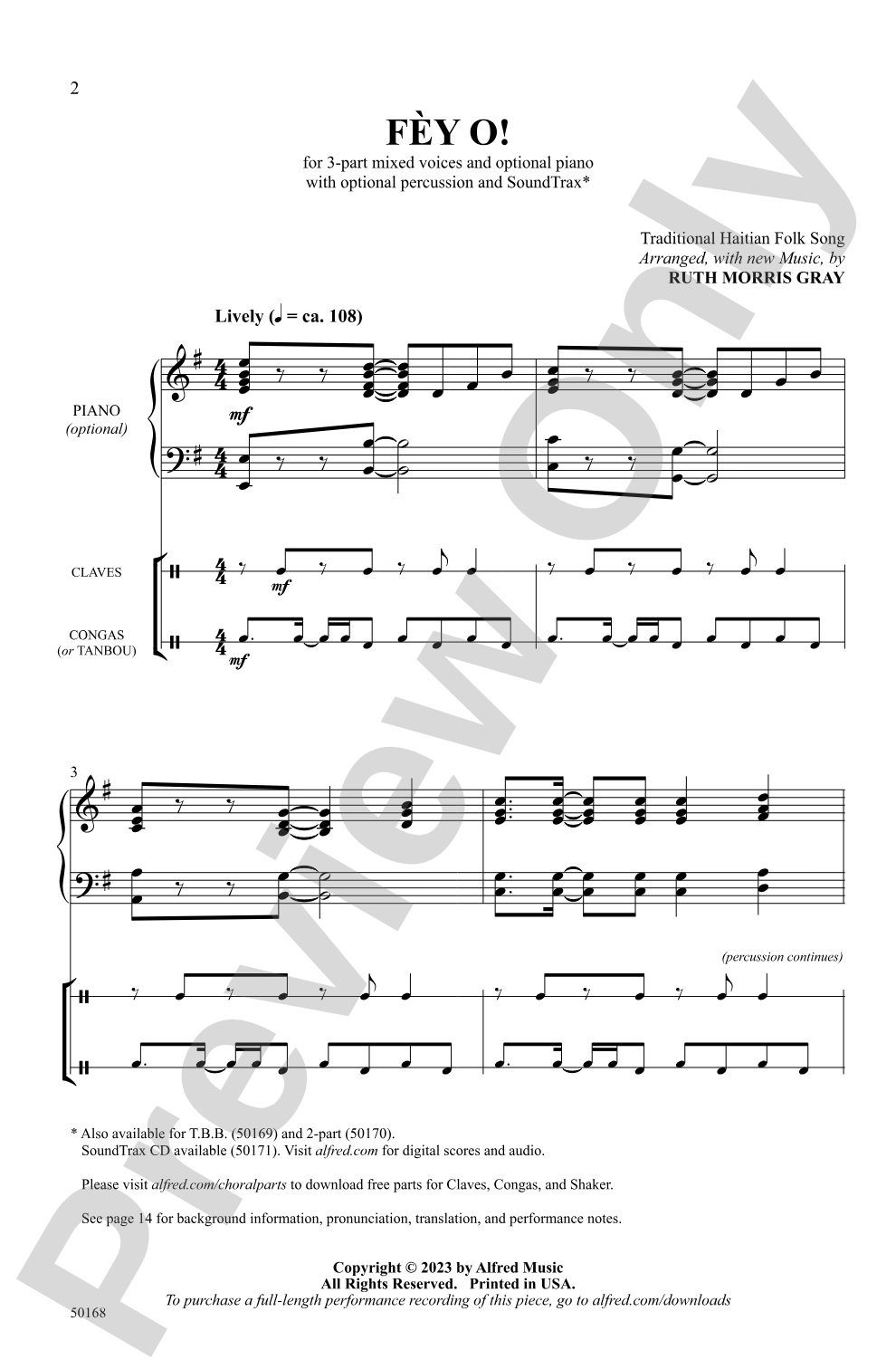
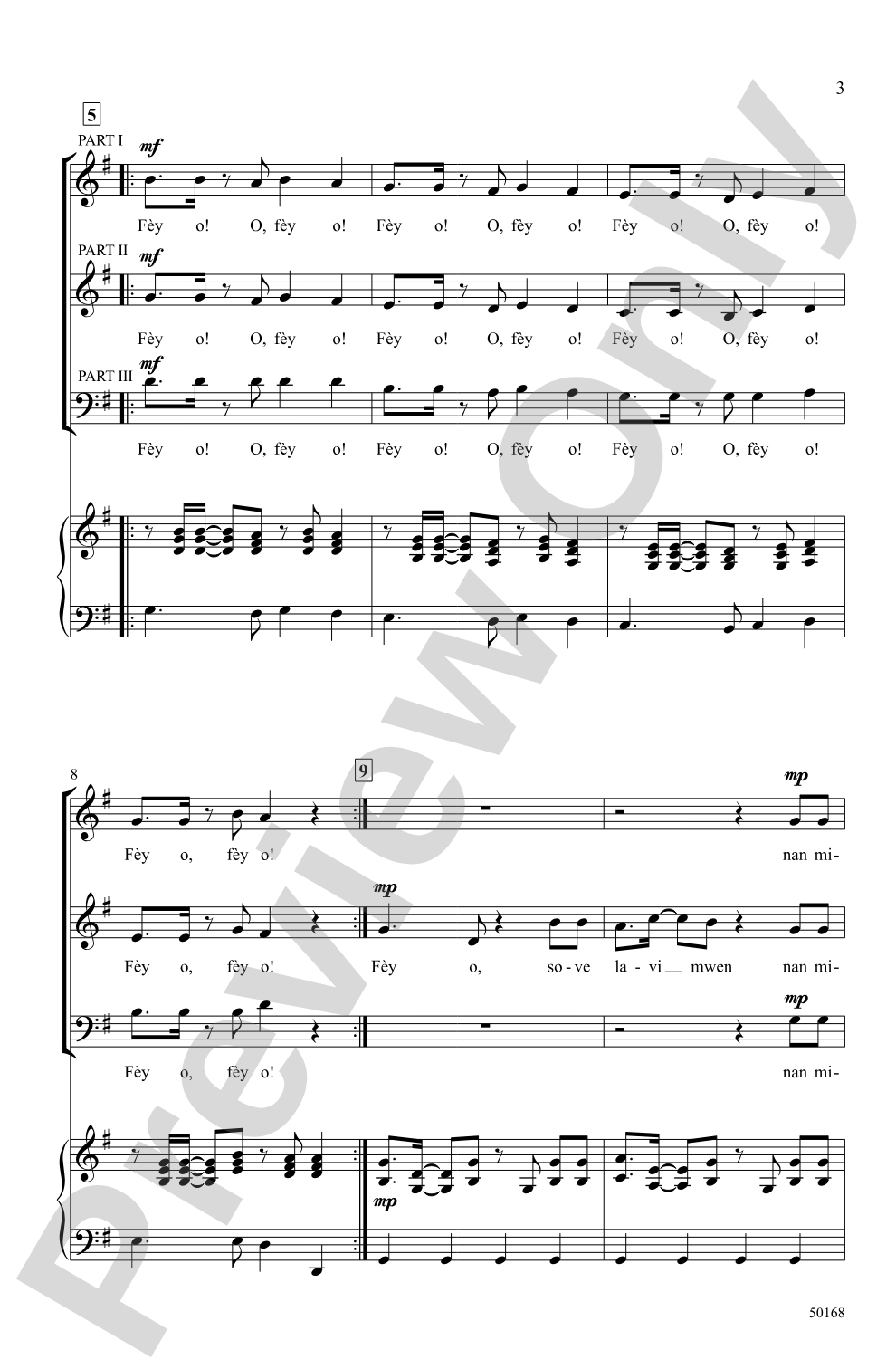
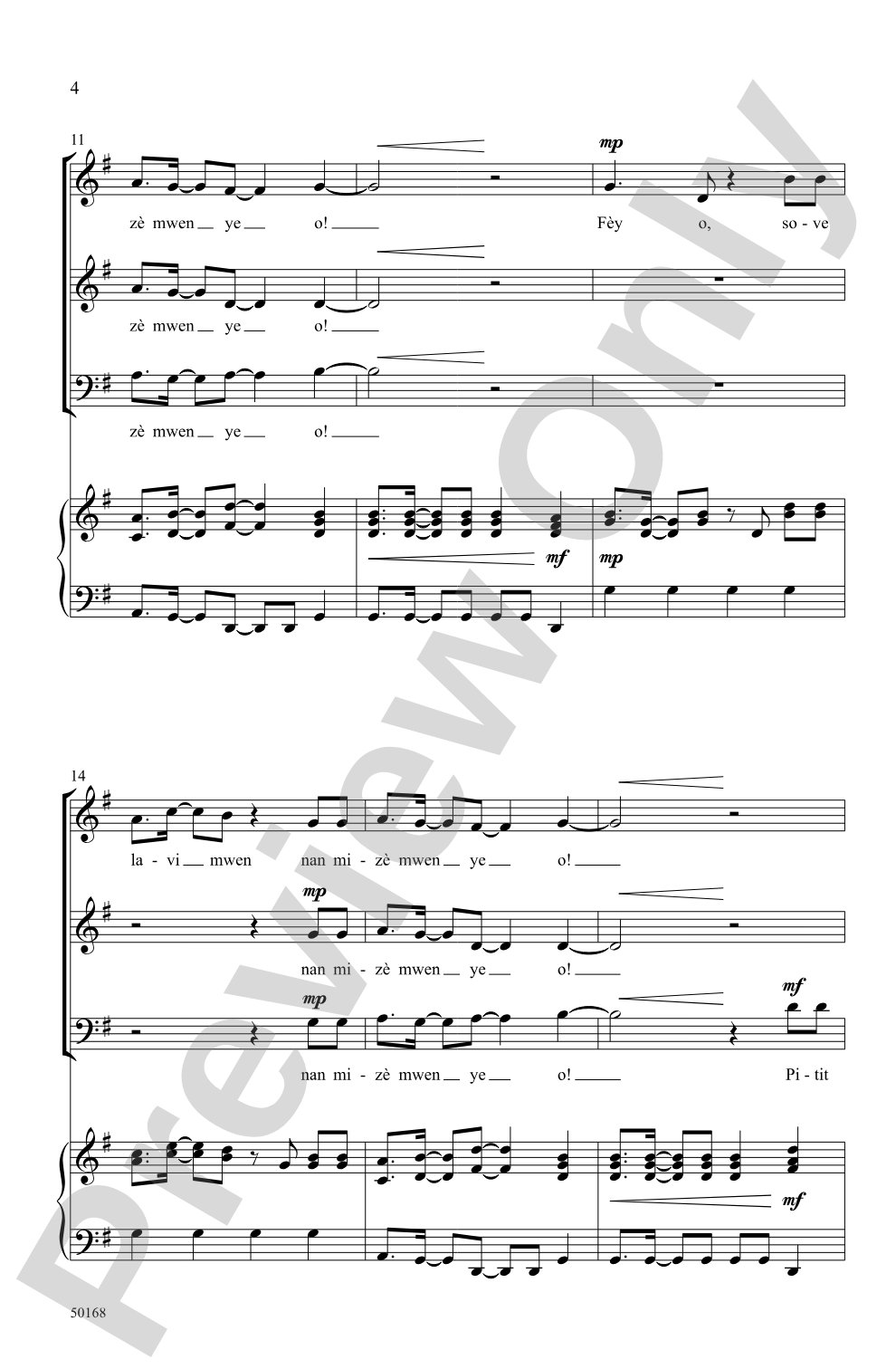

Fèy O!: 3-Part Mixed Choral Octavo
Traditional Haitian Folk Song / arr. with new music by Ruth Morris Gray
Item: 00-PO-0007033
$2.20
Minimum order quantity: 20 copies
Pickup currently not available
Description
Lively percussion and rhythmic choral phrases reflect the urgency of a parent seeking healing herbs for a sick child. Sung entirely in Creole, this song is well-known across Haiti and beyond. The arrangement punctuates a faithful interpretation of the folk song with new material and can be performed with or without piano. Claves, congas, and shaker parts are free to download at alfred.com/choralparts.


Discover MakeMusic Cloud: thousands of interactive titles your students can play along with today.
Sample Audio
1
1 Fèy O! (Full Performance)
--:--
2
2 Fèy O! (A Capella)
--:--
1 Fèy O! (Full Performance)
0:00
0:00
Sample Video
Additional Details
Series:
Alfred Choral Designs
Publisher:
Alfred Music
Page Count:
16
SKU:
00-PO-0007033
Instrumentation:
Percussion
More about this title
About the Arranger: Ruth Morris Gray

Ruth Morris Gray directs choirs at Rosemead High School in California, where she has shaped the vocal program since 2004. She holds a Bachelor of Music in Piano Performance and Composition from Biola University and a Master of Arts in Music Composition from UC Santa Barbara, complemented by her California Single Subject Music Credential from Cal State Northridge.
With over 100 published choral compositions to her credit, Gray brings both compositional depth and classroom experience to her arrangements. Her work spans multiple genres and cultural traditions, reflecting her commitment to bringing diverse voices and stories into the choral rehearsal room.
Why we love this
Gray's arrangement honors the folk song's emotional core while adding sophisticated rhythmic and harmonic layers that elevate it beyond a simple transcription. The option to perform with or without piano, combined with freely available percussion parts, makes this accessible to choirs at different resource levels without sacrificing musical integrity or cultural authenticity.
What to expect
Urgent and propulsive, yet grounded in the specificity of a parent's desperate search for medicine. The percussion pulses like a heartbeat while the Creole text cuts through with directness and emotional clarity, creating an arrangement that feels both rooted in tradition and alive in the moment.
Who it's for
Choirs at the middle school through high school level seeking meaningful multicultural repertoire that tells a human story. This works especially well for ensembles with access to percussionists or singers willing to double on simple percussion parts, and for programs exploring world music, social justice themes, or global folk traditions.
How to get the most out of it
- Keep the claves and congas driving forward as a heartbeat throughout; they anchor the urgency of the narrative and should remain steady even as the choral phrases breathe.
- Balance the three voice parts so the melody stays clear in the soprano line while the alto and baritone parts provide harmonic support without overshadowing.
- Practice the Creole text with intentional articulation and vowel clarity; the rhythm and percussion will tighten naturally once singers feel confident with pronunciation and phrasing.
- If using piano accompaniment, let it enhance rather than lead; the percussion and voices are the primary drivers of the arrangement.
How to use it
Pair this with other world music selections to build a concert theme around folk traditions and cultural storytelling, or program it in a set exploring music as a vehicle for community resilience. Its compact length and contest-friendly appeal also make it ideal for festival competitions where cultural authenticity and engaging arrangement both matter.
Skills your students will build
- Reading and performing text in a non-English language (Haitian Creole)
- Maintaining rhythmic precision against syncopated percussion
- Part independence in three-part mixed voicing
- Interpreting folk music with cultural sensitivity and historical context
- Coordinating with percussion accompaniment and responding to instrumental cues