
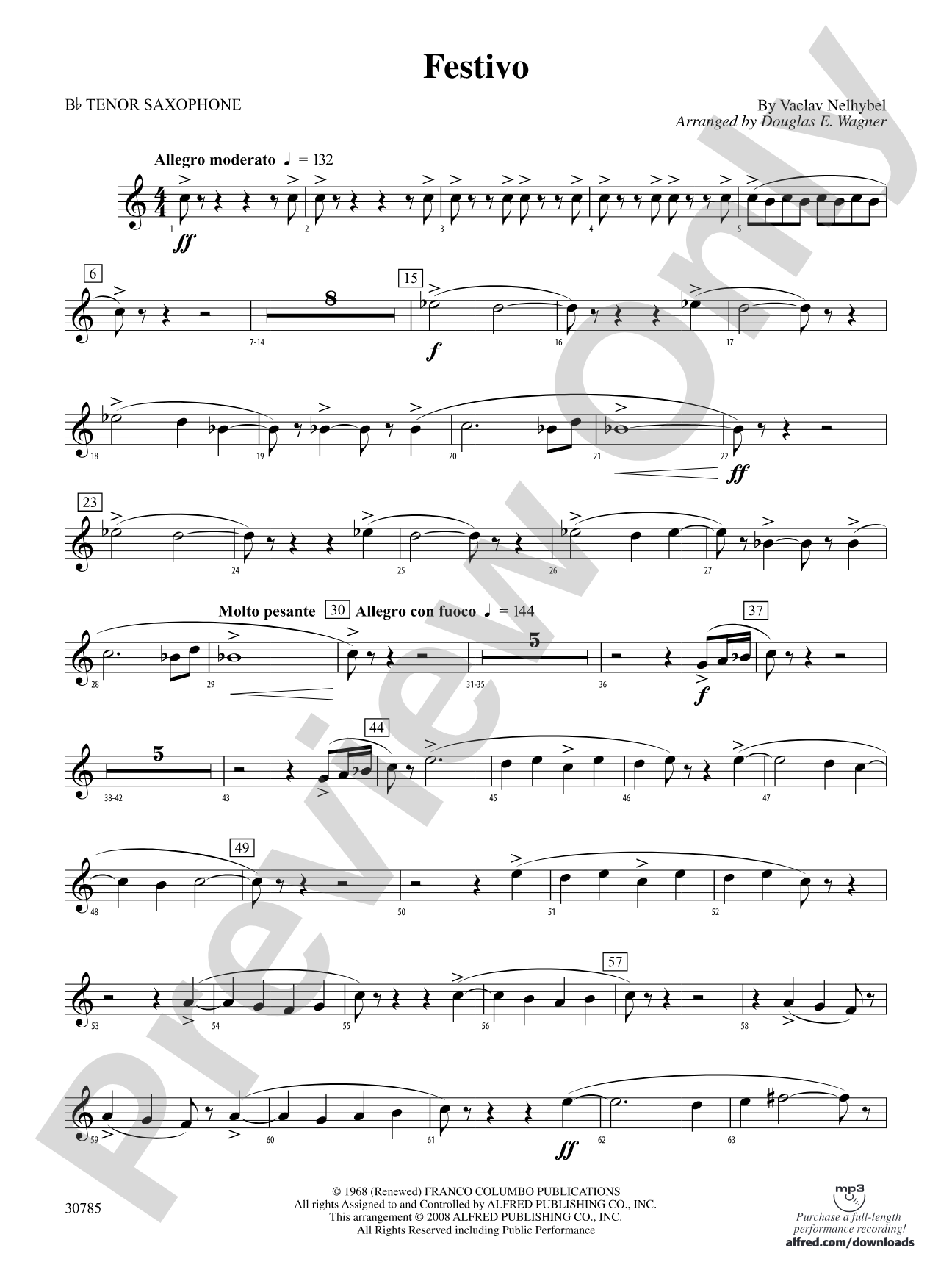

Festivo: B-flat Tenor Saxophone
By Václav Nelhýbel / arr. Douglas E. Wagner
Grade: 2 (Easy)
Item: 00-PC-0001677_TX1
$3.00
Pickup currently not available
Description
A perennial favorite on concert and contest programs for decades, Nelhybel's Festivo has been re-scored to target the young band. Accessible to a wider variety of ensembles, this reduction is a welcomed addition to the literature. Bold and impressive, this arrangement will certainly be met with acclaim. Bravo! This title is available in MakeMusic Cloud.


Don't just read it, hear it, play along with it, and watch your students grow with it. In MakeMusic Cloud, Festivo: B-flat Tenor Saxophone comes alive with professional accompaniment, adjustable tempo, and built-in practice tools that turn solo practice into real progress.
Open in the Player
Jump straight in and assign it today.
Start Your Free Trial
Open this title and explore the full library in minutes.
Sample Audio
1
Audio File
--:--
0:00
0:00
Sample Video
No sample videos found.
Additional Details
Series:
Pop Young Band
Publisher:
Alfred Music
Page Count:
252
SKU:
00-PC-0001677_TX1
More about this title
About the Composer: Vaclav Nelhybel
Vaclav Nelhybel (1919-1996) was a Czech-American composer who wrote extensively for band and orchestra. His works became staples of the concert band repertoire, prized for their melodic craftsmanship and orchestral color. Festivo stands among his most performed compositions, a testament to its immediate appeal and structural integrity.
Nelhybel's music bridges accessible writing and genuine artistic substance. His band works appear regularly on festival and contest schedules worldwide, and his influence on American band composition remains significant decades after his death.
Why we love this
Douglas E. Wagner's reduction preserves every ounce of Nelhybel's original sparkle while making the piece genuinely playable for young ensembles. This is not a simplified version that sacrifices the joy of the music; it's a thoughtfully crafted arrangement that respects both the composer's vision and your students' developing skills. You get a piece that sounds finished, impressive, and contest-ready at Grade 2.
What to expect
Festivo radiates optimism and forward motion. Bright, tuneful themes dance across the ensemble while a steady rhythmic pulse propels the music forward with infectious energy. The piece feels celebratory without being frivolous, offering plenty of room for young musicians to experience the satisfaction of playing something both spirited and substantial.
Who it's for
Young concert bands at the Grade 2 level who want a piece that sounds far more mature than its technical demands. This works equally well for beginning high school bands, accomplished middle school ensembles, and smaller community groups seeking a work of genuine musicianship that audiences will recognize and enjoy.
How to get the most out of it
- Shape the melodic lines with legato phrasing, even in the faster passages. Young players often rush through festive material; encourage them to sing through their parts rather than simply articulate the notes.
- Balance the primary melody against the accompaniment by listening to the trumpet and clarinet lines separately in rehearsal. The arrangement will breathe naturally if the inner voices stay appropriately recessed.
- Lock the rhythmic foundation early. Establish the pulse with your percussion and low reeds before rehearsing full sections; a solid rhythmic foundation lets the upper voices focus on musical gesture rather than staying in place.
- Mark the dynamic shifts explicitly in your parts. Young bands often miss subtle changes in texture; highlighting these moments ensures the piece unfolds with the intended contrast and energy.
How to use it
This is an ideal opener for a concert program or a strong closer for a festival performance. Its accessibility and immediate appeal work beautifully as a confidence builder earlier in the season or as a crowd-pleasing finale. The piece also pairs naturally with other Grade 2 classics, allowing you to program an engaging concert that showcases your band's range without overextending your rehearsal time.
Skills your students will build
- Maintaining steady ensemble tempo through energetic, repetitive figures
- Balancing melodic and accompaniment roles within a homophonic texture
- Responding to subtle dynamic and articulation contrasts
- Sustaining musicality in accessible, straightforward harmonic progressions
- Building confidence in reading and performing standard concert band repertoire