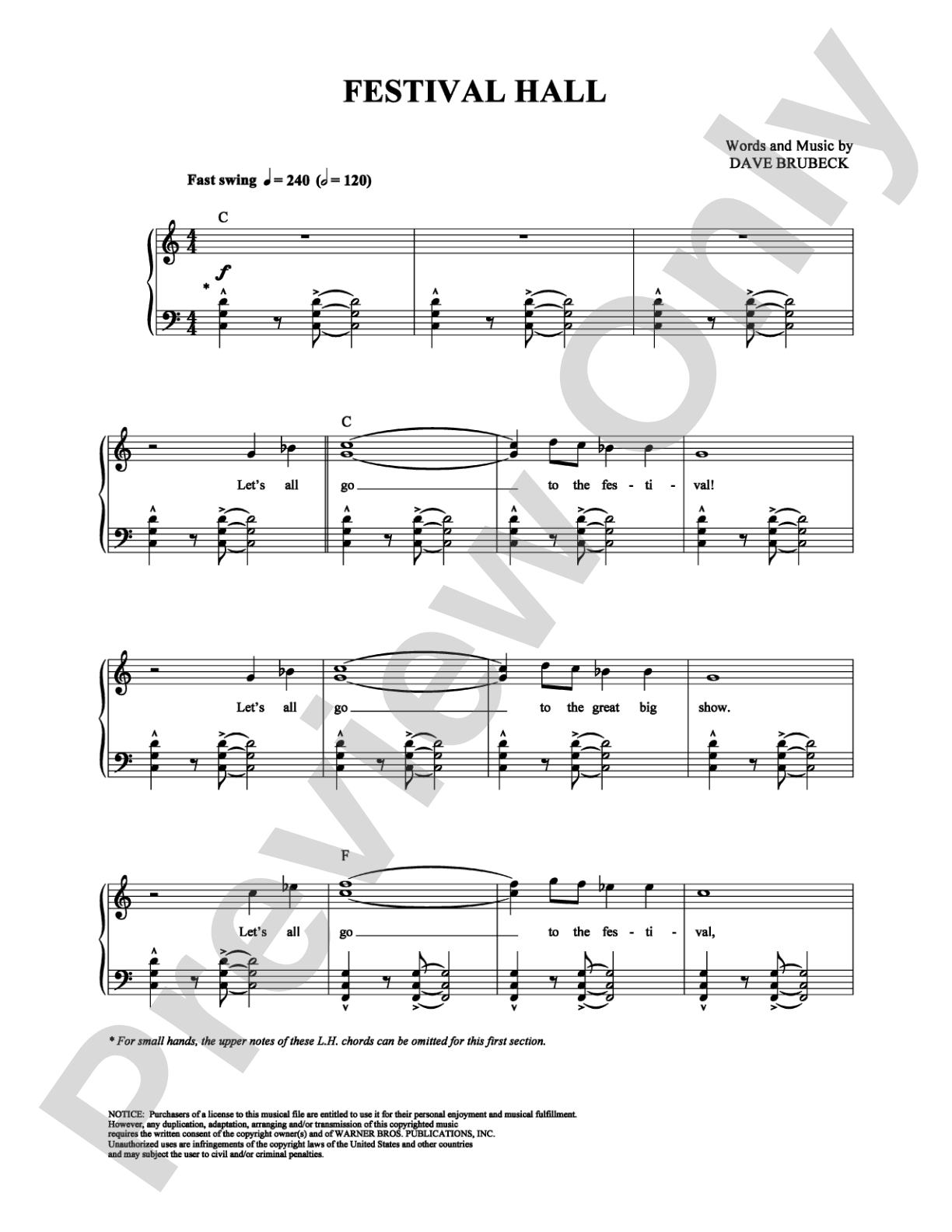
Festival Hall: Piano/Vocal/Chords Digital Sheet Music

Festival Hall: Piano/Vocal/Chords Digital Sheet Music

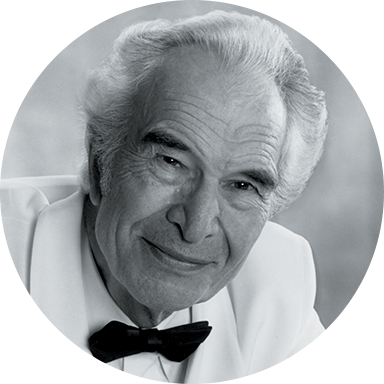
Dave Brubeck

Item: 00-PS-0000793

Digital Download
$3.99
Description

Festival Hall: Piano/Vocal/Chords Digital Sheet Music isn't in MakeMusic Cloud just yet...but it could be. Let us know you'd like to see it, and you'll help shape what comes next. In the meantime, start a free trial and dive into thousands of interactive titles your students can play along with today.

Sample Audio
No sample audio found.
Sample Video
Additional Details
SKU: 00-PS-0000793

More about this title

About the Artist: Dave Brubeck

Dave Brubeck

Dave Brubeck stands as one of jazz's most influential pianists and composers, distinguished equally by his improvisational command and his meticulous approach to musical structure. His formal training under Darius Milhaud at Mills College shaped a compositional voice that merged jazz vernacular with classical sophistication, resulting in works spanning orchestral suites, chamber music, choral pieces, and solo repertoire across multiple instruments. His album "Time Out" became the first jazz recording to exceed one million copies sold, while "Take Five" achieved legendary status in popular culture.

Beyond his groundbreaking recordings and compositions, Brubeck's career reflected his commitment to breaking racial barriers in mid-twentieth-century America. His sacred works, including the mass "To Hope!" and oratorios such as "The Voice of the Holy Spirit" and "Beloved Son," have been performed and recorded by major orchestras and choral ensembles worldwide. He received the Presidential Medal of the Arts from President Clinton, a Grammy Lifetime Achievement Award, and was elected to the American Classical Music Hall of Fame in 2003, cementing his influence across both jazz and classical spheres.

Why we love this

Brubeck's fusion of jazz sophistication with melodic accessibility makes "Festival Hall" an excellent choice for singers and pianists seeking material that respects their musicality while remaining genuinely singable. The piano/vocal/chords format gives performers and accompanists the flexibility to interpret this piece in multiple ways, whether as a straight reading or as a springboard for jazz phrasing. This recording's legacy and professional credentials signal to audiences that they're hearing music of genuine substance.

What to expect

"Festival Hall" carries the sophisticated ease of a seasoned jazz composition; it balances melodic warmth with harmonic complexity, inviting both intimate listening and ensemble exploration. The piece opens space for players to leave their own fingerprints on the music while maintaining Brubeck's underlying compositional intelligence. There's a sense of both refinement and spontaneity, as if the piece exists comfortably in both the concert hall and the jam session.

Who it's for

This digital sheet music suits jazz vocalists and classical singers exploring the jazz repertoire, as well as pianists accompanying singers in jazz or popular music settings. The chord symbols make it accessible to musicians with jazz theory knowledge who want to interpret the arrangement creatively. It's equally valuable for pianists performing solo arrangements or students learning to navigate the intersection of notated melody and jazz harmony.

How to get the most out of it

  • Treat the piano part as a true partner, not merely accompaniment. Jazz voicings require thoughtful balance so chord extensions and comping rhythms support rather than overpower the vocal line.
  • Approach the melody with conversational phrasing that aligns naturally with speech rhythm rather than strict metric placement; Brubeck's compositions reward this kind of interpretive flexibility.
  • Study the chord symbols carefully as a map for harmonic sophistication; even if you stick closely to the written melody, understanding the underlying harmony deepens your interpretation and helps you respond to the pianist's comping choices.
  • Let space breathe between phrases. Jazz ballads and standards thrive on the interplay between sound and silence, giving both the voice and the accompaniment room to land.

How to use it

Feature this in a jazz or contemporary music recital where it can sit alongside other standards and original compositions by established jazz composers. It works well as a bridge between classical and jazz repertoire in a mixed vocal program, signaling artistic ambition without alienating audiences new to jazz singing. For teaching purposes, use it to demonstrate how chord-based notation invites interpretation while melody-driven composition ensures accessibility.

Skills your students will build

  • Reading and interpreting jazz chord symbols and voicings
  • Balancing rhythmic precision with conversational jazz phrasing
  • Accompanying singers as an equal partner in jazz idiom
  • Navigating the relationship between notated melody and harmonic reharmonization
  • Understanding Brubeck's compositional approach to melody and harmony

You May Also Like