
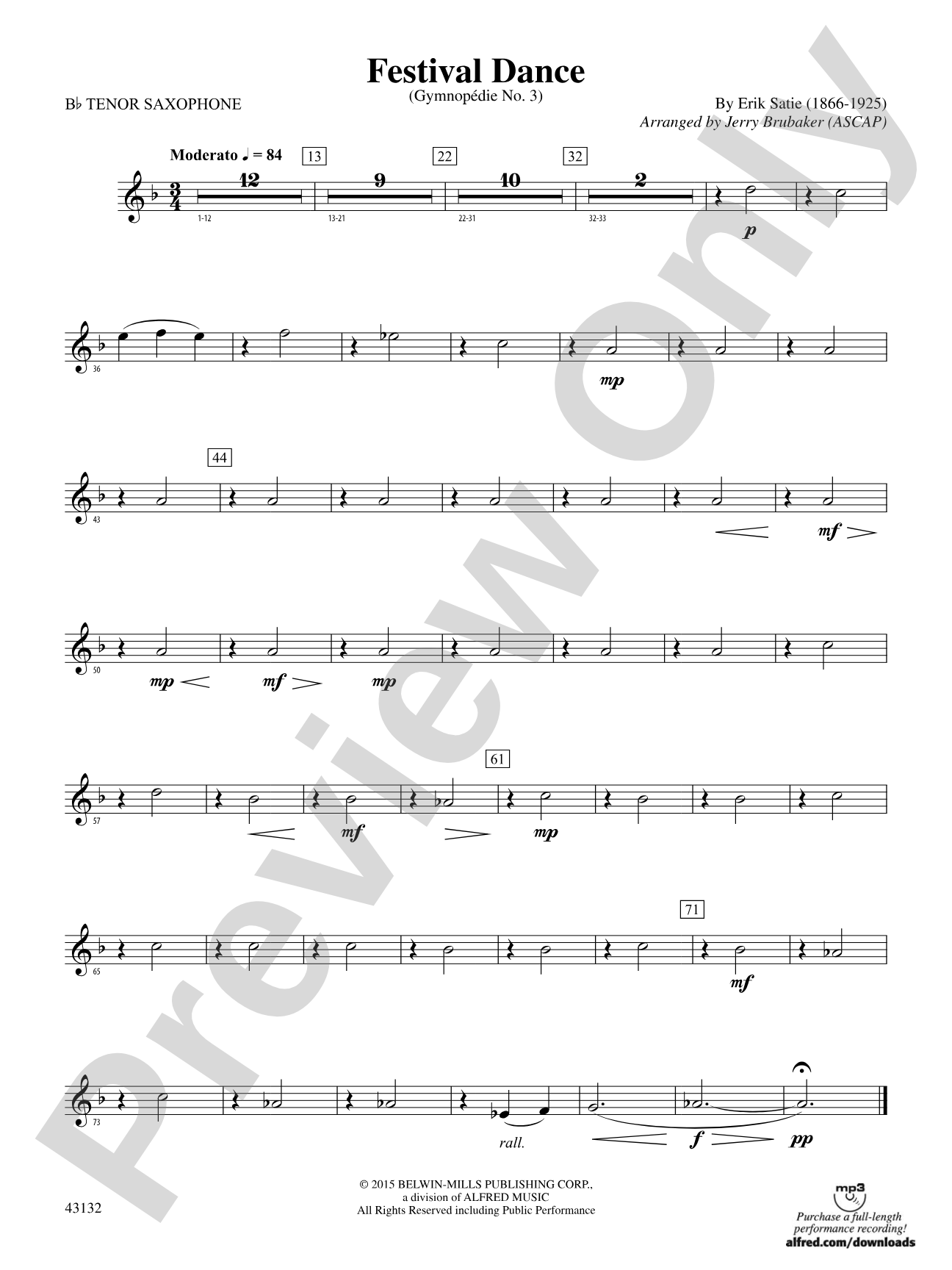

Festival Dance: B-flat Tenor Saxophone
(Gymnopodie No. 3)
By Erik Satie / arr. Jerry Brubaker
Grade: 3 (Medium Easy)
Item: 00-PC-0016780_TX1
$3.00
Pickup currently not available
Description
The Gymnopédies, published in Paris starting in 1888, are three piano compositions written by French composer and pianist Erik Satie. The name referrers to an ancient Greek festival and dance. This piece has a haunting quality to its very familiar melody while its harmonies are atmospheric and ethereal. The setting would easily stand on its own but would also lend itself well to choreography for modern dance or ballet to enhance the performance and involve additional performers on stage at your concert. The flowing lines and beautiful textures make "Festival Dance" a must for your concert band repertoire. (3:00)


Don't just read it, hear it, play along with it, and watch your students grow with it. In MakeMusic Cloud, Festival Dance: B-flat Tenor Saxophone comes alive with professional accompaniment, adjustable tempo, and built-in practice tools that turn solo practice into real progress.
Open in the Player
Jump straight in and assign it today.
Start Your Free Trial
Open this title and explore the full library in minutes.
Sample Audio
1
Audio File
--:--
0:00
0:00
Sample Video
No sample videos found.
Additional Details
Series:
Belwin Concert Band
Publisher:
Alfred Music
Page Count:
126
SKU:
00-PC-0016780_TX1
More about this title
About the Composer: Erik Satie
Erik Satie (1866-1925) was a French composer and pianist whose unconventional harmonic language and minimalist approach fundamentally challenged classical music traditions. Working in Paris during the late 19th and early 20th centuries, Satie developed a distinctive aesthetic centered on simplicity, repetition, and emotional restraint. His music resists dramatic gestures in favor of introspection and quietude, establishing him as a crucial bridge between Romantic sensibility and modernist thinking.
Satie's influence extends far beyond his own era. His emphasis on accessible, beautifully crafted melodies over complex development makes his work ideal for educational settings, while his openness to theatrical and multimedia collaboration presaged contemporary approaches to concert programming. For band directors, Satie represents an opportunity to introduce students to early 20th-century aesthetics through music that rewards careful listening and sensitive interpretation.
Why we love this
Jerry Brubaker's arrangement captures Satie's ethereal harmonic world with remarkable clarity for concert band, allowing mid-level ensembles to access one of modernism's most distinctive voices without oversimplifying the music's contemplative power. The Grade 3 scoring ensures that players focus on tone production and phrase shaping rather than technical fireworks, making this an ideal vehicle for teaching what ensemble maturity actually sounds like. The three-minute length and inherent elegance make it a standout concert piece that audiences remember for the right reasons.
What to expect
Haunting and meditative, with a melody that feels both deeply familiar and mysteriously distant. The atmospheric harmonies create a sense of suspension in time, as if sound itself is being held at arm's length. There's an emotional transparency here that feels effortless until you try to execute it.
Who it's for
Concert bands at the high school or community level seeking repertoire that challenges musicians to play with nuance and control without demanding advanced technical facility. Directors programming festivals or concerts that include works beyond the standard march-feature-overture model will find this piece opens conversations about ensemble musicianship and modern composition.
How to get the most out of it
- Prioritize blend and balance in the sustained harmonies; these ethereal textures collapse immediately when individual voices push for projection. Rehearse the chord changes slowly to ensure intonation and voice independence before building tempo.
- Let the familiar melody breathe without sentimentality. Satie's restraint is the point; excessive rubato or dynamic swell undermines the music's quiet strength.
- Shape the piece through subtle dynamic gradations rather than obvious crescendi and diminuendi. The emotional arc depends on listeners perceiving shifts in color and texture.
- Invite your ensemble to listen to the original piano compositions so they understand the harmonic palette they're recreating. Hearing Satie's sparse original voicing clarifies what each band section is meant to contribute.
How to use it
This works exceptionally well as a concert opener that establishes a thoughtful, listening-focused mood, or as a contrasting interlude between more energetic selections. It pairs naturally with other early modernist works or impressionistic arrangements. Consider pairing it with opportunities for dance or visual elements, as the piece's theatrical origins and flowing lines invite multimedia possibilities.
Skills your students will build
- Sustaining tone with consistent intonation across long passages
- Balancing inner voices to support exposed melodies
- Controlling dynamic subtlety and creating phrase shape without relying on obvious gestures
- Responding to impressionistic harmonic language and its unique sonorities
- Reading and executing atmospheric, non-traditional concert band voicing