
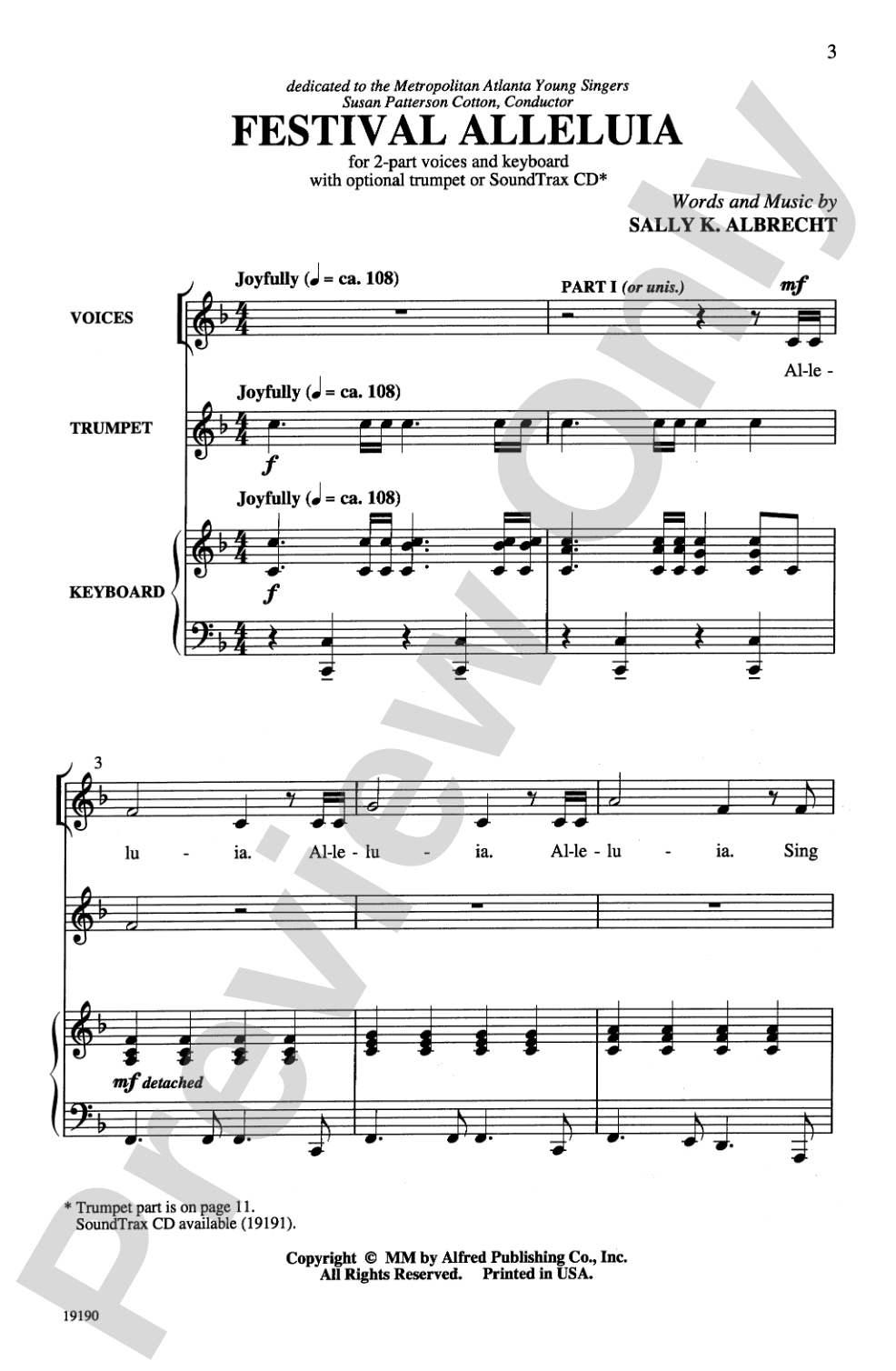

Festival Alleluia: 2-Part Choral Octavo
Music by Sally K. Albrecht
Item: 00-PO-0004134
$2.25
Minimum order quantity: 20 copies
Pickup currently not available
Related Items
Festival Alleluia: Choral Octavo SoundTrax CD |
$19.95
|
View |
Description
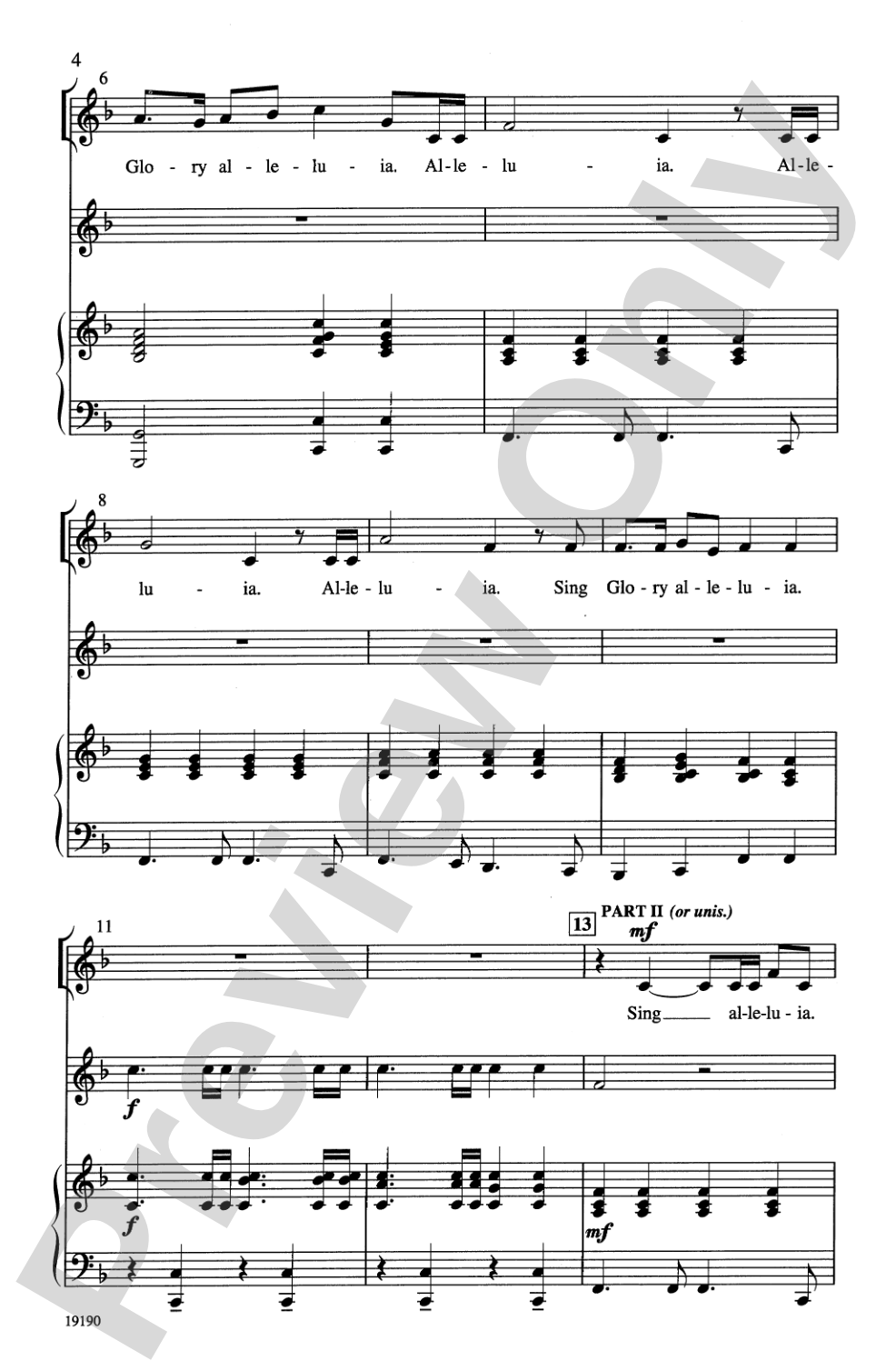
It's a "partner-song plus" that's appropriate for year round use, including the holidays. The two strong but singable melodies combine with a descant and suddenly your 2-part group is singing in 3 parts! An optional, easy trumpet part is included in the publication. Like Sally Albrecht's best-selling Gloria Deo!, her new Festival Alleluia could be used as a concert opener or closer. Learn it in the fall, sing it all year.


Festival Alleluia: 2-Part Choral Octavo isn't in MakeMusic Cloud just yet...but it could be. Let us know you'd like to see it, and you'll help shape what comes next. In the meantime, start a free trial and dive into thousands of interactive titles your students can play along with today.
Request This Title
Tell us you want it.
Start Your Free Trial
Explore everything that's ready to play right now.
Sample Audio
1
Audio File
--:--
0:00
0:00
Sample Video
No sample videos found.
Additional Details
Series:
Alfred Archive Edition: Alfred Choral Designs
Publisher:
Alfred Music
Page Count:
12
SKU:
00-PO-0004134
Instrumentation:
Opt. Trumpet
More about this title
About the Composer: Sally K. Albrecht

Sally K. Albrecht has shaped American choral music for over four decades as a composer, conductor, and educator. Since 1987, she has received annual ASCAP Special Music Awards and maintains more than 600 published choral works in print, alongside 75 larger songbooks and musicals. She has conducted honor choirs at prestigious venues including Lincoln Center, Carnegie Hall, and The Kennedy Center, and spent more than thirty years leading choral and vocal publications at major educational music publishers, including her tenure as Director of School Choral, Vocal, and Elementary Publications at Alfred Music.
Albrecht studied music and theater at Rollins College (B.A., 1976) before earning both an M.A. in Drama and an M.M. in Accompanying from the University of Miami. She has taught in the music departments at Oakland University, Jersey City State College, and Meredith College. Her leadership extends beyond composition; she served as Chair of the Board of Trustees for the Omicron Delta Kappa National Leadership Honor Society and received their "Pillar of Leadership" award. In 2021, she received the Distinguished Alumna Award from both the University of Miami Frost School of Music and Rollins College, where she serves on the Board of Trustees. She lives in Wake Forest, North Carolina, with her husband, composer and arranger Jay Althouse.
Why we love this
Albrecht's architecture here is clever: two independent melodies that stand alone as a partner song, then a descant that transforms the texture into three-part harmony without asking singers to jump to unfamiliar ranges. The optional trumpet part gives you flexibility in concert without making it mandatory. A piece this accessible yet musically satisfying, one that works from September through December and beyond, earns its place on every 2-part director's shelf.
What to expect
Celebratory and accessible, with sturdy melodies that feel both familiar and fresh. The Alleluia text paired with two strong, singable lines creates an uplifting affect that works equally well in November and December, grounded in joy rather than forced holiday sentimentality.
Who it's for
Two-part choirs at the middle school, high school, or community level who want repertoire with depth beyond their voicing. This piece is especially valuable for programs building toward three-part singing or for groups rotating singers of different experience levels throughout the year.
How to get the most out of it
- Work the two melodies separately before combining them, then introduce the descant as an enrichment layer so singers understand how the piece expands rather than complicates.
- If you're adding the trumpet part, rehearse it independently first; it should float over the choir rather than anchor it, so balance the optional line gently underneath.
- Use the recorded accompaniment to lock the harmonic foundation early, but pull it away in final rehearsals so your singers feel confident owning the melody on their own.
How to use it
Open a concert with it to establish energy and confidence, or close one on a bright, affirmative note. Because it's effective in any season and works best when singers have time to internalize both melodies, learn it in early fall and rotate it through rehearsals all year, bringing it out as a reliable, crowd-pleasing encore or programmatic anchor whenever you need it.
Skills your students will build
- Singing independent melodic lines in a partner song structure
- Reading and performing descant harmony above a main melody
- Balancing multiple vocal lines when combined
- Sight-reading straightforward, singable melodic writing
- Blending with optional instrumental color (trumpet)