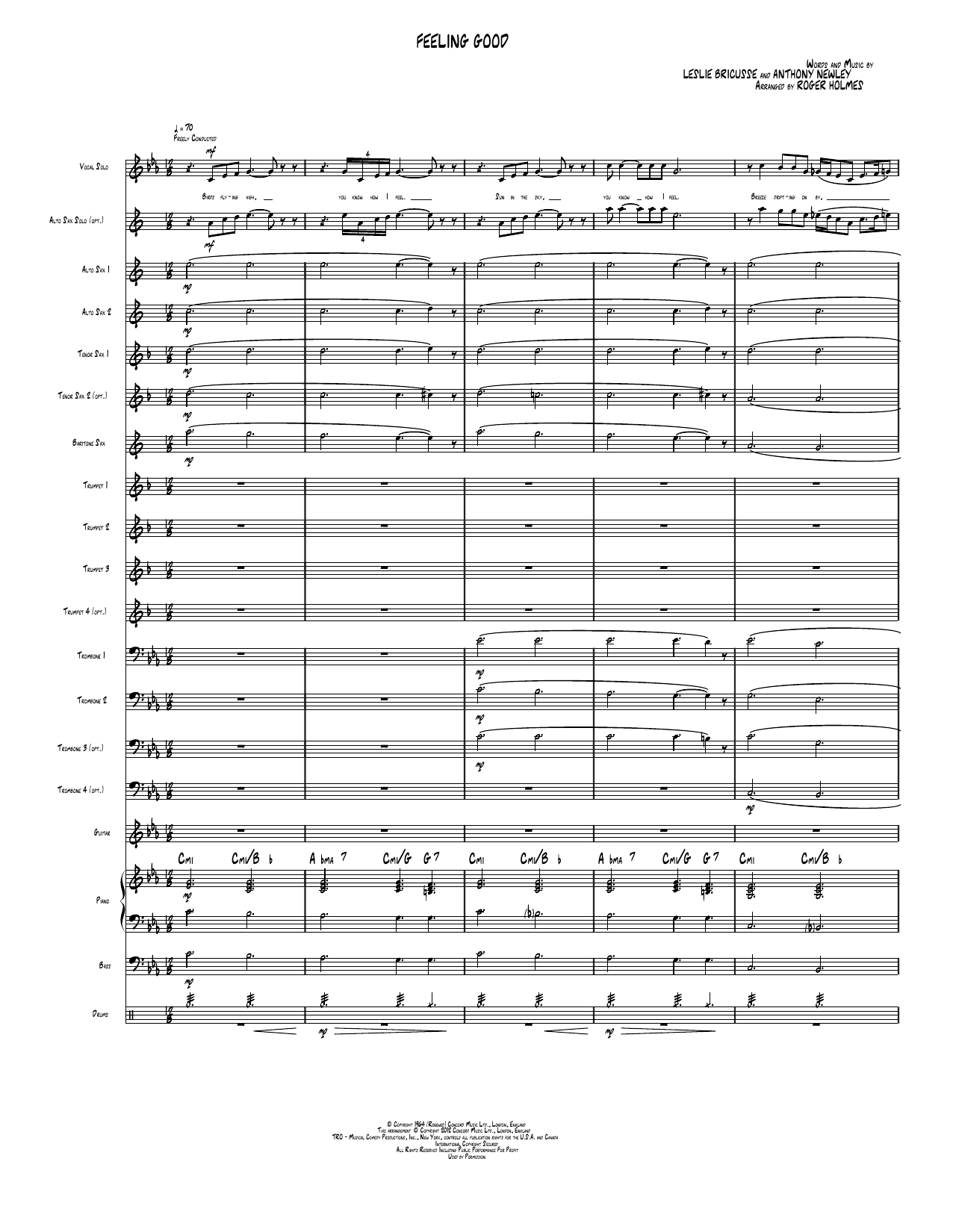
Feeling Good Sheet Music Preview

Feeling Good: Jazz Ensemble Conductor Score & Parts

By Anthony Newley / By Leslie Bricusse / As performed by Michael Bublé / Arranged by Roger Holmes

Grade: 3

Item: 35-PK00426957

Digital Download
$50.00

Buy Extra Parts (Digital PDF Download)

Product Price Quantity
Feeling Good - Full Score $50.00

Parts Added to Cart!

Description
Feeling Good

Feeling Good: Jazz Ensemble Conductor Score & Parts isn't in MakeMusic Cloud just yet...but it could be. Let us know you'd like to see it, and you'll help shape what comes next. In the meantime, start a free trial and dive into thousands of interactive titles your students can play along with today.

Sample Audio
No sample audio found.
Sample Video
Additional Details
Publisher: Hal Leonard
SKU: 35-PK00426957

More about this title

About the Composer: Anthony Newley

Anthony Newley was a British actor, singer, and composer whose theatrical sensibility shaped the sound of 1960s popular music. He created "Feeling Good" with lyricist Leslie Bricusse for the musical "The Roar of the Greasepaint, the Smell of the Crowd," and the song became a standard after Nina Simone's iconic 1965 recording transformed it into a jazz classic.

Newley's gift for melody and his understanding of how to write for the voice made his songs enduringly singable and emotionally direct. For ensemble musicians, his compositions offer the chance to engage with a composer who understood both theatrical drama and musical craftsmanship.

Why we love this

Roger Holmes' arrangement captures the sophisticated ease of the Nina Simone version while keeping the Grade 3 ensemble engaged with purposeful writing rather than padding. The piece balances enough solo space for showcasing strong players with ensemble figures that bind the group together, making it equally valuable for a concert featuring vocals or as an instrumental feature.

What to expect

Sophisticated optimism. The piece radiates calm confidence and warmth, with a gentle swing that invites listeners into a moment of clarity and hope. There's no forced energy here, just the contentment of a melody that has earned its place in the jazz repertoire.

Who it's for

This works for any jazz ensemble wanting a genuine standard that sits comfortably at Grade 3 without condescension. It's equally at home as a feature in a jazz concert, an arrangement choice for a vocalist, or a piece that introduces ensemble players to how swing jazz approaches a timeless melody.

How to get the most out of it

  • Shape the melody with long, legato phrasing in the opening section; resist the urge to chop up the famous opening line.
  • Lock the rhythm section into a conversation with the walking bass and comping chords; the swing feel depends on this dialogue staying relaxed and conversational.
  • Bring out the horn counterlines when they enter behind the lead voice or melody; they're not accompaniment but active voices responding to the main idea.
  • Balance the dynamic arc so that dynamic contrast comes from compositional gesture, not from suddenly getting louder or softer without musical justification.

How to use it

Pair this with other mid-century standards to build a set that shows the range of jazz composition beyond bebop. It also programs well alongside lighter concert fare when you want to keep the audience engaged without asking the ensemble to scale technical mountains. Consider featuring a strong vocalist if you have one available.

Skills your students will build

  • Swing feel and jazz articulation on written notation
  • Comping and chord rhythm coordination in the rhythm section
  • Phrasing a standard melody with lyrical shape rather than mechanical phrasing
  • Listening to and balancing multiple simultaneous melodic lines

You May Also Like