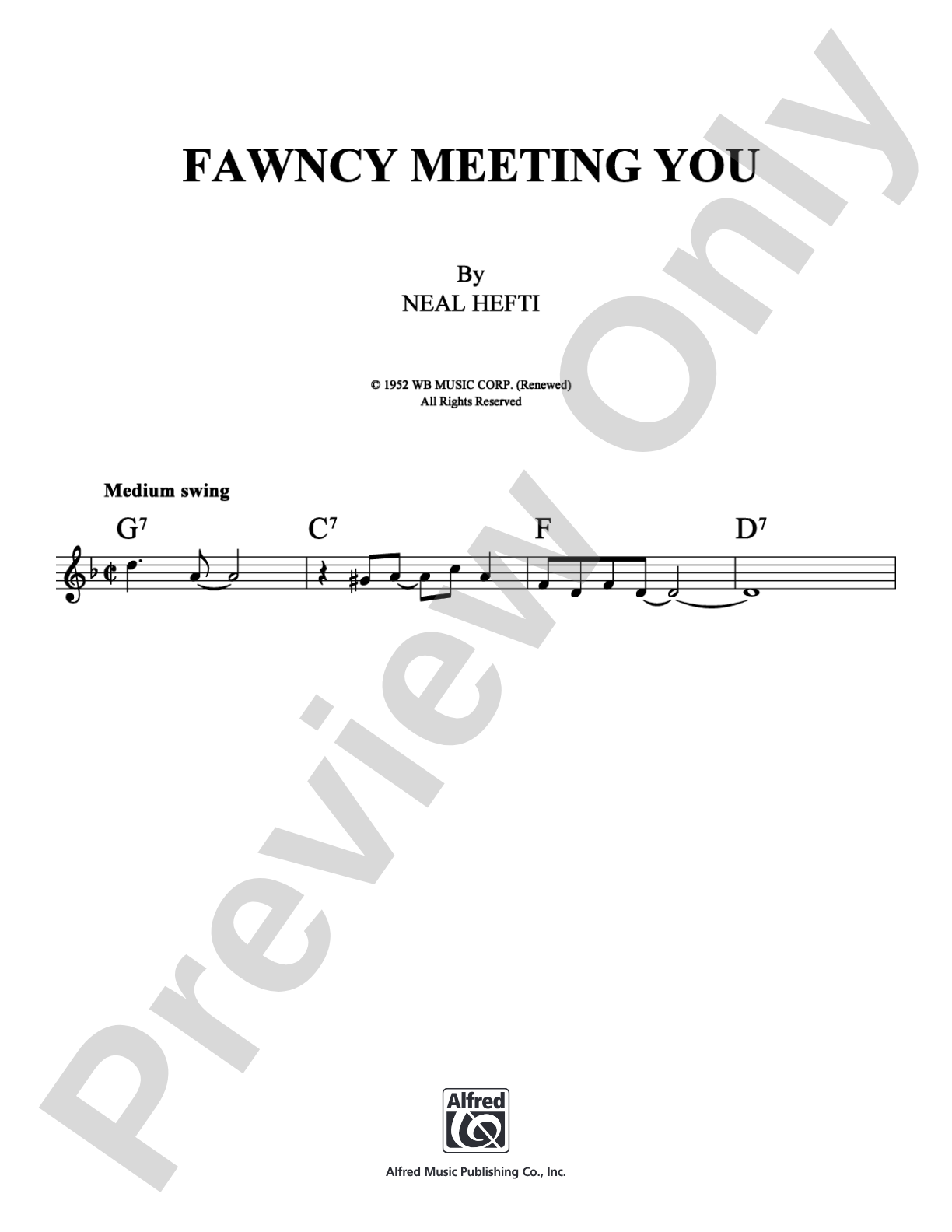
Fawncy Meeting You: Lead Sheet Digital Sheet Music

Fawncy Meeting You: Lead Sheet Digital Sheet Music

Neal Hefti, Count Basie

Item: 00-PS-0006938

Digital Download
$1.99
Description

Fawncy Meeting You: Lead Sheet Digital Sheet Music isn't in MakeMusic Cloud just yet...but it could be. Let us know you'd like to see it, and you'll help shape what comes next. In the meantime, start a free trial and dive into thousands of interactive titles your students can play along with today.

Sample Audio
No sample audio found.
Sample Video
Additional Details
SKU: 00-PS-0006938

More about this title

About the Artist: Count Basie

Count Basie (1904-1984) shaped modern jazz through his work as a bandleader, pianist, and composer. His Kansas City style emphasized a lean, swinging rhythm section that became the template for big band jazz, influencing generations of musicians across all genres.

Why we love this

Basie's compositions are vehicles for understanding how great jazz melody serves rhythm rather than overshadowing it. This lead sheet gives students direct access to a piece built on the principles that made his orchestra legendary: economy of means and maximum swing.

What to expect

Easy, relaxed, and inevitably swinging. The tune unfolds without urgency, letting the rhythm section breathe and the melody settle into the pocket. There's intelligence underneath the simplicity, and the architecture of the piece reveals itself only once you stop trying too hard.

Who it's for

Jazz pianists studying big band arranging and composition, musicians learning to voice chords behind a horn section, and ensemble leaders wanting an authentic Basie chart that doesn't require a full big band. This lead sheet is also valuable for anyone exploring jazz history through its core repertoire.

How to get the most out of it

  • Anchor the left hand on beat 2 and the 'and' of 4 to lock in the Basie sound; avoid playing too far ahead of the beat even when the melody suggests pushing forward.
  • Listen to the original recording with the full orchestra, then strip it down to just the rhythm section to hear how the melody sits in space rather than occupying every moment.
  • Treat the melody as a framework for phrasing and breathing rather than a note-for-note requirement; jazz standards reward intelligent interpretation over literal reading.
  • Work comping voicings that complement the melody without competing for attention; learn to play softly and react to what your bandmates are doing.

How to use it

Use this in a jazz combo setting or as a warm-up tune that teaches your ensemble what authentic swing phrasing sounds like. It pairs well with other Basie standards to show students how consistent compositional thinking can produce dozens of distinct but related pieces. This is also an excellent choice for sectional rehearsal, where you can isolate rhythm section fundamentals without the burden of complex harmony.

Skills your students will build

  • Reading jazz lead sheet notation and chord symbols
  • Swing phrasing and rhythmic interpretation
  • Comping and accompaniment voicing in a jazz context
  • Understanding the relationship between melody and rhythm section in big band style
  • Listening for the pocket and learning to play behind the beat

You May Also Like