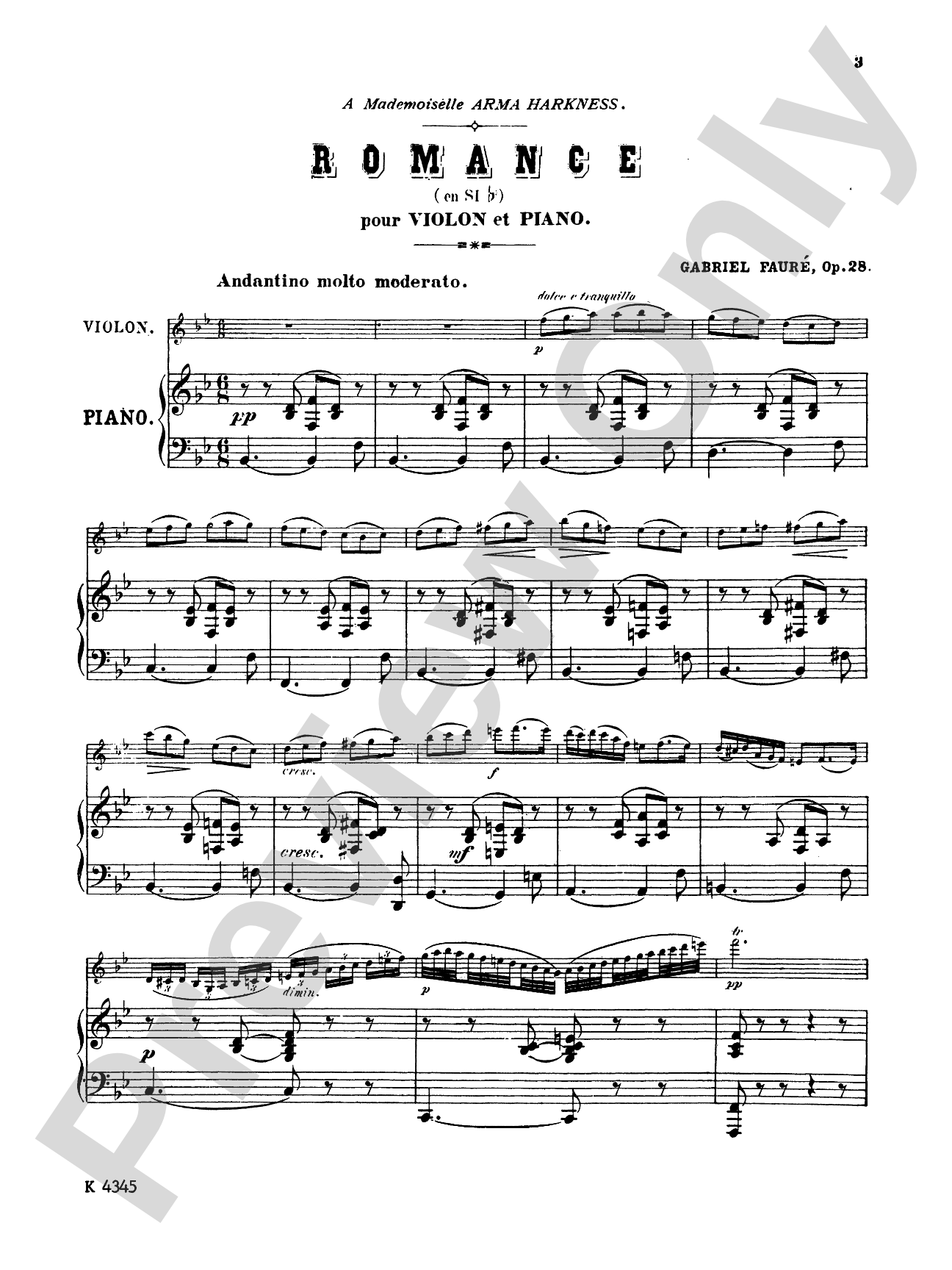
Fauré: Romance, Op. 28 (Urtext) Sheet Music Preview

Fauré: Romance, Op. 28 (Urtext)

By Gabriel Fauré

Item: 00-PC-0010258

Digital Download
$3.99
Description
A solo, for Violin with Piano Accompaniment, composed by Gabriel Fauré.

Don't just read it, hear it, play along with it, and watch your students grow with it. In MakeMusic Cloud, Fauré: Romance, Op. 28 (Urtext) comes alive with professional accompaniment, adjustable tempo, and built-in practice tools that turn solo practice into real progress.

Sample Audio
No sample audio found.
Sample Video
Additional Details
Series: Kalmus Edition
Publisher: Alfred Music
Page Count: 16
SKU: 00-PC-0010258

More about this title

About the Composer: Gabriel Fauré

Gabriel Fauré (1845-1924) shaped French musical taste across five decades as composer, pedagogue, and director of the Paris Conservatoire. His harmonic language bridged Romanticism and Impressionism, favoring elegant restraint and emotional subtlety over grand gesture. Fauré's chamber music and vocal works remain cornerstones of the French repertoire, and his influence on twentieth-century composers runs deep.

As a violin composer, Fauré understood the instrument's lyrical heart. His two violin sonatas and this Romance showcase writing that demands not virtuosity for its own sake, but rather a singer's phrasing and absolute control of tone. Teachers and advanced students return to Fauré again and again because his music rewards the kind of refined musicianship that matters most.

Why we love this

This Romance sits at the sweet spot between advanced amateur and professional repertoire. It requires serious technical control and musical maturity but rewards that effort with a piece that concert audiences genuinely want to hear. The Urtext edition strips away editorial interventions, letting violinists engage directly with Fauré's own notation and intentions.

What to expect

The Romance unfolds with an intimate, almost improvisational quality. Fauré's melodies seem to discover themselves as they go, supported by rich but never heavy piano harmonies. There's a wistfulness here, a sense of gentle longing that feels both personal and timeless.

Who it's for

Violinists preparing for conservatory auditions, competitions, or recitals will find a standard that sits comfortably in the upper-intermediate to advanced range. This is also ideal for student pianists who want to develop collaborative chamber skills alongside their soloist partners. Teachers looking for a piece that bridges technical achievement and genuine musical growth will return to this repeatedly.

How to get the most out of it

  • Treat phrase shapes like a cellist or singer would. Fauré's lines breathe, swell, and recede; avoid mechanical evenness even in passage work.
  • Coordinate with your pianist on the rubato. The piano part contains expressive flexibility that must align with the violin line; excessive freedom from either player fractures the music.
  • Give the opening melody room to sing before building intensity. Many performers rush early sections and have nowhere left to go dynamically.
  • Study the harmonic movement beneath your line. Understanding where Fauré moves through unexpected keys helps you shape cadences and transitions with purpose.

How to use it

Program this alongside other French Romantic violin repertoire (Saint-Saëns, Massenet) to showcase a coherent school of thought. It also pairs well with larger-scale Fauré works on a recital, serving as a bridge between the intimate and the grand.

Skills your students will build

  • Phrasing across longer melodic lines with natural breathing points
  • Tonal control and sustained vibrato that serves expression rather than technique
  • Harmonic awareness and the ability to follow chromatic movement in the piano part
  • Collaborative balance and flexibility with a pianist partner
  • Interpretation of Romantic and early Impressionistic musical language

You May Also Like