
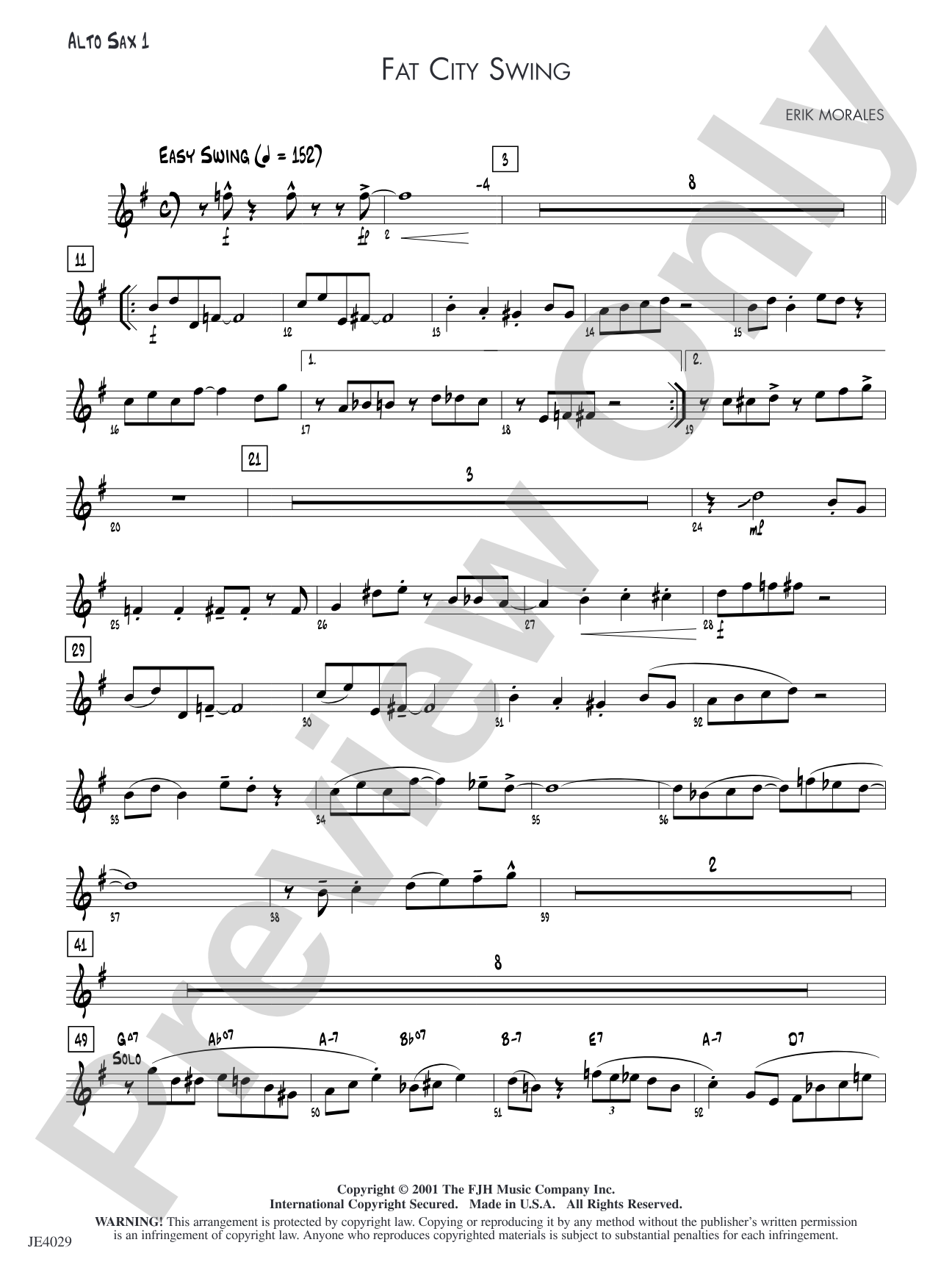

Fat City Swing: Alto Sax 1
By Erik Morales
Grade: 2.5
Item: 98-PC-DJE4029_AX1
$7.00
Pickup currently not available
Description
Here's an easy swinger in Bb, written to showcase each section. All solos are written out with changes provided as well. The rhythm section writing is complete and will lay down easy with inexperienced players. This chart is fun to play and should please most any crowd or adjudication panel.


Fat City Swing: Alto Sax 1 isn't in MakeMusic Cloud just yet...but it could be. Let us know you'd like to see it, and you'll help shape what comes next. In the meantime, start a free trial and dive into thousands of interactive titles your students can play along with today.
Request This Title
Tell us you want it.
Start Your Free Trial
Explore everything that's ready to play right now.
Sample Audio
1
Audio File
--:--
0:00
0:00
Sample Video
No sample videos found.
Additional Details
Series:
FJH Developing Jazz Ensemble
Publisher:
The FJH Music Company, Inc.
SKU:
98-PC-DJE4029_AX1
More about this title
About the Composer: Erik Morales

Erik Morales was born in New York City in 1966 and has since established himself as a prolific composer across classical, jazz, and commercial genres. His output exceeds 150 published works written for wind ensembles, orchestras, jazz groups, and chamber combinations, many of which have been performed internationally. He studied composition at Florida International University and earned his bachelor's degree from the University of Louisiana, Lafayette in 1989. His composing trajectory began immediately after high school in South Florida, when a former band director commissioned him to arrange marching band music in 1985, a pivotal moment that launched his career in educational music publishing.
Morales has contributed substantially to the trumpet repertoire as a performer and composer, with trumpet ensemble works that have earned first place honors at the 2006 and 2008 National Trumpet Competitions. His Concerto for Trumpet in C and Piano premiered at the 2009 International Trumpet Guild conference, and a consortium-commissioned Concerto for Two Trumpets followed at the 2013 ITG conference in Grand Rapids. In 2016, he was inducted into the Louisiana Association for Jazz Education's Hall of Fame. Throughout his career, he has maintained a deliberate focus on balancing artistic integrity with educational accessibility, and he continues to receive commissions from schools and organizations across the country.
Why we love this
Morales understands exactly what makes a Grade 2.5 swing chart work in rehearsal and performance. The rhythm section parts are genuinely playable for developing students without sacrificing the groove, and every section gets a moment to shine with written solos and provided changes. This is the kind of chart that builds confidence and sounds polished from the first solid run-through.
What to expect
Fat City Swing delivers the infectious energy of a classic swing tune with a contemporary harmonic sensibility. The piece grooves with an easy confidence; its straightforward form and clear section writing create a joyful, unpretentious sound that keeps audiences engaged and judges impressed.
Who it's for
This chart is built for Grade 2.5 jazz ensembles ready to explore swing style with complete parts that protect less experienced players. Directors will appreciate the fully realized rhythm section writing and the opportunity to feature each section equally without overextending any individual player.
How to get the most out of it
- Establish the swing feel clearly in your first rehearsal run. Have the rhythm section lock in before adding the full ensemble, as the written parts depend on a steady foundational groove.
- Balance the solo sections carefully. Even though they are written out, encourage soloists to phrase the melody with ownership and minimal vibrato to sit cleanly in the swing pocket.
- Use the provided changes as teaching moments. If your ensemble is ready, point out how the harmonic structure reinforces the melodic contours, and let advanced students explore the changes on their instruments.
How to use it
Program this as a crowd pleaser mid-concert or use it to close a first half set. It works equally well at adjudication festivals and school concerts, and pairs nicely alongside blues-based standards and bebop-influenced pieces in a jazz showcase format.
Skills your students will build
- Swing interpretation and rhythmic feel (quarter-note triplet subdivision)
- Reading and performing written jazz solos with harmonic changes
- Section balance and ensemble cohesion in a functional rhythm section context
- Stylistically appropriate phrasing and articulation within a swing idiom