Farewell to Oxford Sheet Music Preview

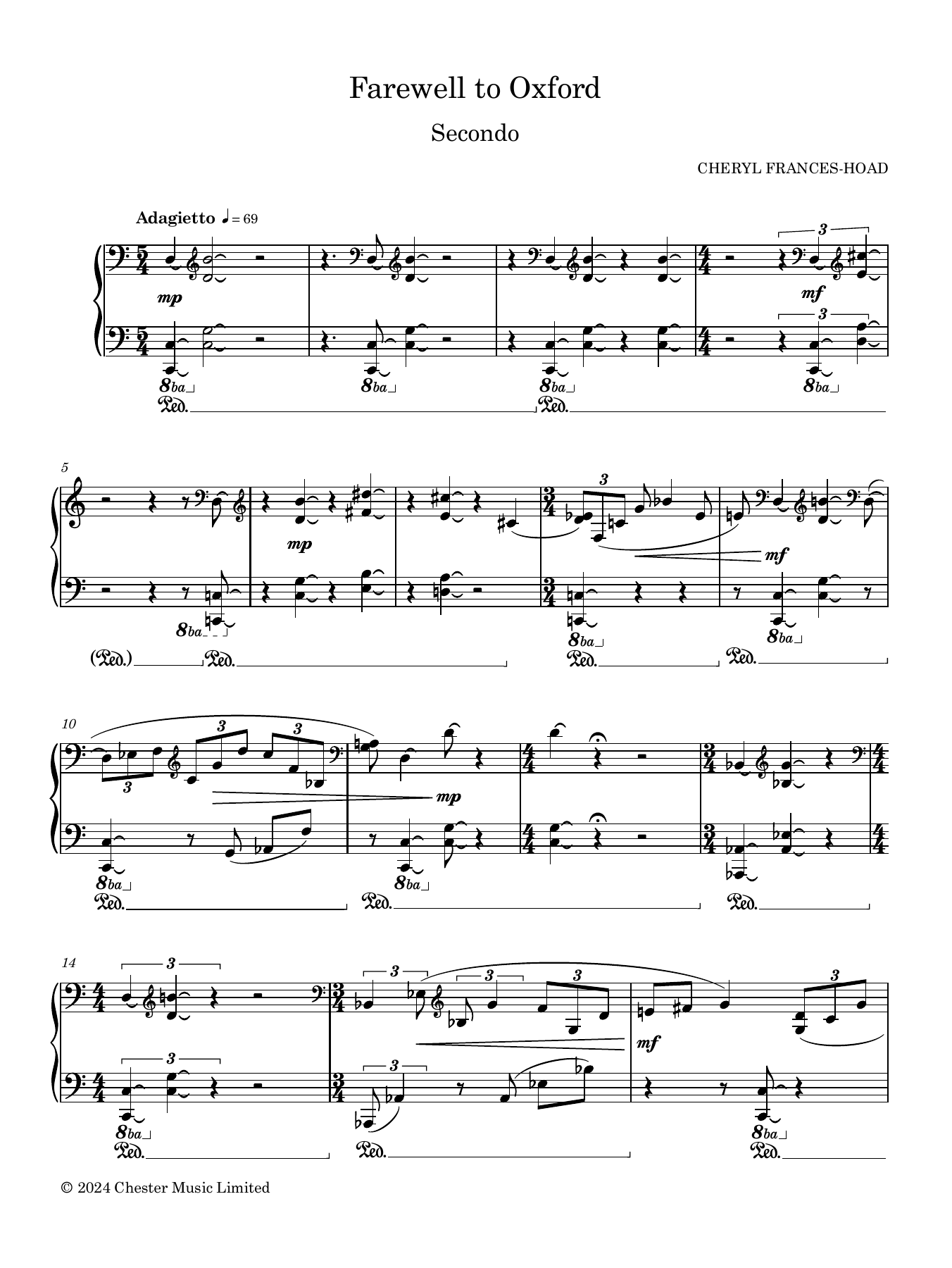
Farewell to Oxford: Piano Duet

By Cheryl Frances-Hoad

Item: 35-DS01519927

Digital Download
$8.99
Description

Discover MakeMusic Cloud: thousands of interactive titles your students can play along with today.

Sample Audio
No sample audio found.
Sample Video
Additional Details
Publisher: Hal Leonard
Page Count: 6
SKU: 35-DS01519927

More about this title

About the Composer: Cheryl Frances-Hoad

Cheryl Frances-Hoad is a British composer whose work bridges classical tradition and contemporary sensibility. Her compositions for solo instruments and chamber ensembles are known for their lyrical voice and accessible yet sophisticated harmonic language, making her a trusted choice for educators seeking music that challenges without overwhelming.

Frances-Hoad's output spans educational repertoire through concert works, and her understanding of what performers need at various levels informs every score she writes. Her pieces frequently appear on music school curricula and festival programs across the UK and beyond.

Why we love this

Frances-Hoad captures something genuine in this piece that avoids both sentimentality and abstraction. The title invites narrative interpretation, yet the music speaks clearly on its own terms, making it rewarding material for pianists who are developing interpretive maturity without needing external justification for every musical choice.

What to expect

Farewell to Oxford carries a reflective, contemplative quality that suggests departure without melancholy. The writing is lyrical yet grounded, creating a sense of quiet resolution and forward motion rather than lamentation.

Who it's for

This work suits intermediate to upper-intermediate pianists ready to explore contemporary classical writing with emotional depth. It serves recital programs, examinations, and concert settings where substance and accessibility converge.

How to get the most out of it

  • Pay attention to the harmonic movement in the opening phrases; let rubato emerge naturally from the chord progressions rather than imposing a rigid tempo structure.
  • Balance lyrical passages against moments of greater rhythmic definition so the piece breathes without losing architectural coherence.
  • Approach dynamics as a means of shaping phrase contour, not merely as dramatic gestures.

How to use it

This piece works beautifully in a concert centered on British piano repertoire or as a moment of introspection within a diverse program. Its six pages make it substantial enough for a full recital slot yet concise enough to anchor a thematic program exploring connections between place and music.

Skills your students will build

  • Pedal control across varying harmonic densities
  • Phrasing across longer spans without explicit melodic anchors
  • Balancing independent layers within a single staff
  • Interpreting contemporary notation and articulation marks

You May Also Like