Farewell Symphony, 1st Movement: Cello Sheet Music Preview

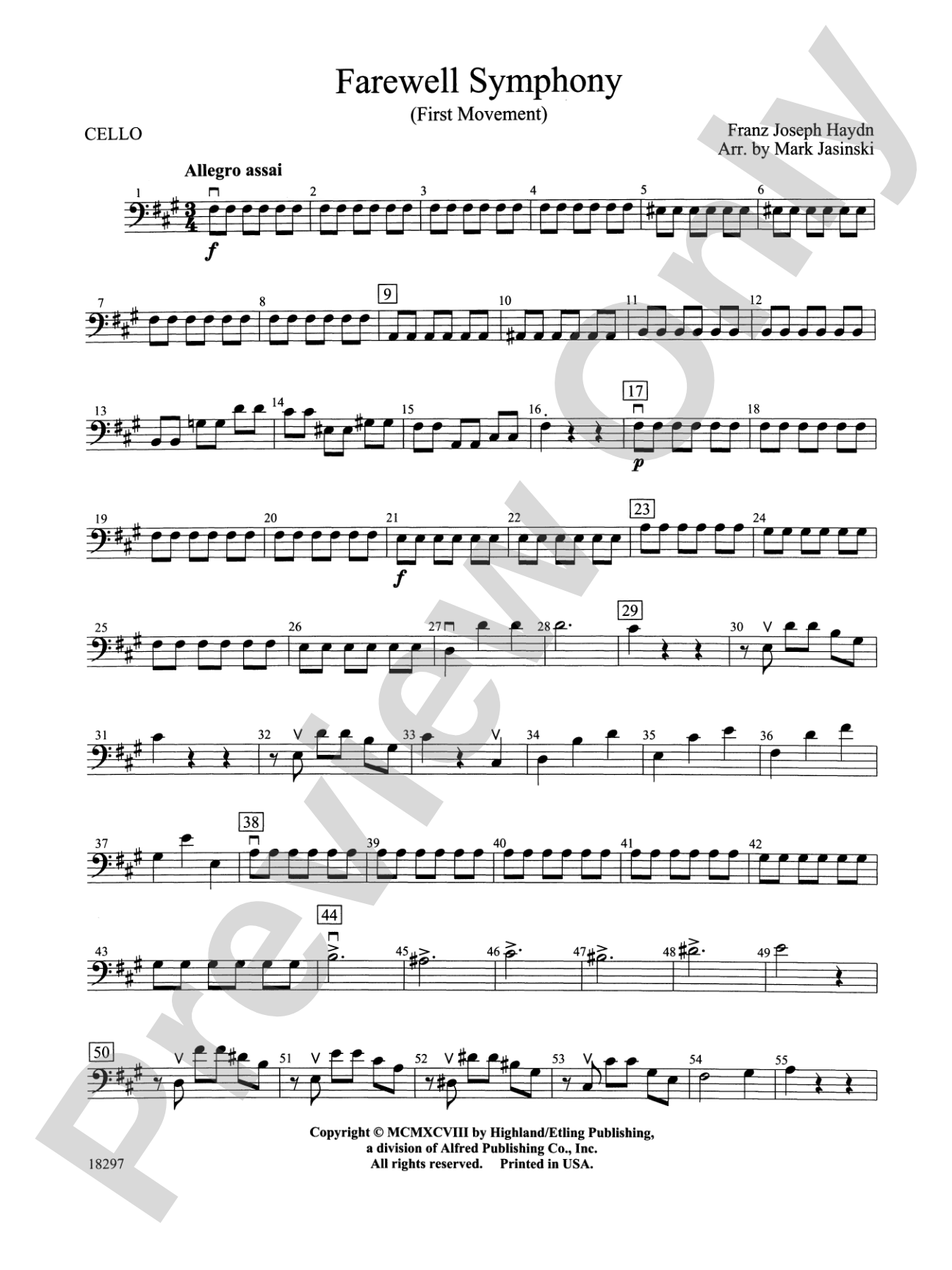
Farewell Symphony, 1st Movement: Cello

By Franz Joseph Haydn / arr. Mark Jasinski

Grade: 4

Item: 00-PC-0014786_VC1

Digital Download
$5.99
Description
This rhythmically exciting selection from one of Haydn's most popular symphonies has been skillfully arranged for string orchestra by Mark Jasinski. Your orchestra will get a workout while getting acquainted with the work of one of the pioneers of the symphonic form.

Don't just read it, hear it, play along with it, and watch your students grow with it. In MakeMusic Cloud, Farewell Symphony, 1st Movement: Cello comes alive with professional accompaniment, adjustable tempo, and built-in practice tools that turn solo practice into real progress.

Sample Audio
0:00
0:00
Sample Video
Additional Details
Series: Highland/Etling String Orchestra
Publisher: Alfred Music
Page Count: 124
SKU: 00-PC-0014786_VC1

More about this title

About the Composer: Franz Joseph Haydn

Franz Joseph Haydn (1732-1809) fundamentally shaped the symphony as we know it. Over six decades of prolific composition, he established the four-movement structure, expanded harmonic language, and proved the symphony could be both intellectually rigorous and deeply entertaining. His work bridged the Baroque and Romantic periods, influencing everyone from Mozart to Beethoven.

Haydn's genius lay in his ability to balance formal architecture with genuine wit and surprise. He commanded the orchestra with precision while never losing sight of immediate musical joy. For string players, his symphonies offer a masterclass in how to write idiomatically for strings while maintaining symphonic weight and substance.

Why we love this

This arrangement captures the Farewell Symphony's signature rhythmic vitality without burying younger orchestras in textural complexity. Jasinski's scoring respects Haydn's harmonic intent while allowing each section to contribute meaningfully, making it an ideal vehicle for groups ready to tackle a major classical work. The result is engaging enough to hold student musicians' attention and sophisticated enough to satisfy any audience's expectations.

What to expect

Bright, propulsive, and perpetually energetic. Haydn's orchestration sparkles with linear interplay and geometric precision; you hear conversation between the string sections rather than a monolithic wash of sound. The movement crackles with classical elegance, urgency, and good humor.

Who it's for

String orchestras at the Grade 4 level ready for a canonical work that demands both technical control and musical maturity. This arrangement serves conductors seeking substantive classical repertoire that builds ensemble confidence through exposure to real symphonic writing, not simplified approximations.

How to get the most out of it

  • Establish a crisp, energetic tempo from the opening; Haydn's rhythmic motifs demand clarity and forward motion rather than lingering over individual phrases.
  • Balance the dialogue between first and second violins carefully. The melodic exchanges that define this movement lose their charm if one section drowns out the other.
  • Shape phrases with attention to the harmonic rhythm. Haydn uses predictable harmonic movement as a feature, not a limitation; let the changes breathe naturally.
  • Work the lower strings (violas, cellos, basses) as a cohesive unit in the accompaniment passages. Unified rhythmic support gives the melody room to sing without sounding thin.

How to use it

Program this as a festival or contest submission where classical literacy carries weight. It pairs naturally with contemporary or Romantic-era works on the same concert, anchoring the program in historical context while demonstrating your ensemble's command of mainstream repertoire.

Skills your students will build

  • Reading dense contrapuntal writing with independent viola and cello lines
  • Maintaining rhythmic precision through syncopated accompaniment patterns
  • Balancing sectional dialogue and ensemble transparency
  • Executing sudden dynamic shifts and articulation changes
  • Sustaining musical phrase architecture across longer formal structures

You May Also Like