
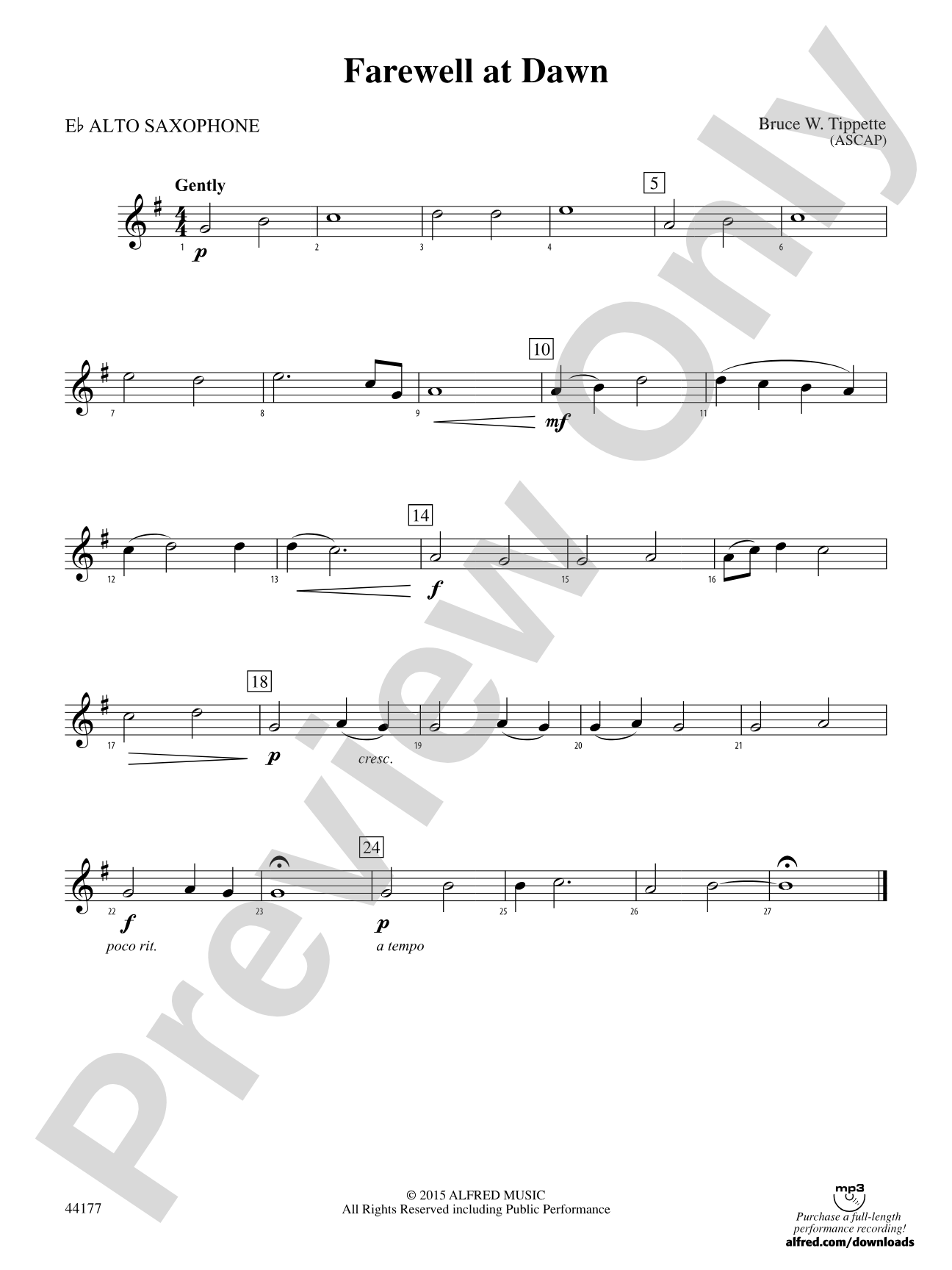

Farewell at Dawn: E-flat Alto Saxophone
By Bruce W. Tippette
Grade: 0.5 (Very Easy)
Item: 00-PC-0017027_AX1
$3.00
Pickup currently not available
Description
As its title suggests, "Farewell at Dawn" is a musical expression of bidding farewell to the night and beginning a new day. The piece opens softly with a gentle motive that evolves through simple, yet expressive material. A short quasi-canon provides a transition for a climax that resolves peacefully using the original musical motive. This is a piece with a mature, lyrical sound that can be performed by the youngest of bands. (1:45)


Don't just read it, hear it, play along with it, and watch your students grow with it. In MakeMusic Cloud, Farewell at Dawn: E-flat Alto Saxophone comes alive with professional accompaniment, adjustable tempo, and built-in practice tools that turn solo practice into real progress.
Open in the Player
Jump straight in and assign it today.
Start Your Free Trial
Open this title and explore the full library in minutes.
Sample Audio
1
Audio File
--:--
0:00
0:00
Sample Video
Additional Details
Series:
Alfred Debut Series
Publisher:
Alfred Music
Page Count:
118
SKU:
00-PC-0017027_AX1
More about this title
About the Composer: Bruce W. Tippette

Bruce W. Tippette combines active work as a composer, performer, and educator with deep roots in both classical training and practical musicianship. He earned his Master of Music in composition from the University of North Carolina School of the Arts and completed dual bachelor degrees in composition/theory and music education at Appalachian State University. His orchestral work Unconquered won the 2012 Mary Starling Composition Competition and has been performed multiple times by the Winston-Salem Symphony.
Beyond concert works, Tippette has expanded his compositional voice into film, dance, and theatrical projects, including collaborative work with Cirque du Soleil and contributions to a children's musical. He currently teaches composition, theory, piano, and voice at the Community Music School of UNCSA while serving as Youth Music and Handbell Director at Augsburg Lutheran Church. His other published works with Alfred Music include the piano solo Dance of Fire, which received the Lynn Freeman Olson Composition Award.
Why we love this
Tippette writes for beginners without condescension. The piece's lyrical maturity means your youngest players experience genuine musical storytelling rather than a watered-down sketch, and the short runtime makes it ideal for concert programming or festival play where rehearsal time is limited. The quasi-canon transition is a compositional moment worth hearing twice.
What to expect
The piece unfolds like watching the sky change color at sunrise. A quiet, contemplative beginning gradually awakens into something fuller and more present, then settles back into stillness. There's no urgency here, only intentional pacing and genuine emotional clarity.
Who it's for
Conductors building confidence in new or very young bands need repertoire that feels complete and purposeful. This piece gives students genuine artistic material to interpret while keeping technical demands low, making it equally valuable for festival rotation, concert openers, or a conductor's teaching tool.
How to get the most out of it
- Keep the opening motive soft enough that the evolution from statement to statement becomes noticeable. If the gentle introduction disappears into the mix, listeners lose the architecture Tippette built.
- Shape the quasi-canon transition as a natural bridge rather than a sudden gear shift. The climax lands harder when it arrives as a logical destination, not a jump.
- Lean into the resolution. The return to that opening motive at the end should feel like homecoming, not just repetition. Let the woodwinds breathe and the low brass support with warmth.
How to use it
Program this as a concert opener to establish focus and maturity from the first note, or pair it with a brisker work to show range in your young ensemble's musicality. At just 1:45, it also works beautifully as a festival performance without consuming rehearsal time better spent on longer selections.
Skills your students will build
- Sustaining soft dynamics without loss of pitch control
- Following a single musical motive through development and transformation
- Listening to ensemble balance in homophonic texture
- Responding to conductor shaping in lyrical, non-metric passages
- Building ensemble unity across simultaneous melodic lines in the quasi-canon